
What’s the Best Text-and-Call Follow-Up Sequence for Hormone Clinic Leads? (And How to Tell When You’re Overspending on Ads)
Most hormone clinics lose leads in two predictable places: the follow-up never happens on schedule, and the ad budget keeps scaling past the point where it works. Both are fixable with a simple cadence and a simple signal. Here’s the text-and-call sequence that converts TRT and HRT leads, why your CRM automations probably aren’t firing, and the cost-per-lead number that tells you exactly when to stop spending.
What’s the Best Text-and-Call Follow-Up Sequence for Hormone Clinic Leads?
Run a “text-text-call” cadence:
- Auto-text the lead the moment they inquire.
- Send a follow-up text if they don’t respond within 24 hours.
- Send a second follow-up 24 hours after that.
- Have a person actually phone them on the third attempt.
- If they’re still unresponsive, disqualify and move on.
The structure works because it matches how today’s lead behaves.
Someone who filled out a web form or a chat box could have called you and chose not to, so meeting them on text first respects their preference and gets a higher response rate than hammering the phone immediately.
The two automated texts do the early lifting; the human call on day three is your last, best effort for the leads worth chasing.
After that, you stop — you can’t drive to their house, and time spent on dead leads is time stolen from live ones.
This is the backbone of a predictable patient acquisition system: a fixed, every-lead cadence that doesn’t depend on anyone remembering to follow up.
Should I Call Hormone Clinic Leads or Text Them First?
Text first.
Leads who submit a web form or chat message have already signaled they’d rather not be cold-called, so a text gets a meaningfully better response than a phone call as the opening move.
This runs against the old “always call in five minutes” instinct, and speed still matters — the auto-text should fire instantly.
But the channel matters too.
Generally, pushing every lead straight to a phone call produces more voicemails and fewer conversations than leading with text and reserving the call for the third touch.
Keep the phone call in the sequence (it converts the serious leads), and always honor a lead who asks to be called — just don’t make the cold call your opening move.
The win is response rate.
Meet the lead where they already chose to engage, and more of them answer.
Why Aren’t My Hormone Clinic Leads Moving Through the Pipeline Even Though Staff Are Replying?
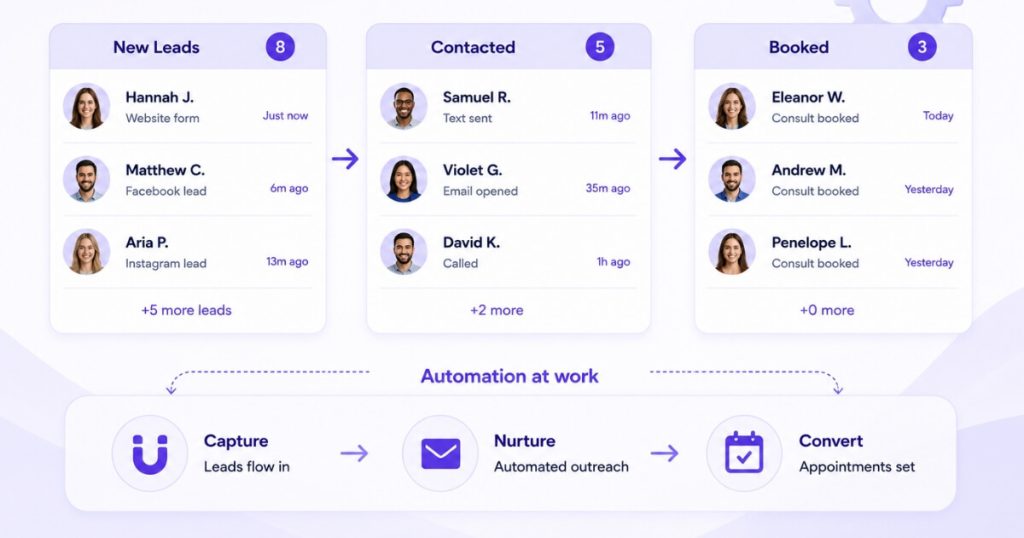
Almost always because your team is answering messages in the conversation inbox instead of moving contacts through the pipeline stages — and your automations only fire on stage changes.
This is the single most common reason follow-up “stops working” in a CRM.
A rep sits in the chat/conversation tab treating it like a texting app, replies to a few people, and never drags the contact from:
- “New lead”
- “Text once”
- “Text twice”
- “Needs final call”
Because the automated sequence is triggered by those stage moves, nothing fires, and leads silently stall.
The fix is twofold:
- Train staff that the job is to move opportunities stage by stage, not just to reply.
- Assign one person to a daily pipeline clean-up sweep that catches anything stuck.
Your automations are only as good as the stage hygiene underneath them.
Reps replying in the inbox feels like work, but if the stages don’t move, the machine isn’t running.
How Much Does a TRT Lead Cost on Google Ads, and Which Keywords Are Worth Bidding On?
High-intent terms like “TRT near me” behave like “one-click wonders” that can run around $15 per click, while broader terms run closer to $5 — and the expensive high-intent clicks usually convert, but it’s worth testing whether the cheaper clicks produce comparable patients.
The temptation is to pour budget into the obvious high-intent keyword because it converts.
It does — but at $15 a click, you want to know whether a $5 click on a broader term books patients at a similar rate, because if it does, your cost per acquired patient drops dramatically.
Test the cheaper clicks in a separate campaign rather than assuming.
Also remember that a brand-new Google campaign needs a learning period before you judge it; spending $100 with no leads in the first couple of days is normal while the algorithm calibrates.
The discipline is to treat keyword cost as a hypothesis to test, not a fixed truth.
Bid on what converts, but keep probing for cheaper paths to the same patient.
How Do I Know When I’m Overspending per Lead on Hormone Clinic Ads?
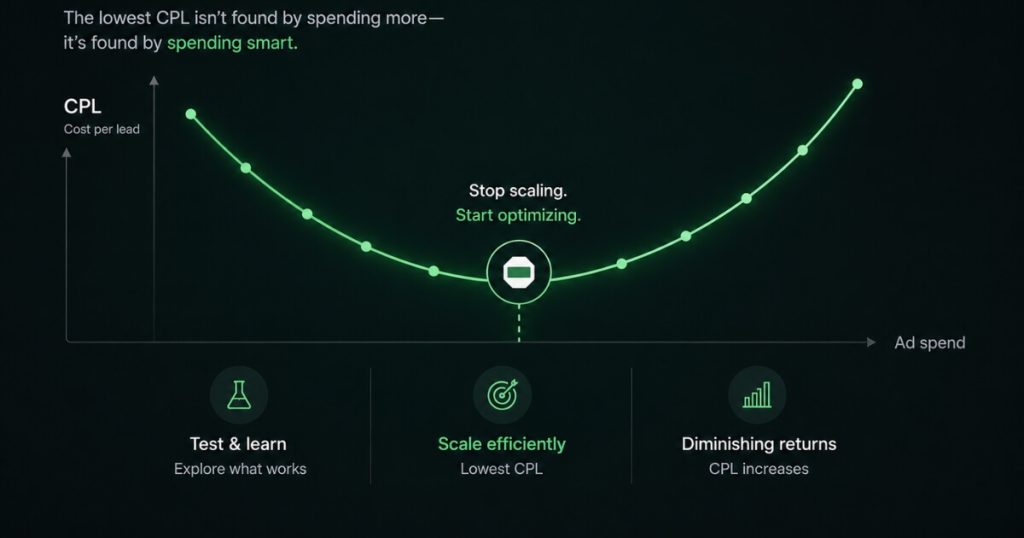
Watch for the point where your cost per lead starts going up instead of down — that rising CPL, not a fixed dollar cap, is the signal to stop scaling a campaign.
Only a finite number of people in any local market are in-market for TRT or HRT at a given moment.
As you push spend past the available demand, you start paying more to reach lower-intent people, and your cost per lead climbs.
That inflection is the market telling you you’ve saturated the channel.
Pushing harder just burns money for worse leads.
The right move is to:
- Hold that campaign at its efficient spend.
- Open a new angle.
- Test a different message, audience, or service.
CPL going up as you scale is the clearest “stop” sign in paid acquisition.
Most clinics ignore it and wonder why their numbers got worse the month they spent more.
Is TikTok or Facebook Better for Advertising a Hormone or TRT Clinic?
TikTok is often the better starting point for hormone ads specifically, because it’s significantly more lenient about what you can and can’t say in your creative than Facebook and Instagram — which matters a lot when your message involves testosterone and hormone claims.
Meta’s stricter health-claim enforcement gets hormone ads disapproved or throttled, while TikTok gives more latitude on copy.
That doesn’t mean abandon Meta — run both, fuel the creative with real patient and wellness video, and let each prove its own economics.
But if you’re choosing where to start with a hormone offer that needs to actually say something about symptoms and outcomes, TikTok’s leniency is a real advantage.
Think in terms of multiple distinct campaigns — for example, separate angles for low-T and for concierge men’s care — each with its own offer so you can measure and scale them independently.
A practical target is several campaigns each producing ten to twelve new patients a month.
The point is to find the highest-intent buyer and meet them with a message the platform will actually let you run.
One clinic owner described it like spotting a tree with aphids from half a mile down the road and driving straight to that house — high-intent targeting is the whole game, and the platform that lets you say the right thing wins.
FAQs About Hormone Clinic Lead Follow-Up and Ads
What’s the Best Follow-Up Cadence for TRT and HRT Leads?
Use text-text-call: auto-text on inquiry, follow-up text at 24 hours, second text 24 hours later, then a human phone call on the third attempt — and disqualify if still unresponsive.
Texting first matches how form and chat leads prefer to engage and gets a higher response rate than cold-calling.
Why Do My CRM Follow-Up Automations Stop Working?
Because automations fire on pipeline-stage changes, not on inbox replies.
If reps answer messages in the conversation tab without moving contacts stage to stage, the sequence never triggers and leads stall.
Train staff to advance stages and assign a daily pipeline clean-up.
How Much Does a TRT Lead Cost on Google Ads?
High-intent terms like “TRT near me” can run around $15 per click and usually convert, while broader terms run closer to $5.
Test cheaper clicks in a separate campaign to see if they produce comparable patients, and give new campaigns a learning period before judging them.
When Should I Stop Scaling My Hormone Clinic Ad Spend?
When your cost per lead starts rising instead of falling.
Because only so many people are in-market locally at once, climbing CPL means you’ve saturated the channel.
Hold the campaign at efficient spend and open a new angle rather than forcing budget into a tapped-out auction.
Should I Run TRT Ads on TikTok or Facebook?
TikTok is often the better starting point because it’s more lenient on hormone-related ad copy than Meta, which frequently disapproves health claims.
Run both if you can, but TikTok’s latitude is a real advantage for a message that has to address testosterone symptoms and outcomes.
What’s the Next Step?
If your hormone clinic is generating leads but losing them — to follow-up that slips, automations that don’t fire, or ad spend that scales past the point of efficiency — the fixes are concrete:
- A fixed text-text-call cadence
- Disciplined pipeline-stage hygiene
- A cost-per-lead signal that tells you when to stop
None of it requires more budget.
It requires the system to actually run.
If you want help installing the cadence, the CRM triggers, and the ad-spend discipline for your practice, that’s the conversation to book.
It’s the same patient-acquisition work behind hormone clinics like Eternity Health Partners, which grew from $1M to $4M a year.
We’ll audit your lead flow and ad efficiency on the call — the core of effective medical practice marketing.