
How Should a Cash-Pay Clinic Price a GLP-1 Weight-Loss Offer? (Why $50 a Week Beats One Big Number)
The GLP-1 boom made weight loss the easiest cash-pay service to sell and the easiest to misprice. Clinics keep slapping a big monthly number on the page and wondering why price-sensitive buyers bounce. The fix is mostly psychological: show a small weekly number, use labs as a low-friction front door, and stop expecting these patients to behave like your high-ticket longevity buyers. Here’s how to price a GLP-1 weight-loss offer that actually converts.
How should I price a cash-pay GLP-1 weight-loss membership so the cost feels lower to patients?
Frame it as a low flat monthly membership plus a small weekly medication price — for example a $99/month membership with “$50 a week for semaglutide” posted publicly — so the number patients see first is small.
The same total dollars convert very differently depending on how you present them.
A patient who’d flinch at a single big monthly charge will say yes to “$50 a week” without much hesitation, because the weekly frame shrinks the perceived commitment.
This isn’t a gimmick — it’s matching the price display to how a price-sensitive buyer actually evaluates cost.
Clinics running this structure (a low membership plus a weekly med price) have built it into serious monthly revenue precisely because the visible number stays small.
The membership is also what turns a one-off injection buyer into a recurring patient, which is where the real value of a weight-loss line lives.
For more on positioning weight-loss and aesthetic offers, see our guide to med spa marketing for cash-pay clinics.
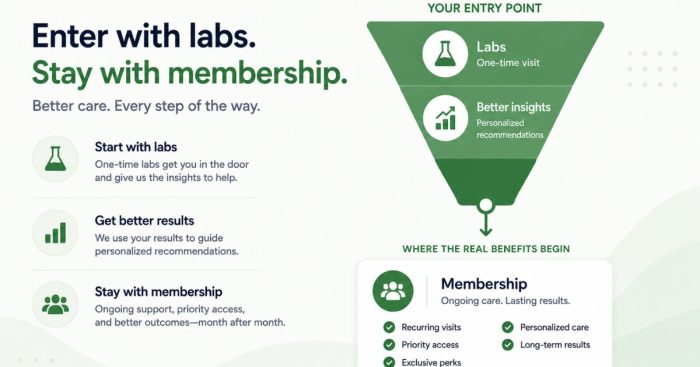
Should I include labs in my weight-loss program’s first-month price?
Yes — use labs as a low-margin entry point, not a profit center.
A common structure is a first month around $199 that includes lab work, deliberately making little or no money on the labs themselves.
The point of the first-month offer is to lower the barrier to enrollment and get the patient started, because a started patient is a retained patient.
The labs do double duty:
- they’re clinically necessary
- they justify a slightly higher first-month price that still feels like a deal
You’re not trying to profit on month one.
You’re trying to get the patient into the program where the recurring membership and downstream services actually make the money.
Think of the first month as customer acquisition cost you happen to break even on.
It buys you a patient relationship instead of a transaction.
Will weekly-pay GLP-1 patients upsell into my higher-ticket longevity programs?
Expect a lower upsell rate from them than from your package buyers — and don’t build your financial model assuming they’ll all upgrade.
Patients who think in weekly dollars tend to be more price-sensitive, and historically they don’t convert into high-ticket longevity or hormone programs at the same rate as patients who bought a package up front.
The big number scares them; that’s the same reason the weekly framing won them in the first place.
It’s still absolutely worth running the offer — the volume is high and the medication margins are strong, so it’s excellent recurring revenue on its own.
Just don’t pencil in a longevity upsell that the data doesn’t support.
The direction that does work is the reverse.
High-ticket patients who started in a package, got educated, and then added GLP-1 convert beautifully — they almost never start from weight loss and climb up.
So sell the GLP-1 offer for what it is:
- a strong, self-sufficient recurring line
and feed your high-ticket programs from the top down, not the bottom up.
Should I run Facebook or Instagram ads for my GLP-1 weight-loss program?
Be cautious — weight loss is one of the most saturated, competitive ad spaces right now, and Meta GLP-1 ads tend to generate a high volume of low-quality calls.
The math that looks great on paper (cheap leads, huge demand) falls apart when your team spends its day on twenty-minute “let me think about it” calls that never book.
Before pouring budget into Meta, look at where your best patients are actually coming from.
For many cash-pay clinics, the heaviest hitters come from community outreach and word of mouth, not paid social — and a single in-person event can outproduce a month of trash leads.
If you do test paid, prove the economics on a tighter channel (like Google for a specific high-intent service) before scaling spend into the most competitive auction on the internet.
None of this means never advertise.
It means don’t assume Meta GLP-1 ads are the growth lever just because everyone’s running them.
The competition is exactly why they so often aren’t.
How should I word my weight-loss and peptide offer to stay compliant?
Use “recommending,” not “prescribing,” for peptides — frame them as a recommended supplement or research item rather than a prescribed drug — and don’t publicly advertise prescribing outside the states where your providers are licensed.
The wording on your offer pages and consent forms is not a detail; it’s the difference between a compliant clinic and an exposed one.
Swap “prescribing” language for “recommending” wherever peptides are involved, and keep public-facing claims inside your licensure footprint.
This protects the clinic without weakening the offer — patients care about the outcome and the support, not the verb on the consent form.
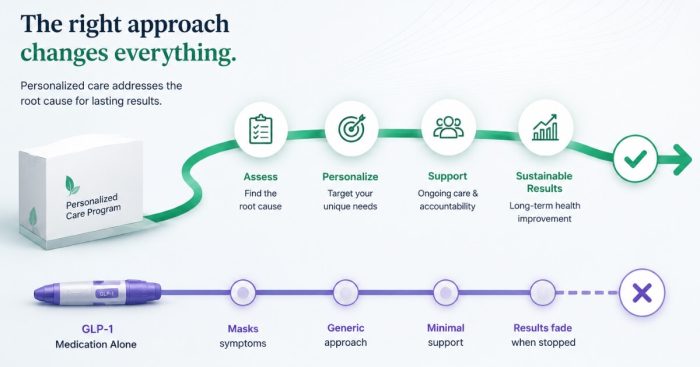
The deeper positioning lesson is to compete on value and hand-holding, not on being the cheapest weekly price in town.
The clinics that win the weight-loss patient long-term are the ones delivering:
- individualized nutrition
- real provider touchpoints
- a program that feels like coaching
which is also what keeps patients past the first refill.
Why are my weight-loss bookings down even though my offer and pricing seem fine?
When results dip, strip out the feeling and audit the basics:
- how many new-patient opportunities came in
- how many you booked
- how many closed
The usual culprits aren’t the price.
They’re:
- team bandwidth — staff spread too thin to work leads
- lead quality — too many low-intent inquiries clogging the pipeline
- the offer being explained without an emotional connection to the patient’s actual goal
Sequence the fixes:
- solve bandwidth first so someone can actually work leads
- then fix lead quality by cutting low-intent sources
For example, a website appointment form often books around 30% while a low-friction chat widget might book only a few percent — so adding friction by routing everyone through the form can raise quality and free your team for the patients who are ready.
Take the emotion out of the diagnosis and the answer usually reveals itself.
“Bookings are down” almost always traces to one of those three, not to a number on the page.
FAQ’s About Pricing a GLP-1 Weight-Loss Offer
What should a GLP-1 weight-loss membership cost?
A proven structure is a low flat membership (around $99/month) with the medication priced weekly (for example “$50 a week for semaglutide”) so the visible number stays small, plus a first month around $199 that includes labs.
The weekly frame converts price-sensitive buyers far better than one large monthly charge.
Should labs be included in the first month of a weight-loss program?
Yes, as a near-break-even entry point.
Pricing the first month around $199 with labs included lowers the barrier to enrollment and gets the patient started — and a started patient is far more likely to be retained.
The profit comes from the recurring membership, not month one.
Do weekly-pay GLP-1 patients upgrade to high-ticket programs?
Less often than package buyers, so don’t model your revenue on it.
Weekly-pricing patients are price-sensitive and rarely climb into longevity or hormone programs.
The reverse works better: high-ticket patients add GLP-1 to an existing package.
Run the GLP-1 offer as strong standalone recurring revenue.
Are Facebook ads good for selling GLP-1 weight loss?
They’re risky — weight loss is among the most saturated ad categories, and Meta GLP-1 ads often produce high volumes of low-quality calls.
Many cash-pay clinics get better patients from community outreach and word of mouth.
Prove economics on a tighter channel before scaling Meta spend.
How do I keep my weight-loss offer compliant?
Use “recommending” rather than “prescribing” for peptides, frame them as recommended supplements or research items, and don’t advertise prescribing outside your providers’ licensed states.
Compete on value and hand-holding rather than the lowest weekly price.
What’s the next step?
If you’re selling GLP-1 weight loss and the leads are there but the conversions aren’t, the problem usually isn’t demand — it’s how the offer is priced, presented, and worked.
Show the small weekly number, use labs as your front door, run the offer as self-sufficient recurring revenue instead of a longevity feeder, and audit the basics when bookings dip.
If you want help building the offer, the pricing, and the funnel that converts it — without burning cash in the most competitive ad space online — that’s the conversation to book.
It’s the same approach behind NuLevel Wellness Medspa, where we added $6.7M in revenue in one year across 3,727 new patients.
We’ll map your weight-loss offer on the call.
For the bigger picture, start with our med spa marketing playbook.