
Do Gift-Card Campaigns Work for a Cash-Pay Wellness Clinic? (The $50 Reactivation Play and the Zero-Ad-Budget Patient Engine)
Every clinic owner eventually asks about gift cards — usually in October, staring down the holidays with a quiet calendar. The honest answer from a strategy call with a women’s hormone and wellness clinic: yes, gift cards work, but as a reactivation and referral tool aimed at your existing list, not as cold acquisition. Here’s the $50 play we endorsed on that call, and the rest of the zero-ad-budget patient engine around it.
Do gift-card campaigns actually work for a wellness clinic?
Yes — as a reactivation tool pointed at people who already know you, not as a cold-traffic offer.
The clinic on this call had 1,330 contacts sitting in its CRM: past patients, old leads, discovery-call no-shows. That list is where a gift card earns its keep, because a $50 gesture lands completely differently on someone who already trusts the practice than on a stranger scrolling past an ad. The campaign we greenlit had two layers — personalized win-back outreach with a complimentary $50 attached, and a list-wide email with giftable $50 cards for the holiday season.
The verdict, verbatim: those are the things I would be doing — and the individualized approach is going to get you the best result. Gift cards aren’t a strategy; they’re the sweetener on a reactivation system. Run the system.
What’s the best way to win back past patients at a cash-pay clinic?
One by one. Review each lapsed patient’s chart, send a personal note from a real team member, and attach the $50 as a no-strings gesture.
The mechanics from the call: go through the database patient by patient, check the last visit and the notes, and task the front desk with a personalized message — “I noticed it’s been a hot second; you should probably get your labs redone” — with the complimentary $50 attached: we’ll just give it to you. No coupon code theater, no fine print.
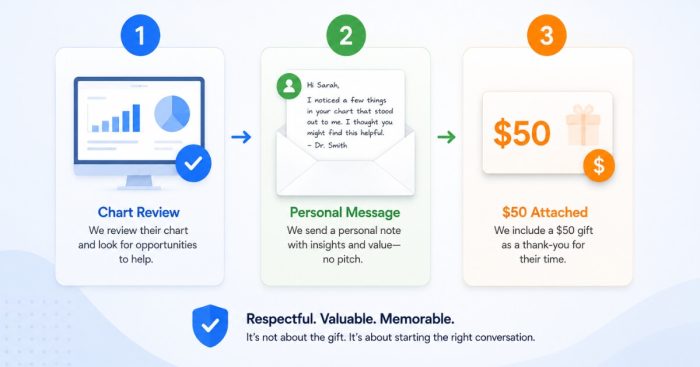
Personalization is the multiplier. A patient who gets a chart-specific nudge from the person who used to greet her feels remembered; the same patient inside a “Dear Valued Patient” blast feels processed. For a hormone or functional medicine practice where the natural cadence is recurring labs and follow-ups, the win-back message almost writes itself from the chart — which is exactly why the one-by-one pass beats the broadcast.
When should I run a holiday gift-card promotion?
Plan it in October — and aim the cards at gifting, which quietly turns your patients into referrers.
The second layer of the campaign was a broadcast email to the full list: here’s what’s new at the practice, and here are $50 gift cards you can give to people — because the season is coming up. That framing matters. A gift card a patient buys for herself is a discount; a gift card she gives her sister is a referral with money attached. The holidays make the give-it-away behavior natural, and every redeemed card walks a pre-warmed prospect through your door.
Pair the seasonal push with the evergreen truth from the same call: patients buy for one core reason — solving their actual problem; one client couple famously ignored an entire value stack because “they just want their meds.” Bonuses, swag, and gift cards make the yes easier; they never replace the core offer. Design the card as the bridge to your real program, not as the product. That’s how the math works at clinics like the HRT practice we work with whose memberships drive $1.7M a year from SEO alone — every incentive points at the recurring program behind it.
When should my clinic start paid ads?
When the business can pay for the ads themselves — and not a month sooner.
This owner had been quietly embarrassed about not running ads. The reframe on the call: that wasn’t failure, there was science behind that decision. Paid traffic amplifies a machine that already converts; pointed at a clinic still building its booking flow and follow-up, it just burns runway faster. Billboards came up too and were self-rejected within a minute — pattern-interrupt copy is fun, but it wasn’t the clientele this practice wants.
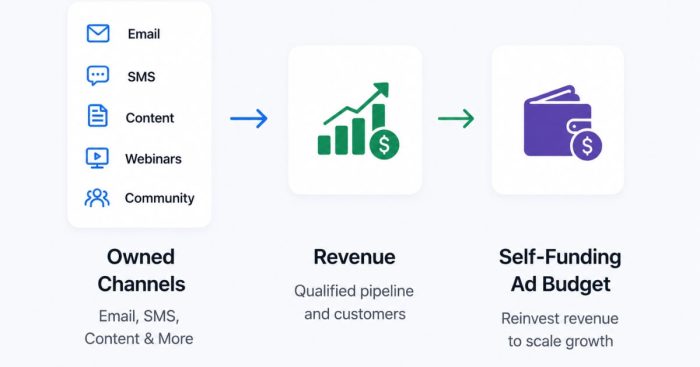
The discipline isn’t anti-ads — it’s sequence. Lead generation and lead nurture from owned channels come first: the 1,330-contact list, the events calendar, the partnerships, the service pages. When those produce enough revenue that ad spend is self-funding, ads become an accelerant instead of a gamble. That sequencing is the backbone of every durable medical practice marketing plan we build.
How do I get new patients with no ad budget?
Work the rooms your patients already stand in: gyms, studios, community events — with an offer that captures the lead on the spot.
Two field-tested plays from the same call. A clinic we work with in Tampa ran a free educational event at a boot-camp gym with one offer — complimentary labs, you just pay for your consultation — and signed three new patients that same day. Another client works community event booths with a spin-the-wheel: prizes are free lab work, a free B12 injection, a free IV — and claiming any prize means filling out a form. The fun is the lead capture.
Add the partnership layer: this clinic’s swag boxes were redirected from existing patients (“we’ve already got them on the hook”) to potential affiliates like the local Pilates studio owner — opening collaboration conversations instead of decorating shelves. Stack list reactivation, events, partnerships, and localized service pages, and you have a patient engine with zero ad spend — the same organic-first pattern behind the regenerative clinic that generated $309,590 in cash-pay revenue in 10 months without paid ads.
Can a small cash-pay clinic grow on this alone?
To about a million a year, yes — on good care, personality, and one good patient-facing closer.
That was the standard set on the call, and the proof ran in parallel: another practice we’d launched five weeks earlier — a $100-a-week concierge telehealth offer — stacked 8, then 6, then 5, then 4 new patients in consecutive weeks with no paid spend at all. The only structural difference from the wellness clinic in this article was 45 days of head start. Organic compounding is slow until suddenly it isn’t.
The honest caveat: nothing in the gift-card layer substitutes for the fundamentals. Clean booking flow so every lead is tracked, a front desk that answers fast, recurring programs worth coming back to — the $50 card just re-opens the conversation. Dashboards, extra hires, and ad budgets all come later, paid for by the growth itself.
FAQ’s About Clinic Gift-Card and Reactivation Campaigns
How big should a reactivation gift card be?
The play in this article used a complimentary $50 — “we’ll just give it to you” — attached to personalized win-back outreach. Big enough to feel like a real gesture against a labs-plus-consult visit, small enough that redemption revenue dwarfs the cost. The card is the nudge; the personal message is what actually reactivates.
Should I email-blast the gift card or reach out personally first?
Personal first, broadcast second. The verdict on the call was explicit: the individualized approach gets the best result — one-by-one review of each lapsed patient’s chart, then a personal note from the front desk with the $50 attached. The list-wide email announcing new services and giftable cards runs as the second layer, not the first.
What should a clinic’s event offer be at a gym or studio?
Complimentary labs — you just pay for the consultation. That’s the offer a clinic ran at a boot-camp gym event that signed three new patients the same day. At booth events, a spin-the-wheel works the same way: free lab panel, free B12 shot, free IV as prizes — and claiming the prize requires filling out a form, which is the lead capture.
When should a cash-pay clinic start paid ads?
When the business can pay for the ads themselves — out of revenue, not savings. That was the rule on this call, and the owner’s relieved summary was that deferring ads “wasn’t failure, there was some science behind that decision.” Until then, the constraint is lead generation and lead nurture from owned channels: the list, events, partnerships, and SEO.
Can a small clinic really grow without an ad budget?
Yes — the standard set on this call was that a clinic can get to a million a year on good care, personality, and one good patient-facing closer, before dashboards or a big team. The comparator on the same call: a $100-a-week concierge telehealth offer that stacked 8, 6, 5, then 4 new patients in consecutive weeks with zero paid spend.
What’s the next step?
If your calendar is quiet and the holidays are coming, don’t start with an ad account — start with your database. Pull the lapsed-patient list this week, review charts one by one, and send personal win-back notes with a complimentary $50 attached. Layer the giftable-card email on top for the season, book one gym or studio event with a complimentary-labs offer, and route every lead through one tracked booking flow.
If you want the full reactivation-and-referral engine mapped for your practice — including when your numbers say it’s finally time to turn ads on — book a strategy call. In 60 minutes we’ll build the zero-budget patient plan for your clinic.