
How Do You Launch a New Treatment to Your Existing Patient List? (The 8-Email Free-Consult Sequence From a Regenerative Clinic)
Most clinics launch a new treatment backwards: they buy ads to tell strangers before they tell the people who already trust them. The cheapest patients for any new service are sitting in your email list right now. This is the actual 8-email sequence a regenerative medicine practice used to launch ozone therapy to its existing contacts — every email anchored to one free-consultation CTA. Steal the structure before you spend a dollar on cold traffic.
How do you launch a new treatment without spending on ads?
Announce it to your existing list with a structured email sequence that ends every message at the same free-consultation booking link.
Your list — past patients, old leads, consult no-shows — already knows your name, your office, and in many cases your results. When a regenerative clinic we work with added ozone therapy, the launch vehicle wasn’t a campaign budget; it was eight emails to people already in the database, each one closing with the identical CTA: “Book your FREE CONSULTATION now.”
The economics are hard to argue with. List sends are free, warm contacts convert at multiples of cold traffic, and the free consult is a zero-risk first step for a treatment nobody’s heard of yet. We’ve watched the organic-first approach carry an entire practice: a regenerative medicine clinic we helped generate $309,590 in cash-pay revenue in 10 months without paid ads — warm channels first is not a compromise, it’s a strategy.
What’s the structure of the 8-email launch sequence?
Warm-up, rapport, announcement, education, enhancement, proof, urgency, vision — in that order.
- Email 1 thanks the contact for choosing the practice and opens the consult offer.
- Email 2 builds common ground — “we both have something in common: the progress of your health” — and lists the conditions treated:
- fibromyalgia
- arthritis and joint pain
- headaches and facial pain
- debilitating diseases
- other musculoskeletal conditions
- Email 3 is the announcement: “Have you heard about our new service? It’s ozone therapy — our patients won’t stop raving about it.”
- Email 4 educates on the regenerative medicine category and lists the menu:
- pure platelet-rich plasma
- cytokine therapy
- stem cell rejuvenation
- ozone therapy
- Email 5 adds value — how diet and supplements make treatment more effective.
- Email 6 is proof: three patient testimonials.
- Email 7 is urgency: “Don’t let this offer expire.”
- Email 8 paints the vision — “imagine living pain free” — and recaps the menu one last time.
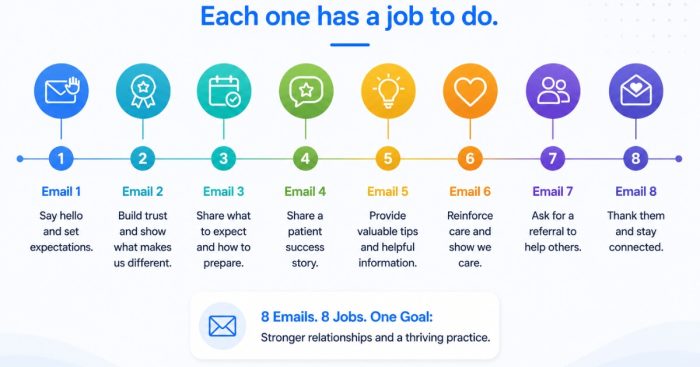
Each email does exactly one job. The sequence sells precisely once (email 3) and spends the other seven touches earning the right to.
Why does the new service get announced in email 3 instead of email 1?
Because an announcement to a cold-ish list reads as a promotion, while an announcement after two warm touches reads as news from your clinic.
The first two emails re-establish the relationship: gratitude, an open door (“call us, e-mail us or drop by our office to say hello”), and the condition list that makes each reader mentally locate themselves on it. By the time the ozone therapy email lands, the reader has been reminded twice that this practice knows them and treats what they have — so “our patients won’t stop raving about it” lands as a tip from their own provider, not an ad.
This is the warm-up principle every list send lives or dies on. Skipping it is why most clinics’ “big announcement” emails underperform: the list hasn’t heard from the practice in eight months, and the first message in the reunion is a pitch.
How do the education emails sell without selling?
By teaching the category and the patient’s own role in their results — with the service menu embedded as reference, not pitch.
Email 4 explains what regenerative medicine actually does — restoring the structure and function of damaged tissues — and where it applies, then lists the four services as the practice’s toolkit. Email 5 goes a step further than most clinics ever would: it teaches patients how to make their future treatment more effective, naming anti-inflammatory food choices and a specific supplement list:
- curcumin
- quercetin
- CoQ-10
- L-arginine
- and more
Generosity is the persuasion: a clinic that educates this freely before the sale signals exactly how it will treat patients after it.
For a regenerative practice, this educational layer is also the long-term moat — the same expertise-forward positioning that powers stem cell clinic marketing across every channel, from email to YouTube to the consult room itself.
How do testimonials and urgency close the sequence?
Email 6 supplies belief with three patient stories; email 7 supplies a deadline; email 8 supplies the picture of life after treatment.
The testimonial email leads with a story built for the skeptic: a patient told she needed carpal tunnel surgery who instead got a nerve test and a single wrist injection — “no numbness anymore.” Two more patients vouch for the provider’s range and approach. Then email 7 turns the standing free-consult offer into a closing window — “Don’t let this offer expire! If you haven’t acted, now’s the time” — and email 8 ends on identity: “Are you ready to start your new life, pain free?” with the service menu repeated for anyone who skimmed.
Proof, deadline, vision — in that order — is the oldest closing stack in direct response because it works. It’s the same arc that fills calendars at scale: a pain practice we helped add $2,095,039 in revenue in 10 months ran on patient-proof-first marketing feeding a high-converting consult flow. Your list launch is the smallest version of the same machine.
FAQ’s About Launching a New Treatment by Email
How many emails should a new-treatment launch sequence have?
The deployed sequence runs eight:
- thank-you
- common-ground with a conditions list
- the new-service announcement
- a category education email
- a make-it-work-better email
- a testimonial email
- an urgency email
- a vision email
Eight touches is enough to warm, announce, educate, prove, and close without exhausting the list.
What CTA should every email in the sequence use?
One, repeated verbatim: “Book your FREE CONSULTATION now.” Every email in the deployed sequence carries the same call to action — sometimes twice. One consistent next step trains the reader; rotating offers between emails resets their decision every time.
Should the launch emails educate or sell?
Educate, with the menu woven in. After the announcement email, the sequence explains what regenerative medicine restores, lists the service menu (PRP, cytokine therapy, stem cell rejuvenation, ozone therapy), and even teaches patients how to make treatment more effective with diet and supplements. Patients buy the new treatment because they finally understand the category it belongs to.
Which conditions should the emails name?
The exact ones your patients would self-identify with. The deployed sequence lists fibromyalgia, arthritis and joint pain, headaches and facial pain, debilitating diseases, and other musculoskeletal conditions — then says “if you see something on this list that relates to you, reach out now.” Named conditions make specific readers raise their hands; generic wellness language makes nobody move.
Where do testimonials belong in the sequence?
Late — email six of eight in the deployed version, after education and before urgency. By then the reader understands the offer; three patient stories (including one who avoided carpal tunnel surgery with a single injection) supply the belief, and the next email’s expiring-offer framing supplies the reason to act today.
What’s the next step?
Adding a new treatment this quarter? Write the eight emails before you write the ad brief: thank-you, conditions list, announcement, category education, effectiveness tips, three testimonials, expiring offer, pain-free vision — every one ending at the same free-consultation link. Send to your full list over two to three weeks, and let the warm market fund the cold-market launch.
If you want the sequence adapted to your specialty — plus the funnel behind the free consult that turns bookings into program enrollments — book a strategy call. In 60 minutes we’ll map the launch plan for your new service.