
How Should a Cash-Pay Clinic Ask Patients for Referrals and Testimonials? (3 Copy-Paste Email Templates + the 2-Day Phone Rule)
Most cash-pay clinics deliver life-changing results and then never ask for the two assets those results create: the testimonial and the referral. Not because owners don’t want them — because asking feels awkward, so it never becomes a system. These are the actual request templates deployed at a regenerative pain practice we work with, plus the timing rules that make them produce. Steal the structure; swap in your specialty.
When Should a Clinic Ask a Patient for a Testimonial or Referral?
One to two days after the service for new patients — the sooner the better — and keep asking until they fill it out.
The timing rule sits at the top of the template doc for a reason.
A patient who just got relief from chronic pain is at the emotional peak of their experience with you; two weeks later they’re back to normal life and the gratitude has faded into routine.
The deployed sequence:
- Fires the first email a day or two after treatment.
- Follows with a phone call within two days.
- Stays in rotation until the patient responds.
This is the cheapest growth lever in cash-pay medicine.
Referred patients:
- Arrive pre-sold
- Cost nothing to acquire
- Close at rates no cold channel touches
Which is why the ask deserves the same systematization as any paid campaign in your medical practice marketing stack.
What Should the First Testimonial Request Email Say?
Subject line:
“How are we doing?”
Then a real patient story, a humble favor, and an escape valve for unhappy patients.
The template opens by hoping the patient’s experience has been great, then immediately shows a story another happy patient sent in:
- Name
- Town
- Most impactful lines of their testimonial
That social proof does two jobs:
- It models exactly what kind of reply you’re hoping for.
- It normalizes the act of writing one.
Then the ask, verbatim from the deployed email:
“I have a favor to ask of you. If you feel like we’ve delivered a great service to you as a patient, I’d love to hear your story.”
And the escape valve:
“If we haven’t exceeded your expectations, I’d like to know that too. I want to know how we can help you become a raving fan.”
One quick-reply question closes it:
“Will you send me a quick reply to let me know how we’ve done?”
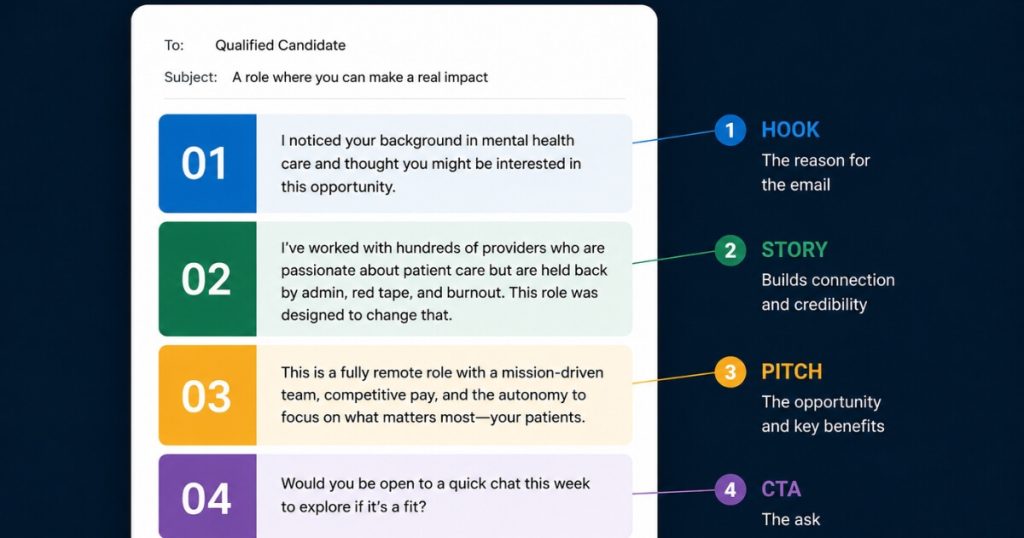
Signed by the treating physician — not “the team.”
A personal note from the doctor who fixed your back is hard to ignore; a clinic newsletter is easy to delete.
How Do I Get Testimonials I Can Actually Use in My Marketing?
Ask for permission explicitly in the email — “I would like to include a quote from you in my marketing” — and give the patient six prompts so the story writes itself.
The second template makes the three-minute ask:
Would you take the next three minutes and write a quick note about your experience with the specific treatment you received — decompression, weight loss, whatever the service was.
Then it says the quiet part out loud:
The reason I’m asking is that I’d like to include a quote from you in my marketing, because the best way for future patients to know how we serve people is to hear it from a current one.
No surprise screenshots.
No awkward permission chase later.
Consent is built into the request.
The P.S. carries the six prompts that turn “great clinic!” into a usable story:
- Tell me a little about yourself.
- Why were you initially interested in the service?
- What made you take the leap of faith?
- Did we meet or exceed expectations, and how?
- How was the support?
- Why would you recommend us to friends and relatives?
Prompted patients hand you specific, objection-killing copy — the raw material of every case study and review wall.
It’s exactly this kind of patient-voice proof that compounds into outcomes like the $2,095,039 in revenue we added to a pain practice in 10 months proof sells what ads only introduce.
How Do I Ask for Referrals Without Feeling Awkward?
Name the exact condition you want referred, tie the ask to your service standard, and request nothing more than a quick reply.
The referral template is three sentences of business:
“Do you have any family, friends or colleagues experiencing chronic back and/or neck pain? If so, I’d love for you to refer them to us.”
Then the standard:
“We work hard to provide a level of service that makes our patients feel comfortable referring their friends and family. I hope we’ve done that with you.”
Then the micro-commitment:
“If you have someone in mind, please just shoot me a quick reply.”
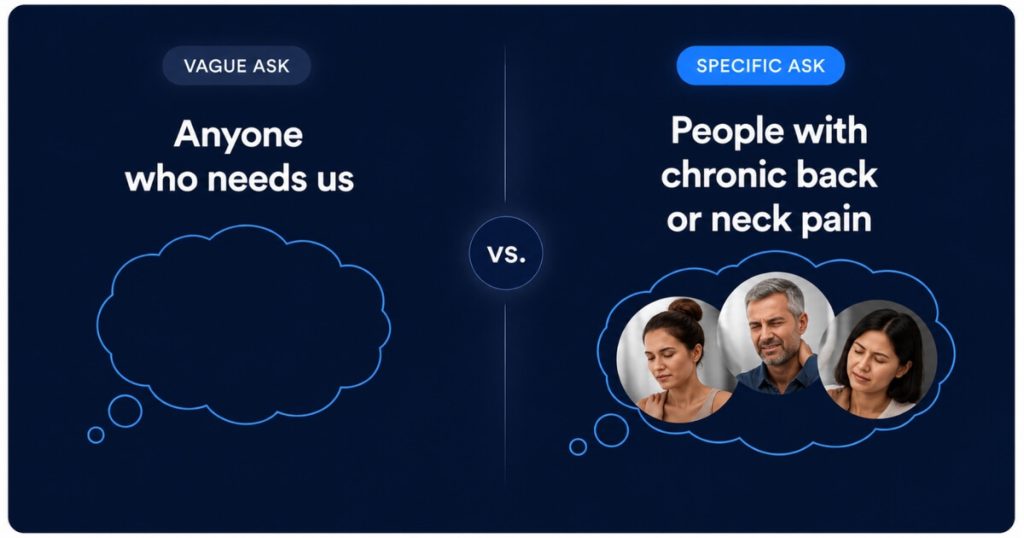
Two details do the heavy lifting.
Detail #1: Name the Condition
Examples:
- Chronic back and neck pain
- Low energy after 50
- Stubborn weight
Specific conditions make specific faces pop into the patient’s head.
“Anyone who could use our services” makes nobody pop into their head.
Detail #2: Don’t Be Afraid to Ask
The header note on the template says the rest:
Don’t be afraid to ask.
The patients who love you are usually willing; they’ve just never been invited.
Why Does the 2-Day Phone Follow-Up Matter?
Because the email plants the ask and the call collects it.
The template’s all-caps footer says it plainly:
Follow up with a phone call two days after the send.
Most clinics send one request email, hear nothing, and conclude their patients “don’t do testimonials.”
The deployed system assumes the opposite:
- The email is the warm-up.
- The human follow-up is where most yeses happen.
A front desk or coordinator working a two-day call cadence:
“Did you see Dr. Schwartz’s note? He’d love to hear your story; want me to text you the link?”
Converts the silent majority who meant to reply and never did.
Run the full loop on every new patient:
- Request at day 1–2.
- Call at day 2 after each send.
- Repeat until response.
Then reviews, testimonials, and referrals stop being luck and start being a pipeline.
An HRT clinic we work with generates 60 new-patient inbound calls a month on the back of exactly this kind of compounding reputation infrastructure: every happy member becomes marketing, on schedule.
FAQs About Patient Referral and Testimonial Requests
How Soon After Treatment Should a Testimonial Request Go Out?
One to two days after the service for new patients — the sooner the better — and keep the request in rotation until they respond.
The emotional peak of a great patient experience decays fast; an email sent the day after treatment catches the patient while the relief and gratitude are still fresh.
What Questions Should I Give Patients to Prompt a Testimonial?
Six prompts, included as a P.S.:
- Tell me a little about yourself.
- Why were you initially interested in our service?
- What caused you to take the leap of faith and try us?
- Did we meet or exceed your expectations, and how?
- How would you describe the support from our team?
- Why would you recommend us to friends and relatives?
Prompted patients write specific, usable stories — unprompted patients write “great place, five stars.”
Who Should the Request Email Come From — the Doctor or the Front Desk?
The treating provider, by name.
The deployed templates are signed by the practice’s physician, not “the team” — because a personal note from the doctor who treated you is dramatically harder to ignore than a clinic newsletter.
The front desk can operate the sequence; the signature should belong to the provider.
What If the Patient Had a Bad Experience?
The template invites that too:
“If we haven’t exceeded your expectations, I’d like to know that as well — I want to know how we can help you become a raving fan.”
The escape valve matters.
It routes unhappy patients into a private reply instead of a public review, and it makes the testimonial ask feel like genuine feedback-seeking rather than fishing for praise.
How Many Times Should I Follow Up on a Referral or Testimonial Request?
Follow up with a phone call two days after every send, and keep the sequence alive until the patient responds.
The email plants the ask; the call collects it.
Most clinics send one email, get silence, and conclude:
“Our patients don’t do testimonials.”
The template system assumes the call is where most yeses actually happen.
What’s the Next Step?
Take the three templates above and deploy them this week:
- The “How are we doing?” story-request a day or two after every new patient’s service.
- The marketing-permission email with the six prompts behind it.
- The condition-specific referral ask.
Each should be followed by a phone call two days later and repeated until the patient responds.
That’s the entire system.
The only failure mode is not asking.
If you want the full referral, review, and reputation engine built around your specialty — including who on your team runs it and how it feeds your paid channels — book a strategy call.
In 60 minutes we’ll map the patient-proof pipeline for your practice.