
What Should a Women’s Hormone Clinic’s Landing Page Actually Say? (The Copy Structure That Converts Over-35 Quiz Leads)
Most women’s hormone landing pages read like a brochure: clinic name, provider headshots, a list of services, and a “book now” button. The pages that actually convert do almost none of that. This is the copy structure behind a live women’s hormone landing page we built for a cash-pay telehealth clinic — headline to CTA — plus the five ad angles that feed traffic into it. If you run an HRT, perimenopause, or women’s health program, this is the FAQ on what the page should say.
What should a women’s hormone clinic landing page say to actually convert?
Five blocks, in this order:
- An identity headline (“Feel Like You Again”)
- Validation copy
- A symptom checklist
- A free-quiz CTA with an expert-feedback promise
- Outcome lines
Not services.
Not provider bios.
The page we built for a women’s telehealth hormone clinic opens with:
Feel Like You Again
and immediately offers the next step:
Take the Free Women’s Hormone Quiz — Get Personalized Feedback From a Real Hormone Expert, In Minutes.
Everything that follows exists to make that one action feel safe and obvious.
There is:
- No menu of treatments above the fold
- No insurance logos
- No staff carousel
The buyer on this page is a woman over 35 whose body suddenly feels like a stranger’s.
The copy meets her there and nowhere else.
The structure matters more than any single line.
- Headline selects the reader
- Validation earns trust
- The checklist makes it personal
- The quiz converts the moment
- The outcomes give her a picture of the other side
That’s the whole page.
And it’s the front door of a predictable patient acquisition funnel, not a standalone art project.
Why does “You’re not crazy” outperform clinical copy on an HRT landing page?
Because the over-35 hormone patient has usually been dismissed before:
- By her PCP
- By a thyroid test that came back “normal”
- By everyone who said it’s just stress
The highest-performing block on the page reads:
You’re not crazy. You’re not lazy. And you’re definitely not alone.
Then it names her reality:
- Gaining weight without changing her diet
- Waking up drenched in sweat
- Snapping at her partner
- Tired all the time
And tells her:
This isn’t “just part of getting older,” and it’s absolutely not something you have to live with.

Clinical copy explains hormones.
Validation copy explains her.
The first reads like a textbook.
The second reads like the first person who’s listened in three years.
In a category where the market leader advertises that 91% of its patients find relief within 60 days and runs testimonials like:
After being denied care for 3 years… they gave me my life back
the emotional positioning is not decoration.
It is the offer.
What symptoms should a women’s hormone landing page checklist call out?
Seven, phrased exactly as she’d describe them:
- Hot flashes or night sweats
- Poor sleep
- Low sex drive
- Weight gain (especially around the midsection)
- Brain fog or memory issues
- Mood swings or irritability
- Feeling sluggish or “off”
The checklist is the conversion hinge of the page.
A visitor who mentally ticks three or four boxes has just diagnosed her own problem in your words.
And the line that follows:
Then it’s time to get real answers
converts that recognition into action.
Use her vocabulary, not yours.
Examples:
- “Can’t button your jeans” beats “metabolic changes”
- “Feeling off” beats “hormonal dysregulation”
This is the same symptom-first doorway that powers quiz funnels across the highest-LTV hormone businesses.
An HRT membership clinic we work with grew from $1M a year to $4M a year on patients who almost all entered through symptom-language marketing rather than treatment-language marketing.
Nobody searches for:
Bioidentical estradiol protocols
at 11pm.
They search for why they can’t sleep.
Should the CTA be a free hormone quiz instead of “book an appointment”?
Yes.
The quiz with an expert-feedback promise is the right ask for this buyer’s awareness stage.
“Book an appointment” demands commitment from a woman who isn’t yet sure her symptoms are even hormonal.
The quiz asks for two minutes.
And the promise:
- Get real recommendations from a licensed hormone specialist
- Find out if BHRT is right for you
- All from the comfort of your home
gives her a concrete payoff for those two minutes.
The quiz also does silent qualification.
Age.
Symptoms.
Goals.
History.
All arrive pre-sorted before your team makes a single call.
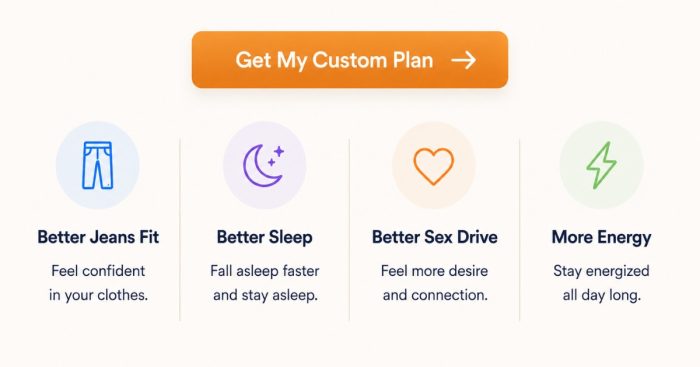
Close the page with outcome lines, not features.
The live page uses four:
- Fit back into your favorite jeans
- Sleep through the night
- Reignite your sex drive
- Get your energy — and your confidence — back
Then one final CTA:
Start Now — It’s Free.
One action.
Repeated.
No competing offers.
What ad angles should drive traffic to a women’s hormone landing page?
Five, each aimed at a different version of the same woman:
- The Symptoms Are Real
- Not Your Primary Care Provider
- Luxury Wellness Without the Price Tag
- The Jean Test
- You’re Not Alone
The ad set we wrote for this clinic runs all five in parallel.
The Symptoms Are Real
Opens on:
- Exhaustion
- Unexplained weight gain
for the symptom-aware.
Not Your Primary Care Provider
Picks a fight with the dismissive PCP.
Examples:
You’re just getting older.
It’s probably stress.
Let’s run another thyroid test.
This angle is for the woman who’s been gaslit.
Luxury Wellness Without the Price Tag
Reframes hormone care against:
- $5K-a-month celebrity longevity routines
for the price-conscious buyer.
The Jean Test
Compresses the whole problem into one image:
You’re still:
- Eating clean
- Moving your body
But suddenly your jeans don’t fit.
You’re Not Alone
Stacks the symptom list and answers it with community.
We help:
- Moms
- Wives
- Business owners
- Real women
feel strong again.
Every variation ends on the identical CTA the landing page makes:
Get Hormone Expert Feedback Now
The click-to-page experience is seamless.
Message match between ad and page is what keeps quiz costs down.
Five different angles feeding one consistent page beats five different pages every time.
How should the page position against primary care and luxury longevity clinics?
Explicitly.
As the two enemies of the page:
- The doctor who won’t listen
- The wellness industry that overcharges
Positioning Block One
Tired of your PCP brushing off your symptoms? At [clinic], we actually listen. We look at the whole picture — from sleep and sex drive to mood swings, weight gain, and energy. No more guesswork. No more gaslighting. Just answers.
Positioning Block Two
Longevity isn’t just for celebrities with $5K-a-month wellness routines. We’re making hormone therapy affordable and accessible.
Between the two, the clinic occupies the exact middle the market wants:
- More attentive than insurance-driven primary care
- More attainable than concierge longevity
This dual positioning is what makes the rest of the funnel work.
The consults.
The membership offer.
The retention.
We’ve watched it compound before:
ran on the same listen-first, accessible-expert positioning this page uses.
Get the positioning right and the landing page stops being a brochure and starts being a sorting machine.
FAQ’s About Women’s Hormone Landing Pages
Should a women’s hormone landing page mention pricing?
Not on the quiz landing page.
The page’s only job is to convert a symptomatic visitor into a quiz completion.
Pricing belongs later in the funnel, after a hormone expert has reviewed her answers and the conversation is about her plan, not the rate card.
The exception is positioning language.
A line that contrasts your care with $5K-a-month celebrity wellness routines sets a value frame without quoting a single price.
Does a free quiz attract lower-quality hormone leads than a booking page?
The quiz produces more leads at lower intent per lead.
That’s the trade.
And for hormone care it’s the right one.
The over-35 woman researching night sweats at 11pm is rarely ready to book a consult on first visit.
The quiz captures her while she’s validating symptoms.
And the expert-feedback promise gives your team a reason to follow up.
Quality is protected by the questions themselves:
- Symptoms
- Age
- Goals
- Health history
pre-qualify every submission before a human touches it.
How many CTAs should the landing page have?
One action.
Repeated.
Every button on the page should start the same free hormone quiz:
- Top of page
- After the symptom checklist
- At the close
Multiple different offers:
- Quiz
- Call
- Newsletter
- Ebook
split a visitor’s attention and depress conversion.
One repeated next step makes the page feel inevitable.
What headline works for over-35 women’s hormone pages?
Headlines that name the feeling or the enemy, not the treatment.
Field-tested openers include:
- Over 35 and feeling off?
- Tired of your primary care provider ignoring your symptoms?
- Tired of overpaying for HRT? Start with a free hormone quiz.
Each one selects the right reader in a single line:
- Symptom-aware
- Dismissed-by-PCP
- Price-shopping
All three outperform clinic-first headlines like:
Welcome to [Practice Name]
Should the page lead with BHRT and treatment details?
No.
Treatments appear late and briefly, as proof there’s a real medical solution:
- Natural options
- Science-backed options
- BHRT
- Peptides
- Supplements
- Lifestyle care
The page sells the next step, not the protocol.
A symptomatic woman doesn’t need a pharmacology lesson to take a free quiz.
She needs:
- To feel understood
- To believe an expert will actually look at her answers
What’s the next step?
Pull up your women’s hormone landing page and read it as the woman it’s supposed to convert:
- Over 35
- Exhausted
- Dismissed twice
- Jeans that won’t button
Ask yourself:
- Does the headline name her feeling?
- Does anything on the page say “you’re not crazy” before it says “BHRT”?
- Is the ask a two-minute quiz with an expert-feedback promise, or a commitment she isn’t ready for?
Rewrite in that order:
- Headline
- Validation
- Checklist
- Quiz
- Outcomes
And match every ad to the page’s exact CTA.
If you’d rather have the team that wrote this page audit yours, book a strategy call.
In 60 minutes we’ll tear down your current page and ad set and map the copy structure for your hormone program.