
How Should a Regenerative Medicine or Neuropathy Clinic Follow Up With Leads Who Don’t Book?
Most regenerative medicine and neuropathy clinics spend real money to make a lead raise its hand — then give up after one unanswered call. The clinics that actually convert those leads run a disciplined eight-touch sequence that mixes voicemails and emails, leads with patient results instead of pressure, and ends with a breakup message that re-engages the people who went quiet. Here’s the FAQ on the exact chase sequence, drawn from the verbatim scripts we built for regenerative and neuropathy practices.
How Should a Regenerative Medicine or Neuropathy Clinic Follow Up With Leads Who Don’t Book?
Run an eight-touch sequence over about two to three weeks that alternates voicemails and emails, and lead every touch with patient results rather than “please call me back.” Persistence plus proof is what recovers the lead.
A lead who requested an evaluation for:
- Joint pain
- Neuropathy
- A regenerative consult
And then didn’t book isn’t a lost cause — they’re a busy person in pain who got distracted.
The clinics that win treat the no-book as the start of follow-up, not the end of it.
The sequence is deliberate:
- Thank them
- Remind them what’s possible
- Show them a real patient who got better
- Send a disarming breakup message if they still haven’t responded
Each touch is short, warm, and centered on the outcome the patient actually wants:
- Walking without pain
- Reducing tingling and numbness
- Getting off the medication treadmill
This is the follow-up discipline behind a pain and regenerative medicine clinic we added $2,095,039 in revenue to in just 10 months.
How Many Follow-Up Touches Does It Actually Take?
Eight. Most clinics quit after one or two, which is exactly why most clinics convert a fraction of the leads they pay for.
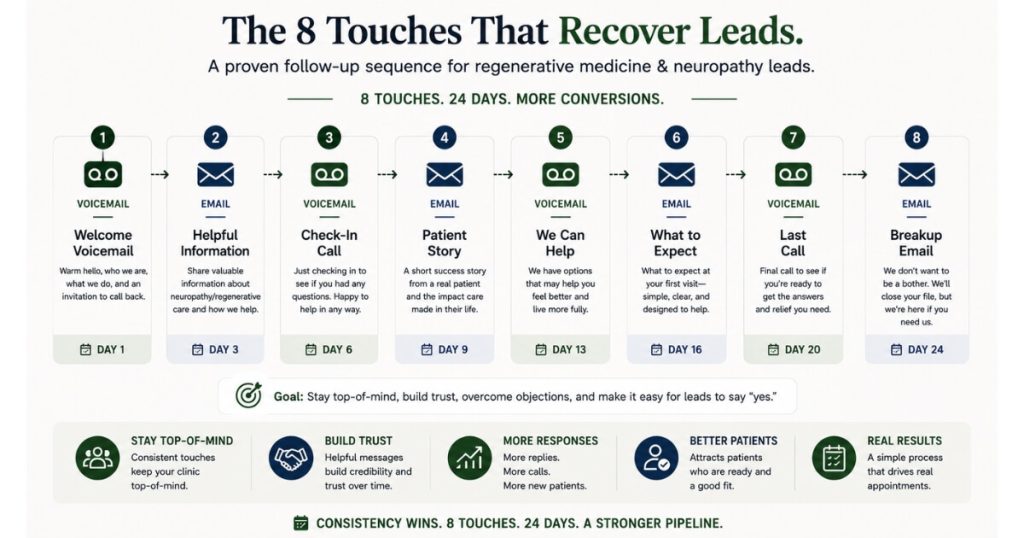
The sequence runs eight touches across two to three weeks:
- Touch 1: Welcome voicemail and email sent the moment the lead signs up
- Touch 2: Phone call with no voicemail
- Touch 3: Follow-up voicemail
- Touch 4: Email and voicemail built around a specific recent patient
- Touch 5: Case-study voicemail
- Touch 6: Results email with a patient screenshot
- Touch 7: Persistence voicemail
- Touch 8: Breakup email and voicemail
Touch 4 uses a message like:
“I was talking with [a patient who got great results] and your name came to mind.”
The lead who books on Touch 6 was never reachable on Touch 1, and the clinic that stopped at Touch 2 never found out.
The whole point of an eight-touch sequence is that the booking is hiding in the touches most clinics never send.
What Should the First Touch Say?
A warm thank-you that reminds the lead what they signed up for and what’s possible. Send the voicemail and the email the same day the lead comes in.
The Touch 1 email names the outcome menu directly:
“If you would like to repair damaged tendons, walk without pain and improve your balance, reduce pain, tingling, and numbness… then we’d love to tell you more.”
For a neuropathy clinic running a specific protocol — like a photobiomodulation-and-physiotherapy program — the email names the therapy and the conditions it addresses, then asks for fifteen minutes on the phone.
The matching voicemail is shorter:
- Thank them for taking the offer
- Say you’d love a few minutes to connect personally
- Repeat your name and callback number twice
Speed matters here — Touch 1 goes out immediately, while the lead still remembers filling out the form.
Why Do Voicemails Outperform Just Calling Over and Over?
Because a voicemail plus an email doubles the impressions per touch and turns a missed call into a message the lead can act on later. A silent missed call teaches nothing; a voicemail plants the name, the result, and the number.
The sequence pairs voicemails with emails on purpose.
A call with no voicemail (Touch 2) is the polite:
“I tried”
But most touches leave a voicemail so the lead:
- Hears a human voice
- Hears the clinic’s name
- Hears a specific reason to call back
The standout is the social-proof touch:
“I was talking with [a recent patient who got great results] and your name came to mind.”
It’s warm, it’s specific, and it makes the lead feel thought of rather than chased.
Layering voice and text across eight touches is what separates a real follow-up system from a front desk that calls twice and shrugs.
How Do I Use a Patient Success Story Inside the Sequence?
Build two touches around a real patient outcome — a case-study voicemail and a results email with a screenshot of the patient and their testimonial. Proof converts the lead who logic and persistence alone couldn’t move.
Touch 5
A voicemail teeing up a case study:
“I have a case study you’ll want to see — it shows how we helped a patient improve their [neuropathy / RSD / joint pain].”
Touch 6
A results email:
“I left you a voicemail about a case study I put together. I know you’re busy, so I’ve included a screenshot below”
Then include:
- An image of the patient
- Their testimonial
- A link to the full video or write-up
For regenerative and neuropathy patients especially, who are skeptical after years of failed treatments, seeing someone with their exact condition get better does more than any pitch.
The proof is the persuasion, which is the same principle behind a regenerative medicine clinic we generated $309,590 in cash-pay revenue for in 10 months at a 79.4% lead-to-appointment conversion rate.
What Should the Final Breakup Message Say?
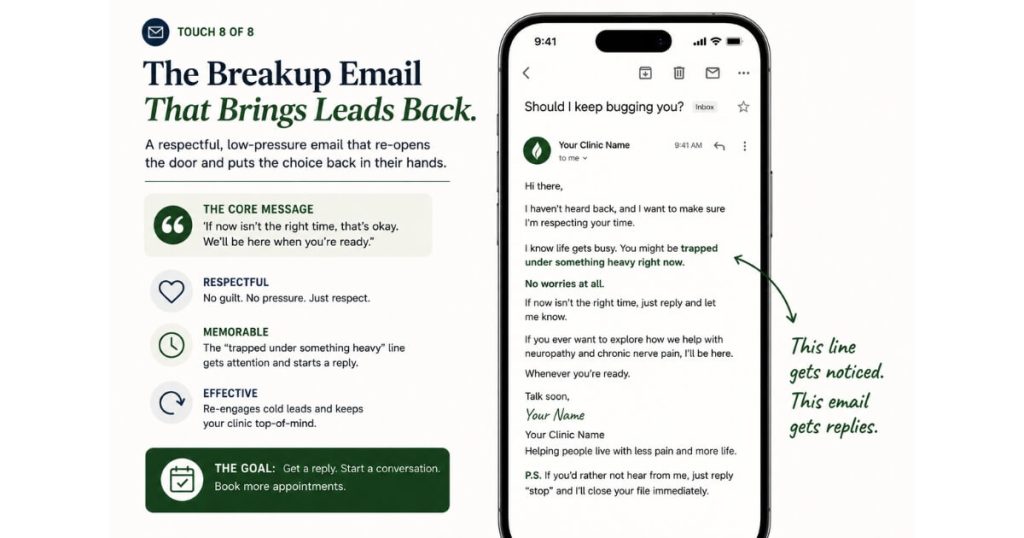
A disarming, slightly humorous message that gives the lead an easy way to respond — the classic “I’m guessing you haven’t called back for one of these reasons” email. It re-engages more cold leads than any other touch.
Touch 8 is the breakup, and it’s the most-skipped, highest-recovering message in the sequence.
The voicemail version says:
“I’m concerned I’ve offended you with my persistence — if so, I apologize. Maybe you no longer have the pain, or you’re getting treatment elsewhere. But if you’re still looking for a solution, call me.”
The email version is lighter:
“My guess is you’re not getting back to me for one of four reasons — I offended you, you’re being treated elsewhere, you no longer have the pain, or you want to call but you’re trapped under something heavy and can’t reach the phone. If it’s the last one, reply and I’ll send help.”
The humor lowers the lead’s guard and gives them a frictionless way to re-open the conversation.
A surprising share of bookings come from this single message.
Why Does Follow-Up Discipline Matter More for High-Ticket Regenerative and Neuropathy Offers?
Because these are high-ticket, cash-pay programs, every recovered lead is worth thousands — and the economics only work if cash comes in as fast as you spend to generate the lead. A tight follow-up sequence is what keeps the math in your favor.
Regenerative and neuropathy programs often carry front-end cash tickets in the thousands.
At that price point, leaving leads on the table after one call isn’t a minor inefficiency — it’s the difference between:
- A profitable ad budget
- A losing ad budget
The clinic that recovers even a handful of “dead” leads per month with an eight-touch sequence dramatically lowers its true cost per acquired patient.
This is core pain management marketing discipline: the offer and the ad get the lead to raise its hand, but the follow-up sequence is what actually turns that hand-raise into cash in the door.
FAQs About Regenerative and Neuropathy Lead Follow-Up
How Many Times Should I Follow Up With a Regenerative or Neuropathy Lead?
Eight touches over about two to three weeks, alternating voicemails and emails. Most clinics quit after one or two, which is why they convert a fraction of the leads they pay to generate.
Should I Leave a Voicemail Every Time I Call?
Mostly yes. Leaving a voicemail plus an email doubles the impressions per touch and gives the lead a name, a result, and a number to act on — far more effective than repeated silent missed calls.
What’s the Most Effective Single Message in the Sequence?
The Touch 8 breakup — the “I’m guessing you haven’t called back for one of these reasons” message. Its light, disarming tone re-engages more cold leads than any other touch.
How Do I Use Patient Success Stories in Follow-Up?
Build two touches around a real outcome: a case-study voicemail and a results email with a screenshot of the patient and their testimonial. For skeptical pain patients, seeing someone with their condition get better is the most persuasive thing you can send.
Why Does Follow-Up Matter So Much for Regenerative and Neuropathy Clinics Specifically?
Because these are high-ticket cash-pay programs where each recovered lead is worth thousands, and the ad math only works when cash comes in as fast as you spend. A disciplined sequence lowers the true cost per acquired patient.
What’s the Next Step?
If your regenerative or neuropathy clinic calls a no-book lead once and moves on, you’re throwing away patients you already paid to generate. An eight-touch sequence — voicemails and emails, results-led, ending in a breakup message — recovers a meaningful share of those leads every month and lowers your true cost per patient.
If you want the full verbatim sequence built and loaded into your CRM for your specialty and offer, that’s the conversation to book. We’ll map your follow-up and show you exactly where the bookings are leaking out.