
How Do I Turn Callers Who Want to Use Insurance Into Cash-Pay Patients?
Most cash-pay practices lose the insurance caller in the first thirty seconds — because the front desk treats “do you take my insurance?” as a yes-or-no question instead of an opening. The clinics that convert these callers do one thing differently: they lead with availability, not price. Here’s the FAQ on the exact front-desk script that turns an insurance inquiry into a same-week cash-pay patient — and why it works.
How do I turn callers who want to use insurance into cash-pay patients?
Lead with availability, not price.
The fastest cash-pay conversion happens when the front desk reframes the entire decision around how soon the caller can be seen — not how they’ll pay.
When someone calls asking about insurance, the instinct is to confirm whether you’re in-network and quote a price.
That hands the caller a reason to comparison-shop and call the next clinic.
Instead, the front desk checks “availability” out loud:
- The insurance path is booked six to eight weeks out.
- A cash visit can happen this week for a flat fee.
Now the caller is choosing between:
- Waiting two months
- Being seen Friday
That’s a completely different decision than “insurance vs. cash.”
Most people in pain or chasing a goal will choose Friday.
This isn’t a trick.
It’s honest triage.
Insurance visits genuinely do book out further because they carry more administrative friction, and a cash slot genuinely is faster.
The script simply makes that real trade-off visible at the exact moment the caller is deciding.
What exactly should the front desk say when a caller asks about insurance?
Here is the verbatim move, drawn from the front-desk script we built for a cash-pay primary care practice.
Caller:
“Do you take my insurance?”
Front Desk:
“Great question — would you be coming in as a new insurance patient or a new cash-pay patient?”
Caller gives an insurance answer.
Front Desk:
“Okay, let me check availability for you. So right now we’re booked out about six to eight weeks for new insurance patient visits. But let me see what I can do…”
(pause)
“…I can actually get you in as a new cash-pay patient this week. It’s $200 for your initial visit. And we have cash-pay membership programs where, once you factor in labs and the little a-la-carte things, it usually ends up cheaper than what your copays would run you. I could get you in as soon as Friday — would that work better?”
The pause matters.
It signals the front desk is doing the caller a favor by finding a faster path, not upselling them.
Notice what the script never does:
- It never argues about insurance.
- It never disparages the caller’s plan.
- It never quotes the cash price before establishing the speed benefit.
A front desk that can convert calls like this is the single highest-leverage hire in a clinic.
It’s the same skill set behind every predictable patient acquisition system we build.
Why does leading with appointment availability convert more cash patients than leading with price?
Because availability reframes the choice from “spend more money” to “get help sooner” — and urgency beats price for a patient who already picked up the phone.
A caller who dials your clinic has already self-identified as motivated.
They have a problem they want solved.
When the first thing they hear is a price:
- The brain files the call under “shopping.”
- The caller starts comparing options.
When the first thing they hear is:
“I can get you in Friday versus eight weeks from now.”
The brain files the call under “solving.”
The cash fee becomes the cost of not waiting two months.
Same dollar amount.
Completely different frame.
The price objection shrinks because the caller is now weighing it against the pain of delay, not against a competitor’s quote.
How do I justify the cash price when the patient could just use insurance?
Show them the real annual math.
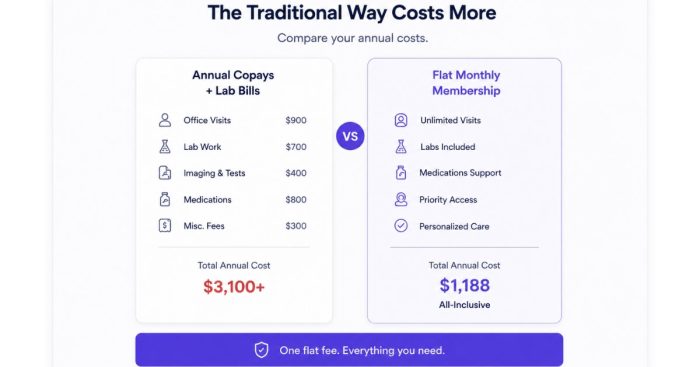
For most patients who actually use the practice, a flat cash membership costs less than a year of copays, coinsurance, and surprise lab bills — and they get faster, more personal care on top.
The front desk should be able to say it plainly:
“Your initial visit is $200, and follow-ups are the same flat rate. If you join the membership, it includes labs and visits, and members get access to things insurance patients don’t. Once you add up your copays plus any lab work over a year, members usually come out ahead.”
The honesty is the close.
You’re not hiding the cash price.
You’re putting it next to the true cost of the insurance path, which most patients have never actually totaled.
Clinics that win the cash-pay model do it by making this comparison routine, the same way an HRT clinic we grew from $1M to $4M a year with 250 members at $1,000/month made membership feel like the obvious value, not the expensive option.
Won’t I lose patients by steering them toward cash instead of insurance?
No.
You lose the patients who were never going to be a fit, and you keep the ones who value speed and access.
Steering callers toward cash also frees the practice from the part of insurance that quietly caps growth.
The fear is that pushing cash drives people away.
In practice, it filters them.
The patient who only wants the cheapest in-network copay was never going to be a high-retention cash member anyway.
The patient who says:
“Yes, get me in Friday.”
becomes the kind of patient who:
- Stays
- Refers
- Pays on time
Reducing insurance dependence is also a structural win.
Dr. Groysman grew monthly revenue by $40K+ and cut his insurance dependence in half — without losing the practice.
The front-desk script is where that transition starts, one phone call at a time.
How do I train my front desk to run this script consistently?
Make it a written script, role-play it weekly, and review recorded calls.
Consistency comes from rehearsal, not a one-time memo.
Put the exact words on a one-page card at the desk.
Role-play the “do you take my insurance?” opening every week until the availability reframe is automatic.
Record inbound calls and review a handful each week, scoring whether the front desk:
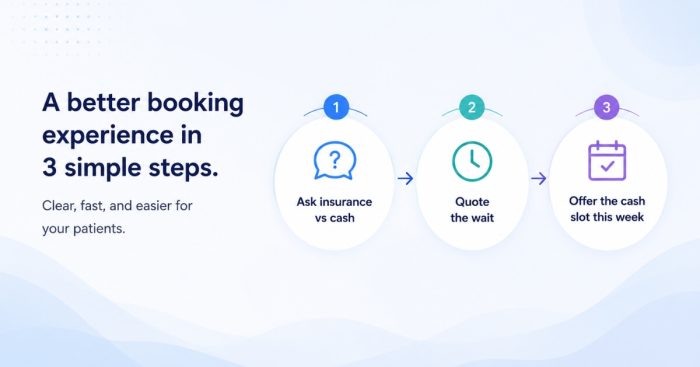
- Led with availability
- Quoted the cash slot
- Offered a specific day
The script only works if it’s run the same way on the hundredth call as the first.
That’s a training and accountability job, not a talent one.
Any front desk can learn it.
FAQ’s About Converting Insurance Callers to Cash-Pay
What’s the first thing the front desk should say when someone asks about insurance?
Ask whether they’d be a new insurance patient or a new cash-pay patient, then check availability out loud.
Leading with the availability difference reframes the call from price to speed before any number is quoted.
Is it ethical to steer insurance callers toward cash visits?
Yes, as long as it’s honest.
Insurance visits genuinely book out further because of administrative friction, and cash slots genuinely open sooner.
The script makes a real trade-off visible — it doesn’t fabricate one.
What cash price should I quote on the first call?
Quote your flat initial-visit fee only after you’ve established the speed benefit, and immediately frame the membership as cheaper than a year of copays plus labs for patients who actually use the practice.
How do I keep the front desk from sounding salesy?
Use the pause and the “let me see what I can do” framing so the cash slot feels like a favor.
Never disparage the caller’s insurance.
Offer a specific appointment day rather than asking them to think about it.
How quickly should I offer the cash appointment?
As soon as possible — ideally this week.
The entire advantage of the cash path is speed, so naming a specific near-term day (“I can get you in Friday”) is what converts the caller.
What’s the next step?
If your front desk is treating “do you take my insurance?” as a yes-or-no question, you’re losing cash patients you already paid to make ring the phone.
The fix is:
- A written script
- Weekly role-play
- Recorded-call review
And it pays for itself in the first month.
If you want help building the script, the membership math, and the conversion system around it for your specific specialty, that’s the conversation to book.
We’ll map your intake flow and show you exactly where the cash patients are leaking out.