
How Do I Make My Functional Medicine Website Actually Convert? (The Refinement Playbook That Beats a Bigger Competitor)
Your functional medicine website is probably accurate, thorough, and completely failing to convert. It reads like a medical textbook, fragments every service onto its own page, and leans on stock photos that make you look like every other clinic. Meanwhile a bigger, over-leveraged competitor with millions in equipment and a dozen staff is winning purely on a site that feels personal. Here’s the FAQ on refining a functional medicine website so a leaner clinic out-converts a bigger one.
Why Does My Functional Medicine Website Feel “Too Medical” and Not Convert?
Because it reads like an encyclopedia instead of an experience — accurate, exhaustive, and emotionally flat. People book the clinic they connect with, not the one with the most paragraphs.
The most common problem with a functional medicine site is that it’s “just a website”: clinically correct, densely written, and impossible to feel anything about. Functional medicine patients are usually problem-aware and frustrated — they’ve been dismissed by conventional care and they’re looking for someone who clearly gets it. A wall of medical detail doesn’t reassure them; it overwhelms them.
The fix is to lead with the emotional piece. Each major section should open with:
- What you actually do
- How it differs from conventional medicine
Use language a real human feels before it ever drills into mechanisms and protocols.
You’re not dumbing it down — you’re sequencing it so connection comes first and depth comes second. That single reorder is often the difference between a site that informs and a site that books.
Should I Have a Separate Page for Every Treatment and IV Drip on My Site?
No. Fragmenting every service onto its own page overwhelms visitors and buries what they’re looking for. Consolidate aggressively.
A classic mistake is breaking one category into a dozen near-identical pages — separate Wellness, Detox, Repair, Energy, and Immunity IV pages, for instance, when they could all live on a single “Custom IVs” page.
Every extra page is another decision you’re forcing on a visitor who’s already tired of decisions. More pages feels like more thoroughness to the owner; to the patient it feels like a maze.
Collapse related offerings into clean, single pages so people can actually find what they need. The goal is a lean site that maps to what you do, not an exhaustive directory of every permutation. Fewer, stronger pages convert better than many thin ones — and they’re easier to keep current.
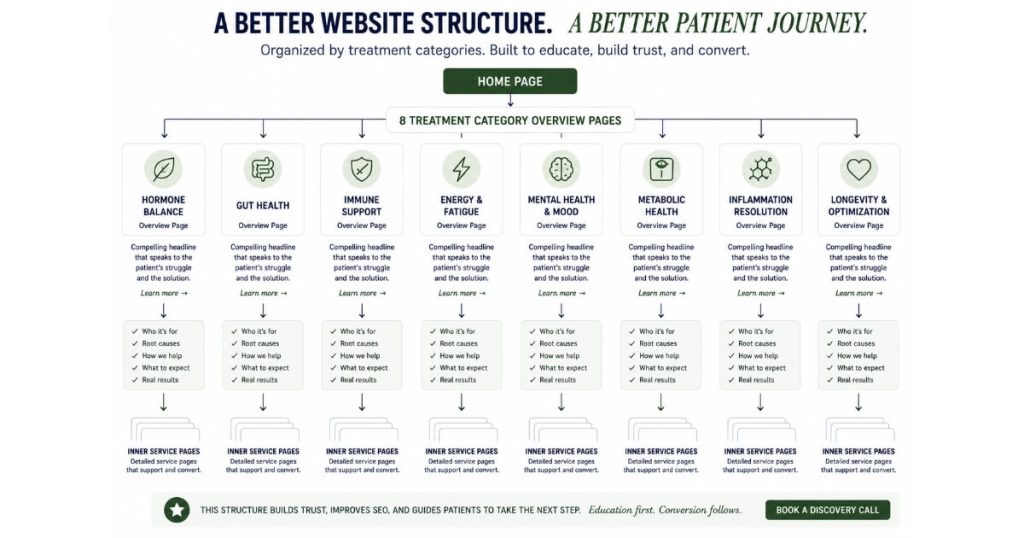
What Is an Overview Page, and Does My Treatment Menu Need One?
An overview page is a landing page that sits above your individual service pages and gives each treatment category a compelling summary before the visitor drills into the details. Yes — every main category needs one.
Think of your top navigation:
- Functional medicine
- Brain health
- Ozone or EBOO
- IV therapy
- Conditions you treat
Each of those buttons should open not to a bare list of links, but to an overview page with a strong headline and supporting subtext that frames the category emotionally and explains what you do and why it’s different.
Then, from that overview, the visitor can choose to go deeper into the specific inner pages.
This structure does two jobs at once:
- It gives a human a satisfying, low-overwhelm path through your site.
- It gives each category a substantial, keyword-relevant page that search engines and AI can index.
Get the framework up first — organize the navigation, build the overview pages, consolidate the inner pages — and refine the copy after.
Structure before polish.
VYVE Wellness, where we increased website leads by 900% and added 100+ inbound calls a month, is what this kind of structured, conversion-first site can produce.
Should I Write My Clinic Website for AI and ChatGPT, or for Humans?
Both — and they’re not in conflict. Write clear, bullet-pointed content at about a fifth-grade reading level so AI can consume and re-serve it accurately, and a human can actually read it.
This is a real shift. AI overviews, ChatGPT, Perplexity, and the rest now chew up your content and spit it back to searchers in their own words, which means your brand voice matters less than it used to and your clarity matters more.
Content that’s structured:
- Short paragraphs
- Bullet points
- Plain language
- Direct answers
Gets parsed and surfaced correctly.
Content that’s a dense, lyrical wall gets ignored or garbled.
So write for the machine and the human at the same time:
- Lead each section with a direct answer.
- Keep the reading level accessible.
- Break the substance into scannable points.
You’re not choosing between SEO and readability. The same clean structure that makes an LLM cite you is the structure that makes a tired, problem-aware patient keep reading.
Is Professional Photography and Video Worth It for a Small Functional Medicine Practice?
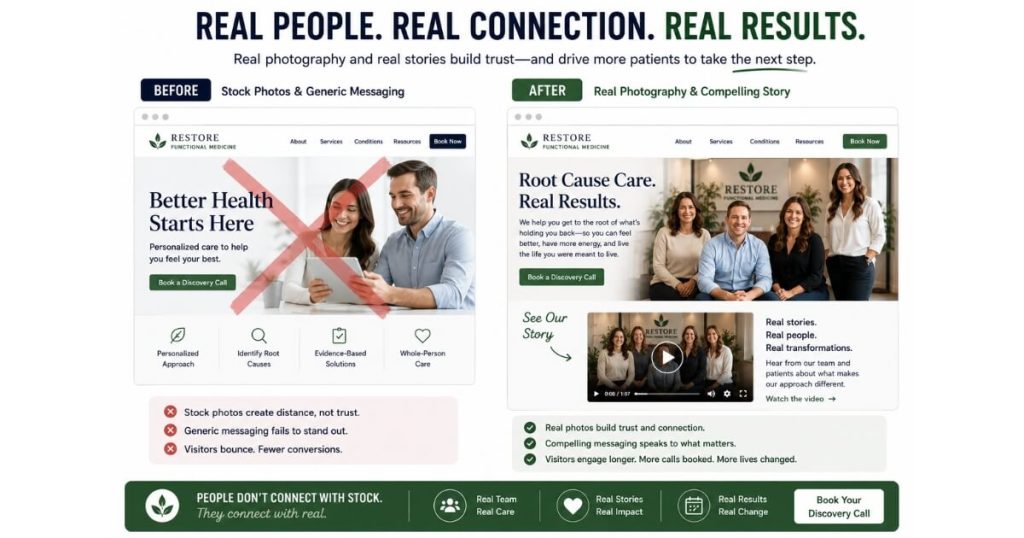
Yes — it’s one of the highest-leverage investments you can make. Real images of your actual team and clinic are what make a site feel personal and trustworthy; stock photos quietly signal “generic.”
When you study the sites that out-convert their category, the thing that consistently stands out is personalized imagery:
- Real humans
- The real space
- No stock photos
That’s what makes a visitor feel they’re looking at a specific, real clinic run by specific, real people, rather than a template.
Hire a photographer and videographer, shoot your team and your space, and refresh those images whenever your clinic or equipment changes, because stale photos undercut credibility.
A short teaser reel or provider intro video on the homepage is worth the production cost — it lets a prospect meet you before they ever call.
You don’t need a film crew and a six-figure budget; you need authentic, current visuals of the actual people a patient will meet. That authenticity is exactly what a bigger, glossier-but-impersonal competitor can’t fake.
What Should I Copy From a Bigger Competitor’s Website — and What Should I Avoid?
Copy the personalized, real-human imagery and the engaging feel. Avoid their bloat — the dark, heavy design, the endless content, the everything-about-the-doctor framing, and the broken-out SEO keyword dump at the bottom of the page.
A bigger, well-funded competitor is a useful study, but only some of it is worth imitating.
The one thing consistently worth copying is:
- The use of real, personalized images
- A site that feels alive
Almost everything else is often a cautionary tale:
- Sites that are too dark and hard to read
- Sites crammed with far too much content
- Sites built entirely around glorifying the lead doctor
- Obvious SEO keyword dumps at the bottom of the homepage
That keyword dump is a giveaway of someone who isn’t actually good at SEO — and it does more harm than good for both readers and modern search ranking.
Aim for the opposite: a lean, warm, well-structured site that clearly lines up with what you do.
You don’t beat a bigger clinic by matching their volume. You beat them by being clearer, more personal, and easier to act on.
How Does a Better Website Actually Lift My Consult Close Rate?
The website warms and qualifies the lead, but the close still happens when your intake staff engage prospects directly instead of punting every one to a senior closer.
A strong site does real conversion work before anyone picks up the phone:
- It builds trust.
- It frames the offer.
- It pre-sells the difference between you and conventional care.
But the website isn’t the whole funnel.
The clinics that move their close rate train the front-desk and intake staff to actually talk to and engage leads themselves, rather than treating every prospect as something to hand off to the one or two people who “do the closing.”
One functional medicine clinic moved from roughly a 2% close rate toward a 50% target by doing exactly this — pairing a clearer, more engaging site with intake staff empowered to handle leads directly, while keeping steady lead flow so there were always at-bats to improve on.
The website earns the conversation. A trained, confident front desk converts it.
FAQs About a Converting Functional Medicine Website
Why Doesn’t My Functional Medicine Website Convert?
It likely reads like a medical encyclopedia — accurate but emotionally flat — and fragments every service onto its own page. Functional medicine patients are frustrated and problem-aware; they book the clinic they connect with. Lead each section with what you do and how you differ before the clinical detail.
Should Every Treatment Have Its Own Page?
No. Consolidate related services (for example, collapse separate Wellness, Detox, and Energy IV pages into one “Custom IVs” page) so visitors aren’t overwhelmed. Fewer, stronger pages convert better than many thin ones and are easier to keep current.
Do I Need to Write My Website for AI Now?
Yes, and it doesn’t conflict with writing for humans. Use clear, bullet-pointed content at about a fifth-grade reading level so AI overviews and chatbots can consume and re-serve it accurately. The same clean structure that gets you cited is the structure that keeps a tired patient reading.
Is Professional Photography Worth It for a Small Clinic?
Yes — real images of your actual team and space are what make a site feel personal and trustworthy, while stock photos signal generic. A short homepage teaser or provider video lets prospects meet you before they call, and you should refresh photos whenever your clinic changes.
What Should I Avoid Copying From a Bigger Competitor’s Site?
Avoid the dark, heavy design, the overload of content, the everything-about-the-doctor framing, and the SEO keyword dump at the bottom of the page. Copy only their use of real, personalized imagery — then beat them by being leaner, warmer, and easier to act on.
What’s the Next Step?
If your functional medicine website is thorough but quiet, the fix isn’t more content — it’s better structure. Lead with emotion, consolidate the fragments, build a real overview page for each category, write clearly for both humans and AI, replace stock photos with your real team, and train your intake staff to convert the leads the site warms up.
On a strategy call we’ll audit your site against exactly these points and tell you what to change first for your clinic and your market. We’ve built conversion-first sites across functional medicine, hormones, and longevity — including practices where a structured, SEO-strong site became the single biggest source of new patients, like an HRT clinic whose SEO traffic grew from 80 to over 1,000 visitors a month and drove $1.7M a year in memberships.