
How Do I Launch a Cash-Pay Weight Loss & Performance Medicine Practice? (Why You Should Target Women, Not Men)
Almost every new performance, longevity, or weight-loss practice launches aimed at the same person: the affluent male biohacker. It feels obvious, and it’s usually a mistake. The clinics that launch fastest get three things right before they spend a dollar on ads — the message, the market, and the offer — and the market they pick is the one everyone else is ignoring. Here’s the FAQ on how to launch a cash-pay weight loss and performance medicine practice the right way.
How Do I Launch a Cash-Pay Weight Loss or Performance Medicine Practice the Right Way?
Message before media. Decide the single result you get people and exactly who you help best, then go find where those people are — only after that do you touch an ad platform.
The order is always:
- Message
- Market
- Media
What result do I get for people? Who can I help best? Where are those people, and how do I get in front of them?
Owners reverse this constantly — they pick a platform first, write some ads, and wonder why nothing converts. You can’t out-spend a muddy message. Get crystal clear on the transformation you sell and the exact person who buys it, and the channel choice becomes almost automatic.
Then build a genuinely strong offer and do your competitor research before you ever launch a campaign. A launch isn’t an ad budget. It’s a message, a market, an offer, and the assets to deliver them — assembled in that sequence. Skip the front half and the ad spend just buys you faster proof that the message is wrong.
Should My Weight Loss or Performance Clinic Target Men or Women?
Target women. Everyone chases the affluent man, but weight loss is an emotional purchase — and women buy on emotion far more often, in a market that’s been badly underserved.
This is the pivot that changes the whole launch. Weight loss and transformation are emotional buys, and the data on who acts on emotion points to women. On top of that, women’s health is a massively underserved market: women are routinely told “everything’s fine,” handed birth control, and sent home without anyone actually solving the hormonal, metabolic, or energy problem they came in with. A credible, lab-driven clinic that takes them seriously walks into far less competition than the saturated male-optimization space.
Get specific about the avatar. Picture the mom who’s been offered an anti-anxiety prescription and birth control instead of a real hormone workup; who’s spent years preparing meals for her kids and partner and never thought about her own nutrition; who hasn’t slept properly in three or four years and has no energy left to exercise.
Build the homepage, the message, and the front-end offer around her, leading with sustainable weight loss, and you’re speaking to a buyer no one else is really talking to.
What Should I Do Before I Spend Money on Paid Ads for My Clinic?
Lock the message and offer, complete a full competitor-research grid, prepare your creative assets, and — most important — have a sales process and a salesperson ready.
Before a dollar goes to ads, build a competitor-research grid. For each competitor in your space, capture:
- How they position
- What they actually do
- Their price points
- Their deliverables
The more you fill in, the more obvious your own gap and angle become.
Then get your assets ready:
- Video ads
- A VSL
- Tight written copy
The ad is only as good as the creative behind it.
The piece owners underestimate most is the sell. Generating a lead is the easy part; actually closing it is usually the hardest part of the whole machine. If you turn on ads with no sales process and no one whose job is to sell the offer, you’ll generate leads you can’t convert and conclude — wrongly — that the marketing failed.
Have the closer and the process in place first.
A weight-loss and medspa clinic we helped add $6.7M in a single year across 3,727 new patients didn’t win on traffic alone — it won because the offer, the funnel, and the follow-up were all built before the spend scaled.
How Is a Root-Cause Performance Practice Different From a Typical Weight Loss Clinic?
A typical clinic ramps up the weight-loss medication because that’s what it sells, skips the lifestyle work, and the patient loses muscle, becomes medication-resistant, and rebounds. A root-cause practice does the opposite.
Most weight-loss clinics are transactional: maximize the drug, ignore the lifestyle, and watch the patient regain the weight once they stop. That’s the script your message should explicitly reject.
The differentiated positioning is:
“We don’t gaslight you or mask your symptoms — we find the root cause and help you make lasting change.”
Mechanically, that means:
- Micro-dosing GLP-1s to open a window for real change rather than relying on the drug alone
- Using comprehensive blood work to drive precise, individualized recommendations
- Building in the lifestyle and nutrition work so patients preserve muscle and don’t rebound
That’s a genuinely different promise, and it’s the kind of curiosity-driving message — something like “medically sustainable, age-specific weight loss” — that makes a prospect stop and want to know more, instead of blending into every other GLP-1 ad in the feed.
What Makes an Irresistible Offer for a Cash-Pay Clinic Membership?
Bundle every component that raises the prospect’s belief that they’ll actually get the result, and anchor the whole thing on one curiosity-driving promise — never the word “diet.”
A strong offer isn’t a low price; it’s a high perceived likelihood of success.
Stack the elements that build that belief:
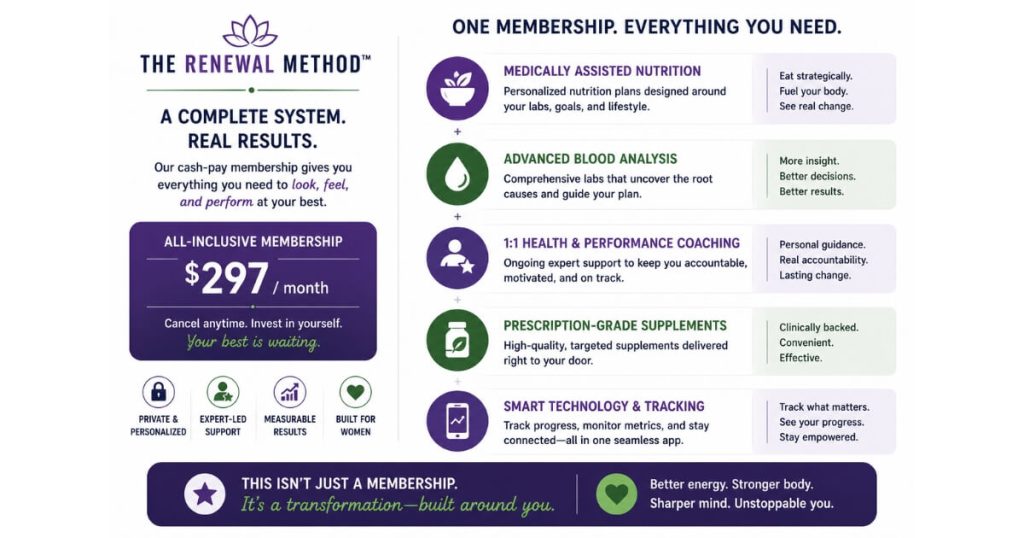
- Medically assisted nutrition
- Comprehensive blood and metabolic analysis
- A bio-individual nutrition plan
- Set protein and macro targets
- Food-allergy testing
- Coaching and accountability
- Supplements and food recommendations
- Supportive technology
- Personalized training
Each component is another reason the patient believes:
“This will finally work for me.”
Two language rules matter.
- Never call it a “diet” — people hate diets and have failed at them.
- Call it a bio-individual nutrition plan.
And anchor the offer on a single, specific, curiosity-creating name rather than generic “weight loss.” When the offer is this complete and the promise is this specific, pricing genuinely isn’t complicated — the value is self-evident.
How Should I Price a Cash-Pay Membership Program for Cash Flow?
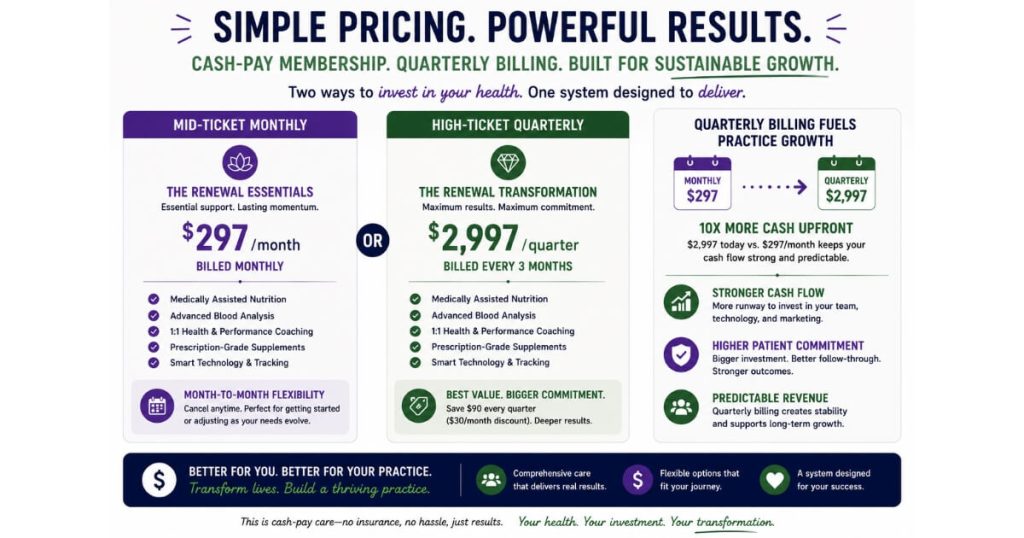
Use tiers — a mid-ticket monthly membership around $297 a month and a high-ticket program around $5,000 per quarter — and bill quarterly, with the commitment up front, to transform your cash flow.
Comparable programs run roughly:
- $297 a month for a mid-ticket group membership
- Around $5,000 per quarter for a high-ticket plan that bundles blood work, supplements, and peptides
Typically on a one-year commitment paid 90 days at a time.
The high-ticket tier is where the margin lives; the mid-ticket tier is a lead-generation and ascension tool that feeds it.
The billing model matters as much as the number. Charging quarterly — collecting 90 days up front instead of an upfront fee plus per-visit billing — dramatically improves cash flow and lets you advertise more aggressively, because you have the capital in hand.
It also lets you lean more on telehealth to escape the limits of your physical space. Predictable, front-loaded recurring revenue is what makes a launch durable rather than a cash-flow rollercoaster.
How Do I Add a Performance or Fitness Arm to My Practice to Drive More Telehealth?
Use a front-end weight-loss offer as a lead-generation tool that upsells qualified patients into your higher-ticket program, run it largely via telehealth, and pay your coaches per client managed.
The weight-loss offer is the front door. It’s the emotional, high-demand entry point that brings patients in; the higher-ticket performance or hormone program is what they ascend into once they trust you. Running this largely through telehealth lets you grow past the limits of your physical rooms and diversify away from referral dependence.
Two structural notes.
- Pay coaches per client managed rather than on salary.
- Get your site and offer through the relevant approvals (LegitScript and the like) on a clean, properly-named domain.
A practice like VYVE Wellness, where we increased website leads by 900% and added 100+ inbound calls a month shows what this front-end-to-program model can produce once the message and offer are dialed in.
FAQs About Launching a Cash-Pay Performance Medicine Practice
What’s the First Step to Launching a Performance Medicine Practice?
Start with message before media: define the single result you deliver and exactly who you help best, then find where those people are. Build a strong offer and complete competitor research before you ever launch an ad — the platform choice becomes obvious once the message and market are clear.
Should I Target Men or Women for a Weight Loss Clinic?
Target women. Weight loss is an emotional purchase and women act on emotion more often, and women’s health is badly underserved — many are told “everything’s fine” and handed birth control instead of a real workup. A credible, lab-driven offer for women faces far less competition than the saturated male-optimization market.
What Should I Have in Place Before Running Ads?
Lock your message and offer, build a competitor-research grid, prepare creative (video ads, a VSL, copy), and — most important — have a sales process and a salesperson ready. Generating leads is easy; closing them is the hard part, so never turn on ads without someone to sell the offer.
How Should I Price a Performance Medicine Membership?
Use tiers: a mid-ticket monthly membership around $297 a month and a high-ticket program around $5,000 per quarter, often on a one-year commitment paid 90 days at a time. Bill quarterly with the commitment up front to dramatically improve cash flow and fund more aggressive advertising.
What Makes a Clinic Membership Offer Irresistible?
Bundle the components that raise belief in the result — medically assisted nutrition, blood and metabolic analysis, a bio-individual nutrition plan, coaching, supplements, and technology — and anchor it on one curiosity-driving promise. Never call it a “diet,” and keep the price simple because a complete offer makes the value self-evident.
What’s the Next Step?
If you’re launching a cash-pay weight loss or performance practice, resist the urge to open an ad account first. Get the message, the market, and the offer right — pick the underserved women’s market, reject the transactional GLP-1 script, stack an offer that builds belief, price it in tiers, and bill quarterly. Then, and only then, turn on traffic with a closer in place.
On a strategy call we’ll map your launch end to end — the avatar, the positioning, the offer stack, the pricing and billing model, and what to build before you spend. We’ve launched and scaled cash-pay practices across weight loss, hormones, and functional medicine, and we’ll show you exactly where your leverage is.