
Why Can’t My Men’s Hormone Clinic’s Front Desk Convert Leads? (The Operations Fix Behind the 30-Minute Callback Rule)
If you run a men’s hormone clinic, you have probably had this exact thought: the ads are working, the leads are coming in, and somehow new patients still aren’t booking.
The instinct is to blame the marketing or the lead quality.
Almost always, that’s wrong.
The leads are dying in the first four hours of your morning — buried under walk-in injections, lab draws, and the operational chaos your front desk is drowning in.
Here’s the FAQ on why it happens and the operations fix that recovers those patients.
Why does my men’s hormone clinic lose new leads even when the marketing is working?
Because the same staff you’ve asked to call new leads are the people putting out four hours of walk-in fires every morning — and a new lead loses to operational drag every single time.
Picture a typical Tuesday.
From 8 a.m. to noon, the front desk is:
- Fielding walk-in testosterone injections
- Drawing labs
- Rescheduling no-shows
- Answering the phone
Meanwhile your automation has already texted a new lead:
“I’ll be right back with you shortly.”
Four hours later, nobody has been “right back.”
The lead has:
- Cooled off
- Lost interest
- Googled the men’s clinic across town
The marketing did its job.
The operation failed to catch what the marketing delivered.
This is the trap that more ad spend makes worse, not better.
Pouring more leads into a front desk that physically cannot answer them just raises your cost per acquired patient while your conversion stays flat.
The fix isn’t a bigger budget.
It’s protecting the moment of contact so the lead never has to wait four hours for a human.
That starts with:
- One hard rule.
- One structural change.
How fast should a TRT or men’s hormone clinic respond to a new lead?
Within 30 minutes during business hours — and the moment a lead texts back, call them while the phone is still in their hand.
Speed to lead is the whole game in hormone marketing.
A man who fills out a low-testosterone quiz at 9:14 a.m. is thinking about:
- His fatigue
- His weight
- His energy
Right now.
By 1 p.m. he’s thinking about lunch.
Set a hard service-level expectation with your team:
- Every inbound lead gets a human reply inside 30 minutes during business hours.
- If there’s no response within 24 hours, a second message goes out.
- Someone is assigned to call.
Don’t let a text thread crawl across three days.
If the lead actively responds to a message, that is the signal to:
Pick up the phone immediately.
Why?
Because:
- They are engaged.
- The phone is in their hand.
- A live conversation books far more often than a slow back-and-forth.
Solve the patient’s problem within an hour of first contact and you book them.
Wait, and you’ve trained them to wait too.

Who should actually own lead conversion at a men’s hormone clinic?
One dedicated lead-handler, physically isolated from patient-care interruptions — not “whoever is at the front desk.”
Anyone you put in a separate space, free of walk-in interruptions and clinical fires, will out-produce a front desk trying to convert leads between injections.
The reason is simple:
Conversion requires:
- Focus
- Consistency
- A calm, unhurried phone manner
The front desk during a busy morning has none of those.
When the person responsible for calling leads is also the person being flagged down for a B12 shot every six minutes, the leads always lose.
Give that role:
- Its own desk
- Its own calendar
- One job
Respond to new leads fast and book them.
Use your extra clinical capacity — a nurse or LPN handling injections and lab draws — to pull those tasks off the front desk entirely so the conversion person is never the bottleneck.
The clinics that scale recurring hormone memberships protect this role the way the practices in our work on an HRT clinic we grew from $1M a year to $4M a year by building the operations structure before adding spend protect their weekly numbers.
Structure first. Volume second.
How do I stop my front desk from stalling leads with “let me go ask someone”?
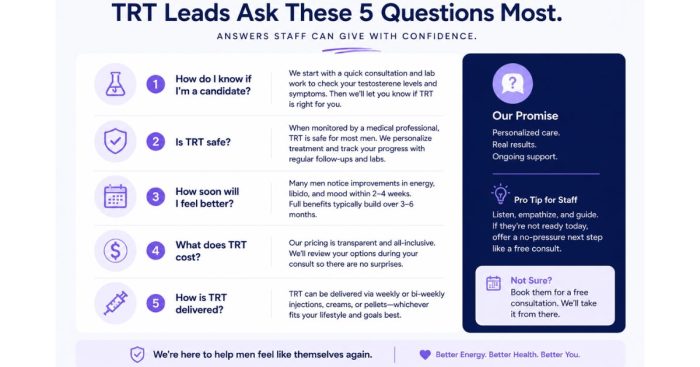
Build a written FAQ of the clinical and pricing questions patients actually ask, and train your team to answer them in real time.
Hormone leads stall the instant your staff says:
“Let me check on that and call you back.”
The patient’s momentum dies on the spot.
TRT patients often know more about testosterone than the person they’re talking to, which erodes trust fast.
The bottleneck is almost never attitude.
It’s that the front desk genuinely doesn’t know the answer and is afraid to guess.
So document the answers.
Write down the ten questions every lead asks, including:
- How the labs work
- What the membership includes
- How injections are handled
- What the first visit looks like
- How pricing compares to a competitor
Then document the exact way you want them answered.
Train:
- Tori
- Austin
- Whoever picks up the phone
On that script.
Now the lead gets a confident answer in the moment instead of a callback that never comes.
A team that can answer questions converts.
A team that has to “go ask somebody” leaks.
How should I pay the person responsible for converting leads?
Tie their compensation to conversion — every staff member who touches a new-patient signup should win when that patient signs up.
If the only thing your front desk is paid for is showing up, that’s exactly what you’ll get:
Attendance, not conversion.
The moment you put a bonus on the productive outcome:
- A booked discovery call
- A new membership signed
Behavior changes.
People optimize for what they’re paid for.
Set up the lead-handler and supporting staff so a new patient signup pays them something real, and you’ve aligned the entire team behind the number that actually grows the practice.
Keep it clean:
- Bonus on patient attended and enrolled.
- Not on texts sent.
- Not on activity that is easy to fake.
When everyone on the floor has skin in the conversion game, the lead that comes in at 9:14 a.m. suddenly becomes everyone’s problem to solve — fast.
Should the doctor personally call new leads to close them?
It works almost too well — owners report booking rates around 95% when the doctor calls — but it doesn’t scale, so use it to build the system, not to be the system.
There’s a real reason the doctor converts.
When a man gets a text signed by the physician, he thinks:
“The actual doctor is communicating with me.”
That perceived access closes the deal.
If you’re a solo owner-operator early on, lean into it.
That’s how a lot of hormone clinics get their first hundred members:
- The founder sits at the front desk.
- Answers the phone.
- Becomes the first face every patient sees.
But it’s a trap if it becomes permanent.
The doctor’s time is:
- Your most expensive resource.
- Your least scalable resource.
A physician who personally chases every lead can never step back.
The smarter move is to capture what makes the doctor’s calls convert:
- The answers
- The framing
- The reassurance
Then bake it into:
- The staff FAQ
- The conversion script
So a coordinator can deliver an 80% experience without the doctor on the phone.
Build the machine while you’re still the machine.
Then walk out of it.
When should I raise my hormone membership price?
Once you have a steady referral stream — then raise it, and anchor any discount to the group already driving your referrals.
Price increases are earned by demand, not by calendar.
One men’s clinic we worked with:
- Started memberships at $125/month.
- Held that price until roughly 200 members.
- Raised the standard rate to $150/month.
- Kept a $125 first-responder rate.
Specifically for:
- Firefighters
- Military patients
Who were already referring their friends.
That’s the move.
Raise the standard price as demand proves out, and reserve your discount for the population that’s already sending you business.
Don’t discount broadly to chase volume.
Discount narrowly to reward the segment that compounds.
The patients whose referrals lower your real acquisition cost.
Everyone else pays the rate the market will bear.
Which, for recurring high-LTV hormone care, is more than most owners think.
FAQ’s About Men’s Hormone Clinic Lead Conversion
What is a good speed-to-lead time for a men’s hormone clinic?
Reply to every inbound lead within 30 minutes during business hours, and call the moment a lead texts back.
If there’s no response within 24 hours:
- Send a second message.
- Assign someone to call.
Speed of first human contact is the single biggest lever on whether a TRT lead books.
Why are my marketing leads not converting into patients?
Usually the leads are fine and the operation is the problem.
If the staff calling leads are the same people handling:
- Walk-in injections
- Labs
- Morning chaos
Leads sit unanswered for hours and cool off.
Protect the moment of contact with a dedicated, interruption-free conversion role.
Should my front desk or a dedicated coordinator handle lead conversion?
A dedicated coordinator, isolated from patient-care interruptions, will out-convert a busy front desk every time.
Conversion needs:
- Focus
- Consistency
- An unhurried phone manner
Give that person:
- Their own desk
- Their own calendar
- One job
Respond fast and book.
How do I get staff to answer patient questions instead of saying “I’ll call you back”?
Write a one-page FAQ of the ten questions leads ask most and train your team on it.
Examples include:
- Labs
- Membership
- Injections
- First visit
- Pricing
Leads die on:
“Let me go ask someone.”
Giving staff confident answers in the moment is what keeps momentum alive.
Does it work for the doctor to call leads personally?
Yes.
It converts at very high rates because patients feel the physician is personally engaged.
But it doesn’t scale and traps the owner in the day-to-day.
Use it early to learn what converts.
Then bake those answers into a staff script so a coordinator can deliver the same experience without the doctor on every call.
What’s the next step?
If your men’s hormone clinic is generating leads but the front desk can’t seem to turn them into booked patients, the bottleneck is almost certainly operational — not your ad spend and not your lead quality.
The fix is structural:
- A 30-minute callback rule
- A dedicated and protected conversion role
- A written FAQ so staff can answer in the moment
- Compensation tied to signups
On a strategy call we’ll map exactly where your leads are leaking:
- The morning-chaos window
- The “let me ask someone” stalls
- The compensation structure
And what to change first for your specific clinic.
We’ve done this for clinics that turned inbound interest into seven figures, including a clinic where a tightened inbound-call and conversion system helped add $6.7M in a single year across 3,727 new patients.