
The 10 Best (and Worst) Ways to Get New Plastic Surgery Patients in 2026 — Riding the GLP-1 “Makeover” Wave
For most of medicine, the GLP-1 boom is a story about weight loss.
For plastic surgery, it is the largest demand tailwind in a generation.
The American Society of Plastic Surgeons named GLP-1 makeovers the leading trend of 2026 — millions of patients who dropped significant weight on Ozempic and Wegovy now have loose skin and lost volume, and they want tummy tucks, body lifts, liposuction, skin-tightening, and fat transfer to finish the job.
The patients are motivated, the tickets are high, and the pipeline starts in a place most surgeons are not even looking: the weight-loss clinic down the road.
Here are the 10 best and the worst ways to capture them.
What changed for plastic surgery patient acquisition in 2026?
A massive new pool of post-weight-loss patients showed up, all needing exactly what a plastic surgeon sells.
The American Society of Plastic Surgeons identified GLP-1 makeovers as a leading trend of 2026.
After sustained weight loss on medications like Ozempic and Wegovy, patients are left with:
- Diffuse loose skin
- Volume depletion in the face
- Volume depletion in the breasts
- Volume depletion in the extremities
And they are turning to surgery to address it.
The procedures riding the wave include:
- Tummy tucks
- Circumferential tummy tucks
- Arm lifts
- Body lifts
- Liposuction paired with skin-tightening technology
- Fat transfer to restore lost volume
Alongside the volume surge, the aesthetic itself is shifting toward:
- Natural results
- Long-lasting results
- Well-aging outcomes
Rather than the obvious work of the last decade.
The strategic point is this:
The demand is not something you have to manufacture in 2026.
It already exists and it is growing.
Your job is to position for it explicitly and to build a path from the weight-loss world into your operating room before your competitors realize the pipeline was sitting next door the whole time.
What are the 10 best ways to get new plastic surgery patients right now?
Position for the GLP-1 makeover, then build a real pipeline and a real funnel behind it.
These are the ten that are working in 2026, in rough order of leverage.
1. Position explicitly for the GLP-1 makeover.
Name it, build a dedicated page and offer for post-weight-loss body contouring, and you instantly stand out to the fastest-growing patient segment in the field.
2. Partner with weight-loss clinics, med spas, and GLP-1 programs.
They produce your future surgical patients every week.
A referral relationship and a co-marketed offer turn that flow into booked consults.
3. Make before-and-after galleries your core marketing asset.
Nothing sells surgery like credible, realistic results.
Deep, well-organized, procedure-specific galleries are the single most persuasive thing on your site.
4. Own the Google name-search for your procedures.
Patients search:
- Tummy tuck
- Mommy makeover
- Skin removal after weight loss
By name.
Procedure-specific landing pages plus Local Service presence capture high-intent demand.
5. Run Instagram and TikTok for visual discovery.
Aesthetic transformation is inherently visual and shareable.
Patient stories and tasteful result content build the brand that makes every other channel convert.
6. Build a consult-to-surgery funnel with financing.
The money is made between the consult and the operating room.
A structured consult process and clear financing options convert far more candidates into surgeries.
7. Treat reviews and reputation as a growth channel.
High-ticket, high-trust decisions hinge on reputation.
Systematic review generation and a strong online presence are non-negotiable.
8. Retarget across the long decision cycle.
A surgical decision can take months.
Retargeting and email nurture keep you present from first click to booked date.
9. Create educational content around the GLP-1 makeover.
The post-weight-loss patient has questions about:
- Timing
- Options
- Recovery
The practice that answers them becomes the trusted choice — and the citable one for AI search.
10. Use Meta for high-ticket body procedures.
Facebook and Instagram excel at creating demand among people who were not yet searching.
That is exactly the body-contouring audience when the offer, creative, and follow-up are aligned.
That last point is not theoretical.
We added $2M in revenue from Facebook ads alone for one surgical practice — proof of what dialed-in Meta looks like for high-ticket surgical care when the ad team, the offer, and the consult process all line up.
What are the worst ways to get plastic surgery patients — the ones that burn budget and trust?
They mostly come down to optimizing the wrong number and neglecting the funnel that actually closes surgery.
The most expensive mistake is chasing the cheapest cost per lead.
Plastic surgery leads cost more than med spa leads — often $100 to $200 — because the patient is worth so much more.
The practice that obsesses over cheap clicks:
- Fills its calendar with tire-kickers.
- Starves itself of real surgical candidates.
The metrics that matter are:
- Cost per booked consultation.
- Consultation-to-surgery conversion.
Right behind that is sending paid traffic to a generic homepage instead of a procedure-specific page built to convert.
That quietly wastes a large share of every ad dollar.
Then there is:
- Overhyping results.
- Thin or dated before-and-after galleries.
- Appearing so exclusive that you shrink your own addressable market.
The most common silent killer is no structured follow-up across a months-long decision cycle.
A lead goes cold not because they chose a competitor, but because nobody stayed in touch until they were ready.
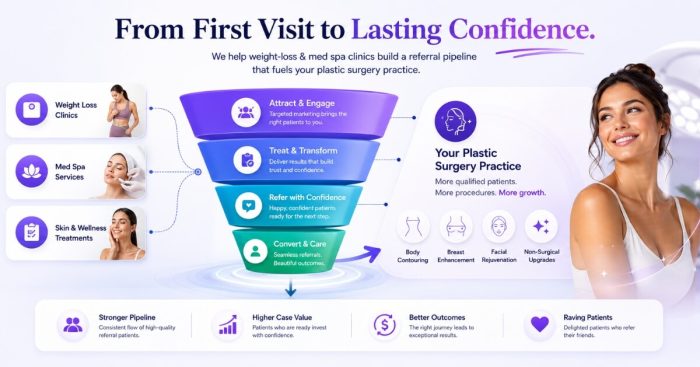
How do you turn the GLP-1 weight-loss boom into a surgical pipeline?
Get upstream of the demand instead of waiting at the bottom of it.
Every week:
- Med spas
- Weight-loss clinics
- GLP-1 programs
Are creating patients who will eventually need body contouring as the weight comes off.
Most plastic surgeons wait for those patients to find them months later, by chance.
The practices that win build the relationship at the start of the journey through:
- Referral partnerships
- Co-marketed GLP-1 makeover offers
- Educational content aimed at weight-loss patients
Specifically, the patient who is just starting to think about what comes after the scale stops moving.
The front end of that pipeline is the same multi-channel demand engine that powers the weight-loss world.
We built one with a weight-loss and medspa clinic where we added $6.7M in revenue in one year across 3,727 new patients — and every one of those weight-loss patients is a future body-contouring candidate.
Whether you partner with a clinic like that or capture the upstream demand yourself, owning the start of the journey is how you fill the operating room.
FAQ’s About Getting Plastic Surgery Patients
What is the biggest plastic surgery growth opportunity in 2026?
The GLP-1 makeover.
The American Society of Plastic Surgeons named GLP-1 makeovers a leading trend of 2026.
Millions of patients who lost significant weight on medications like Ozempic and Wegovy now seek:
- Tummy tucks
- Arm lifts
- Body lifts
- Liposuction
- Skin-tightening
- Fat transfer
To address loose skin and volume loss.
This is the largest new pool of motivated, cash-ready surgical candidates the field has seen in years.
The practices that win 2026 are the ones that:
- Position explicitly for this patient.
- Build a pipeline from the weight-loss world.
- Create a clear path into the operating room.
Rather than waiting for these patients to find them by accident.
How do you turn the GLP-1 weight-loss boom into a surgical pipeline?
Build relationships upstream with the clinics creating the demand and position your practice as the natural next step.
Med spas, weight-loss clinics, and GLP-1 programs are producing post-weight-loss patients every week who will need body contouring as the pounds come off.
The winning combination is:
- Referral relationships
- A co-marketed GLP-1 makeover offer
- Educational content aimed at weight-loss patients
The same multi-channel demand engine that built a $6.7M year for one weight-loss and medspa clinic is the front end of your surgical pipeline.
You are capturing the patient at the start of their journey and being there when they are ready to operate.
What metric should a plastic surgery practice optimize in its ads?
Cost per booked consultation and consultation-to-surgery conversion — not raw cost per lead.
Plastic surgery cost per lead typically runs higher than med spa, often in the $100 to $200 range, because the patient value is so high.
Chasing the cheapest lead:
- Fills your calendar with tire-kickers.
- Starves it of surgical candidates.
Optimize for:
- Cost per booked consultation.
- Consultation-to-surgery conversion.
That is the math that actually maps to revenue.
Do Facebook and Instagram ads work for plastic surgeons?
Yes.
Especially for high-ticket body procedures when:
- The offer is dialed in.
- The creative is dialed in.
- The follow-up is dialed in.
Meta excels at creating demand among people who were not actively searching.
That is exactly the post-GLP-1 body-contouring audience.
Strong before-and-after creative, a clear offer, and a fast-follow-up operation are what separate a profitable campaign from a money pit.
We added $2M in revenue from Facebook ads alone for one surgical practice — that is what dialed-in Meta looks like when the ad team, the offer, and the consult process are aligned.
What is the most common plastic surgery marketing mistake?
Treating the website as a brochure and sending paid traffic to the homepage instead of a procedure-specific page built to convert.
The patient who clicks a tummy-tuck ad and lands on a generic homepage has to hunt for what they came for.
Most leave.
Other costly mistakes include:
- Overhyping results.
- Optimizing for cheap leads over booked consults.
- Weak or sparse before-and-after galleries.
- No structured follow-up across a decision cycle that often takes months.
Fix the funnel, the proof, and the follow-up before spending more on traffic.
What’s the next step?
The GLP-1 makeover wave is the rare moment when demand outruns the field’s ability to capture it.
The patients exist.
The tickets are high.
The pipeline starts in the weight-loss clinics already operating in your market.
The practices that win 2026 will be the ones that:
- Position explicitly for the post-weight-loss patient.
- Get upstream of the demand.
- Run a funnel that turns high-intent leads into booked surgeries.
Not the ones chasing the cheapest click to a homepage.
If you run a plastic surgery or cosmetic practice and you want a plan to capture the GLP-1 makeover wave — the positioning, the referral pipeline, and the consult-to-surgery funnel — that is the conversation to book.
We will map your highest-leverage channels and your surgical pipeline on the call.