
Why Should a Cash-Pay Clinic Track Patient Outcomes? (The Delivery Metric That Drives Lifetime Value and Referrals)
Almost every cash-pay clinic tracks leads, bookings, and revenue. Almost none of them track the one number that actually drives all three over time: delivery.
Delivery is the share of your patients who actually got the result you promised them.
It is invisible on most dashboards. That blind spot is exactly why so many clinics fight so hard for new patients while their best growth lever sits unmeasured.
Here is the FAQ on why tracking patient outcomes is the highest-leverage measurement a cash-pay practice can add — and how it quietly drives lifetime value, retention, and referrals.
Why should a cash-pay clinic track patient outcomes?
Because almost nobody tracks delivery — the percentage of patients who actually got the result you promised — and that number is the root cause of lifetime value, retention, and word-of-mouth.
Most clinics obsess over acquisition metrics and never measure whether the care they sold actually worked at scale.
They know their cost per lead to the dollar. But they cannot tell you what share of patients hit the outcome they came for.
That is backwards. The outcome rate is what determines whether a patient stays, buys again, and tells other people — the three things that make a practice grow without constantly buying new patients.
When you start measuring delivery, you make the most important part of the business visible.
You can see which protocols, providers, and patient types produce results, and you can fix the ones that do not.
The clinics that track outcomes are managing the actual engine of their growth.
The ones that do not are flying blind on the thing that matters most.
What is the “delivery” metric and how do you measure it?
Delivery is the share of your patients who got the specific result you promised — and you measure it by defining the promised outcome, then tracking what percentage of patients actually reach it.
The mechanics are simpler than they sound.
Decide what result each program is supposed to deliver — the weight lost, the symptom resolved, the level corrected, the pain reduced.
Then track the percentage of patients who achieve it.
That single number is your delivery rate, and it is the most honest measure of your clinic’s quality you can have.
Everything else is a proxy. Delivery is the thing itself.
Most clinics never define the promised outcome precisely. That is exactly why they cannot measure it.
Forcing yourself to name the result and count who reaches it does two things at once. It surfaces where care is breaking down, and it gives the whole team a concrete standard to hit.
You cannot improve what you refuse to measure.
Why does tracking patient outcomes increase lifetime value?
Because a patient who got the result they paid for has every reason to stay, buy again, and renew — and tracking delivery is how you find and fix the cases where that is not happening.
Lifetime value is not built by clever retention emails. It is built by patients getting what they came for.
When you measure delivery, you can see exactly which patients are at risk because the outcome is not landing.
You can intervene before they churn.
A patient who feels the result is a patient who renews the membership, adds the next service, and stays for years.
The outcome is the retention strategy.
This is why outcome tracking belongs next to your revenue metrics. It should not be buried in clinical notes.
The same measurement that tells you whether care is working tells you where your lifetime value is leaking.
That outcome-to-retention link is exactly what builds durable recurring revenue — the engine behind an HRT clinic we grew from $1M to $4M a year on memberships where patients stay because the therapy keeps delivering.
How do patient outcomes drive referrals and word-of-mouth?
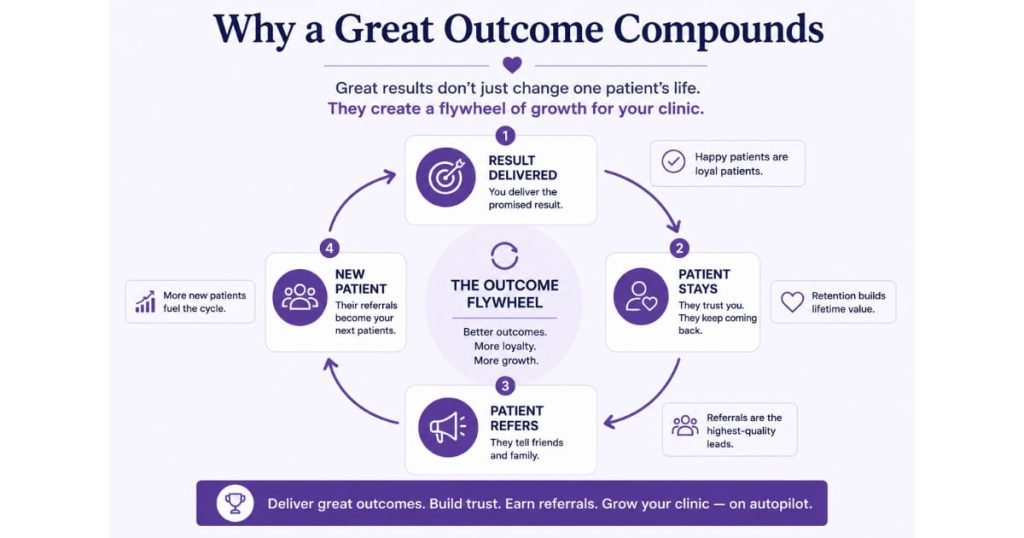
Because if your product is good enough, people talk about it without being asked — and a measured, consistently high delivery rate is what makes that happen reliably instead of occasionally.
The principle is blunt.
If the result you get for people is genuinely good, you do not have to say a damn thing — they advocate for your business every day.
Word-of-mouth is not a marketing tactic you bolt on.
It is the natural output of patients getting results.
When delivery is high and consistent, referrals become a dependable channel instead of a happy accident, because every satisfied patient is a salesperson you did not have to pay.
This is also the cheapest growth a clinic can have.
We have seen results-driven, word-of-mouth and organic growth produce $309,590 in cash-pay revenue in 10 months with zero ad spend and a 79.4% lead-to-booking conversion rate at a regenerative clinic — the kind of numbers that only happen when the underlying product is delivering and patients are doing the talking.
Why is most marketing actually a product problem?
Because if you are leaning hard on sales, it usually means your marketing is not pulling its weight — and if your marketing is not pulling its weight, it usually means the product is not good enough to market itself.
There is a chain worth internalizing.
You are focused on sales because you failed at marketing. You failed at marketing because you failed at product.
It sounds harsh, but it points at the real leverage.
When the product — the patient outcome — is excellent, marketing gets easier because there is something genuinely worth saying.
Sales gets easier because patients arrive half-convinced by reputation.
When the outcome is mediocre, no amount of clever marketing or aggressive selling fixes it for long.
That is why tracking delivery is not a clinical nicety. It is a marketing strategy.
Improving the outcome rate makes every downstream dollar of marketing and sales work harder.
The clinics grinding hardest on acquisition are often the ones who would get the biggest return from simply making the product better — and they would never know it, because they are not measuring delivery.
What should you track beyond delivery?
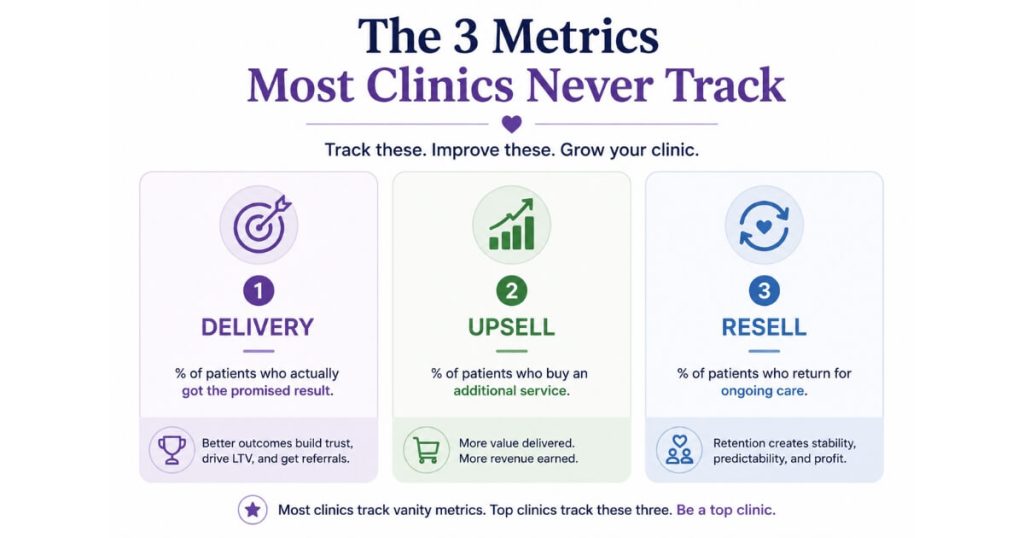
Two more metrics almost nobody watches: upsell and resell — whether patients move up to a higher level of care and whether they come back to buy again.
Delivery, upsell, and resell are the three blind spots.
Delivery tells you whether the care worked.
Upsell tells you whether patients are progressing into deeper, higher-value programs.
Resell tells you whether they return for repeat purchases over time.
Together they describe the entire back half of the patient relationship — the part where lifetime value is actually made — and almost no clinic measures any of them.
Start with delivery, because it drives the other two: patients who get results are the ones who upsell and resell.
But once delivery is visible, adding upsell and resell tracking completes the picture.
With all three on the dashboard next to your acquisition metrics, you finally see the whole business — not just how patients come in, but whether they win, grow, and stay.
FAQ’s About Tracking Patient Outcomes to Drive Lifetime Value
What is the delivery metric for a medical practice?
Delivery is the percentage of your patients who actually got the specific result you promised them.
You measure it by defining the promised outcome for each program — weight lost, symptom resolved, level corrected — and tracking what share of patients reach it.
It’s the most honest measure of clinic quality there is.
Why does tracking outcomes increase lifetime value?
Because a patient who got the result they paid for has every reason to stay, renew, and add services, while tracking delivery shows you exactly which patients are at risk because the outcome isn’t landing.
The outcome itself is the retention strategy — lifetime value is built by patients getting what they came for.
How do good outcomes create referrals?
If the result you get for people is genuinely good, they talk about it without being asked and advocate for your business every day.
A measured, consistently high delivery rate turns word-of-mouth from a happy accident into a dependable channel, because every satisfied patient becomes a salesperson you didn’t have to pay.
Is my marketing problem actually a product problem?
Often, yes.
Leaning hard on sales usually means marketing isn’t pulling its weight, and weak marketing usually traces back to a product that isn’t good enough to market itself.
Improving the patient outcome makes every downstream marketing and sales dollar work harder, so tracking delivery is itself a marketing strategy.
What should I track besides patient outcomes?
Upsell and resell — whether patients move up into higher levels of care and whether they return to buy again over time.
Delivery, upsell, and resell are the three blind spots most clinics never measure, and together they describe the back half of the patient relationship where lifetime value is actually made.
What’s the next step?
If your clinic tracks cost per lead to the dollar but cannot tell you what share of patients actually got the result you promised, you are measuring the wrong end of the business.
Start tracking delivery — define the promised outcome and count who reaches it — then add upsell and resell.
Those three numbers reveal where your lifetime value is made or lost, and they turn patient results into your cheapest growth channel.
If you want someone to build outcome tracking into your operation — defining the promised result, measuring delivery, and connecting it to retention and referrals — that is the conversation to book.
We will map the metrics that actually drive your growth on the call.