
What Should a Men’s Hormone Quiz Ad Actually Say? (6 Proven 60-Second Scripts and the Identity-Callout Formula)
Most men’s hormone ads fail for the same reason: they sell “testosterone therapy” to a man who does not think he has a testosterone problem — he thinks he has a willpower problem.
The ads that work do the opposite.
They call out exactly who he is, name the symptoms he has been blaming on himself, reframe “lazy” as “low,” and send him to a 60-second quiz instead of a sales consult.
Here is the FAQ on what a men’s hormone quiz ad should actually say — including six proven 60-second scripts you can film this week.
What should a men’s hormone quiz ad actually say?
Call out the man’s identity and life stage, name the specific symptoms he has been blaming on willpower, reframe them as a hormone or metabolism issue, and point him to a fast quiz — not a consult.
The structure is consistent across every high-performing version:
- A hook that names who he is.
- A middle that lists the symptoms and reframes them.
- A call-to-action that lowers the barrier all the way down.
Examples:
- “Men 35+: running the office, but not your waistline?”
- “If the belly won’t budge and energy tanks by 2 PM, it might be hormones or metabolism — not willpower.”
- “Take the 60-second Men’s Hormone & Metabolism Quiz. Get your action plan.”
Notice what the ad does not do:
- Ask him to book a consultation.
- Ask him to admit he needs help.
- Ask him to commit to anything.
It offers a 60-second answer to a problem he is already frustrated by.
That is the entire conversion mechanism.
Why does the identity callout outperform a generic “Low T” ad?
Because a man will scroll past “Low Testosterone Treatment” but stop on an ad that describes his exact life — the executive, the stalled lifter, the pilot, the shift worker, the business owner running on fumes.
Generic hormone ads speak to a diagnosis.
Identity-callout ads speak to a person.
Examples:
- “High responsibility. Low energy?”
- “Training hard, getting softer?”
The callout works because it makes the man feel seen before it ever mentions a treatment — and a man who feels seen keeps watching.
This is why the same offer can be wrapped in six different identities:
- The exec dad
- The stalled lifter
- The pilot on layovers
- The business owner
- The shift worker
- The tech pro
Each one outperforms a generic ad with the audience it names.
You are not changing the product.
You are changing who recognizes themselves in the first two seconds.
What symptoms should a men’s hormone ad name?
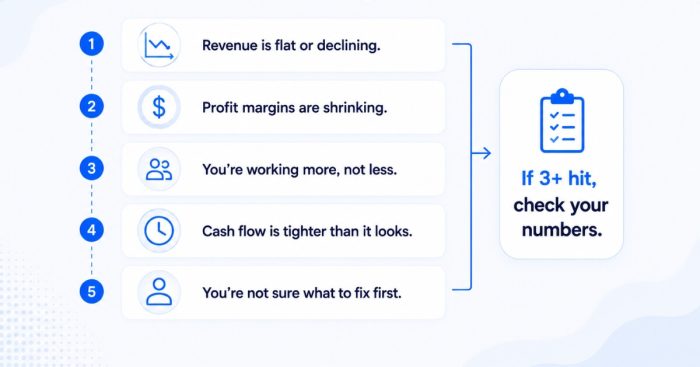
The five men dismiss as personal failings:
- A belly that won’t budge
- A 2 PM energy crash
- Foggy focus
- Low drive
- Poor sleep
With the line:
“If 3 or more hit, check your numbers.”
These symptoms work in an ad because every one of them is something a man currently blames on himself.
He thinks:
- The belly is discipline.
- The crash is needing more coffee.
- The fog is age.
- The low drive is stress.
- The bad sleep is just how it is.
Naming them as a cluster — and tying them to “your numbers” rather than your character — is the reframe that opens the door.
“Not lazy. Low.” does more persuasion in three words than a paragraph of clinical copy.
The checklist format also primes the quiz.
When the ad says “if 3 or more hit, check your numbers,” the man is already mentally counting.
The natural next action is to take the quiz that finishes the count.
The symptoms are the hook and the bridge at the same time.
Why use a quiz instead of a “book a consult” call-to-action?
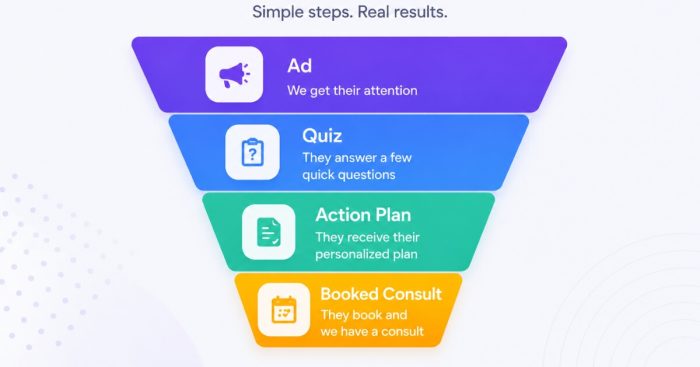
Because a 60-second quiz with results “in under a minute” asks for almost nothing, while a consult asks a man to admit he needs help and give up his time — a far higher bar he is not ready for.
The quiz is the lowest-friction commitment you can offer.
It promises:
- A fast answer
- A private answer
- No salesperson
- No appointment
“Stop guessing — the quiz flags common male hormone and metabolic issues and what to do next” gives him a reason to engage that costs him nothing.
By the time he finishes, he has:
- Self-identified his symptoms.
- Received an action plan.
- Warmed himself up for the next step.
That next step is where the booking happens — but it happens after the quiz has done the qualifying and the priming, not before.
The quiz turns a cold viewer into a self-aware, semi-committed lead, which is a far better person to put in front of a booking page than someone you asked to “book a consult” off a cold ad.
What do proven men’s hormone quiz ad scripts actually look like?
Here are three of the six proven 60-second scripts — each built on the same formula, wrapped in a different identity.
Script 1 — “CEO at Work, Rookie in the Mirror.”
Hook:
“Men 35+: Running the office, but not your waistline?”
Meat:
“If the belly won’t budge and energy tanks by 2 PM, it might be hormones or metabolism — not willpower.”
CTA:
“Take the 60-second Men’s Hormone & Metabolism Quiz. Get your action plan.”
Style:
Direct-to-camera, office-to-gym cut.
Script 4 — “5 Signs Men Ignore.”
Hook:
“5 signs your hormones aren’t pulling their weight:”
Meat:
- Belly won’t budge
- 2 PM crash
- Foggy focus
- Low drive
- Crappy sleep
“If 3+ hit, check your numbers.”
CTA:
“Quiz first. Then fix the right thing.”
Style:
Checklist with finger-count overlay.
Story 1 — “The Exec Dad.”
Hook:
“Men 35+: Running the office… but your belt won’t?”
Story:
“Mark, 41. Promotions up, energy down. By 2 PM he’s on coffee number three, snapping at the kids by dinner. He thought it was willpower — turns out it was hormones and metabolism.”
CTA:
“Take the 60-second Men’s Hormone & Metabolism Quiz. Get your plan.”
The pattern across all six is identical:
- Name the man.
- Name the symptoms.
- Reframe willpower as numbers.
- Send him to the 60-second quiz.
Swap the identity, keep the structure.
How do you turn the quiz into booked TRT patients?
By using the quiz result as the bridge — deliver a personalized action plan, then route the most symptomatic men into a consult or membership while the rest stay nurtured.
The quiz is not the finish line.
It is the qualifier.
A man who flags three or more symptoms and receives an action plan is primed to book.
The result page should carry him straight into the next step with a clear, low-friction path.
Men’s hormone patients are:
- High-LTV
- Recurring once they start
So the quiz-to-consult-to-membership path is what turns a 60-second ad interaction into years of retained revenue — the same recurring-membership engine behind an HRT clinic we grew from $1M to $4M a year on memberships.
The quiz also feeds the rest of your funnel.
Every man who takes it is now:
- A known lead
- A lead with self-reported symptoms
That makes follow-up far more targeted than a generic email list.
That qualified, quiz-warmed lead flow is exactly the kind of engine that drove multi-channel growth at a clinic where we added $6.7M in revenue in one year across 3,727 new patients.
FAQ’s About Men’s Hormone Quiz Ads
What should a men’s hormone (low-T) ad actually say?
Call out the man’s identity and life stage, name the symptoms he blames on willpower:
- Belly won’t budge
- 2 PM crash
- Foggy focus
- Low drive
- Poor sleep
Reframe them as a hormone or metabolism issue, and send him to a 60-second quiz instead of a consult.
The ad’s job is to make him feel seen, not to sell a treatment.
Why does an identity callout work better than a generic hormone ad?
Because men scroll past “Low Testosterone Treatment” but stop on an ad that describes their exact life:
- The exec
- The stalled lifter
- The pilot
- The shift worker
The callout makes the man recognize himself in the first two seconds, before any treatment is mentioned, which is what keeps him watching.
Why use a quiz instead of asking men to book a consult?
Because a 60-second quiz asks for almost nothing — a fast, private answer with no salesperson — while a consult asks a man to admit he needs help and give up his time.
The quiz qualifies and primes him, so the booking conversation happens with a warm, self-aware lead instead of a cold one.
What symptoms should the ad list?
The five men dismiss as personal failings:
- A belly that won’t budge
- A 2 PM energy crash
- Foggy focus
- Low drive
- Poor sleep
With the line:
“if 3 or more hit, check your numbers.”
Tying the cluster to “your numbers” rather than character is the reframe that opens the door.
How do I turn quiz takers into TRT patients?
Use the quiz result as the bridge:
- Deliver a personalized action plan.
- Route the most symptomatic men straight into a consult or membership.
- Keep the rest nurtured.
Because men’s hormone patients are high-LTV and recurring, the quiz-to-consult-to-membership path turns a 60-second ad into years of revenue.
What’s the next step?
If your men’s hormone ads are not converting, the problem is almost always the message, not the budget.
Stop selling “testosterone therapy” and start calling out:
- His identity
- His symptoms
- His frustration
Then send him to a 60-second quiz instead of a consult.
Wrap the same formula in:
- The exec
- The lifter
- The pilot
- The shift worker
And let each version win its own audience.
If you want someone to build your men’s hormone quiz funnel — the ad scripts, the quiz, the result page, and the path to a booked TRT membership — that is the conversation to book.
We will map the full funnel from hook to recurring patient on the call.