
How Does a Cash-Pay Practice Break Past the $50K–$200K-a-Month Plateau? (Profitability, Channel Diversification, and the EBITDA That Sells)
Most cash-pay clinics live in a specific band: between $50,000 and $200,000 a month.
The owner has usually already stepped out of seeing patients and out of the day-to-day, and now the goal is different — make it more profitable, hit a profit number, or get the practice to an EBITDA mark that makes a sale possible.
The levers that get a clinic to this band are not the levers that get it past it.
Here is the FAQ on breaking through the $50K–$200K-a-month plateau by shifting from chasing revenue to building profitability, diversifying patient acquisition, and developing affiliate relationships that make growth less fragile.
How does a cash-pay practice break past the $50K–$200K-a-month plateau?
By changing the goal from more revenue to more durable profit — running leaner, diversifying how patients are acquired, and building affiliate relationships so the practice is no longer dependent on a single channel.
At this stage, growth is not about turning up the ad spend.
It is about making the existing business perform better and depend on fewer fragile inputs.
That means:
- Tightening operations so more of every dollar drops to the bottom line.
- Spreading patient acquisition across multiple channels so no single platform can throttle your growth.
- Forming partnerships that bring patients in independent of paid ads entirely.
The shift in mindset is the whole game:
- Stop working in the business.
- Start working on it.
The clinics that break the plateau are the ones whose owners treat the practice as an asset to be made leaner and more valuable, not a job to be worked harder.
Why do most cash-pay clinics get stuck between $50K and $200K a month?
Because the moves that got them there — the owner’s personal effort and one or two reliable acquisition channels — are exactly the moves that cannot take them further.
A clinic reaches this band on:
- Hustle
- A working acquisition channel
But by the time the owner has stepped out of seeing patients and out of daily operations, the next constraint is structural, not effort-based.
The business is:
- Profitable enough to feel comfortable.
- Dependent enough on its current setup to feel stuck.
More of the same produces more of the same plateau.
Breaking through requires deliberately working on the things that do not feel urgent:
- Margin
- Channel risk
- Partnerships
Those are the levers that compound quietly, and they are the ones most owners postpone because the practice is “doing fine.”
Doing fine is precisely what the plateau feels like.
Why does profitability matter more than revenue at this stage?
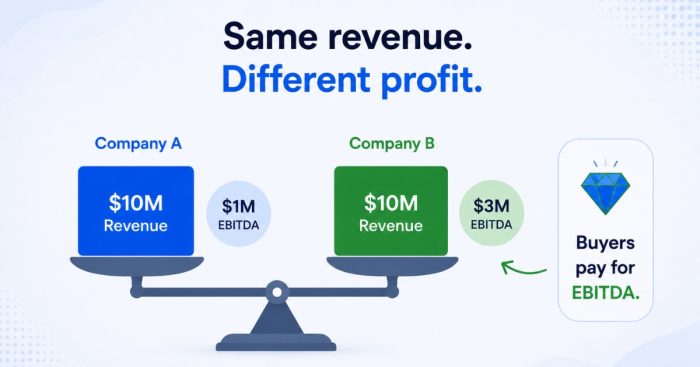
Because past the plateau the goal is usually a profit target or an exit — and both are measured in EBITDA, not top-line revenue.
Two clinics with identical revenue can be worth wildly different amounts depending on how much of that revenue becomes profit.
An owner who wants to take more money home, or who is eyeing a sale in the next few years, has to hit an EBITDA mark.
That comes from:
- Running leaner
- Making the operation perform better
- Protecting margin
Not from adding gross revenue that leaks out as cost.
Revenue is vanity at this stage.
Profit is the number that actually changes the owner’s life.
This is why the work shifts inward.
You:
- Audit where margin is lost.
- Make the team and the systems run more efficiently.
- Let the bottom line — not the top line — be the scoreboard.
We have watched this efficiency-and-structure work pay off at an HRT clinic we grew from $1M to $4M a year while removing both owner-operators from the day-to-day, where the durable, ownerless profitability is what made the growth worth having.
How do you diversify patient acquisition so you’re not dependent on one channel?
By deliberately running more than one acquisition channel, so that if any single platform’s cost, policy, or performance changes, your patient flow does not collapse.
Most plateaued clinics are quietly dependent on one channel that has been working — and that dependence is a hidden risk.
An ad account gets restricted.
A platform’s costs climb.
An algorithm shifts.
Overnight, the practice’s only reliable source of patients dries up.
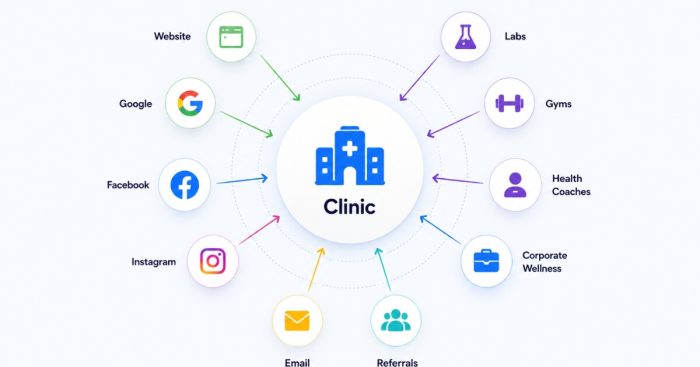
Diversifying acquisition spreads that risk across:
- Paid social
- Search
- SEO
- Referrals
- Events
Each behaves differently, so a problem in one does not become a crisis for the whole business.
The point is not to run every channel at once.
It is to not be hostage to one.
A multi-channel acquisition base is what lets a clinic keep growing through platform turbulence instead of stalling every time one source wobbles.
That diversified engine is exactly what drove a weight-loss and medspa clinic where we added $6.7M in revenue in one year across 3,727 new patients — multiple channels feeding the same practice, so no single one could cap the growth.
What are affiliate relationships, and why do they de-risk growth?
Affiliate relationships are partnerships — other businesses, providers, or influencers — that send you patients independent of any ad platform, which makes your growth less dependent on paid channels you do not control.
When patient flow comes only from advertising, you are renting your growth from platforms that can change the terms at any time.
Affiliate relationships are different:
- A referral partner
- A complementary provider
- A community relationship
Each brings patients through a door that no algorithm controls.
The more of your acquisition that comes from relationships you own, the less fragile your business is.
This is the lever most clinics ignore at the plateau because it is slower to build than turning up ad spend.
But it is durable in a way paid traffic never is.
Developing affiliate relationships diversifies your acquisition away from rented attention and toward owned relationships — which is exactly what makes a practice both more stable and more valuable to a future buyer.
How does breaking the plateau prepare the practice for a profitable exit?
Because the same work that breaks the plateau — leaner operations, diversified acquisition, owned affiliate relationships — is precisely what a buyer is paying for.
A buyer is not buying this month’s revenue.
They are buying:
- Continuity
- Predictability
A practice that runs lean, acquires patients from multiple channels, and has affiliate relationships that survive the owner’s departure is a business, not a job with a logo.
That is the practice that hits a strong EBITDA mark and commands a premium multiple when it sells.
So the plateau work and the exit work are the same work.
You make the practice:
- More profitable
- Less dependent on the owner
- Less dependent on any single channel
And in doing so you simultaneously break through the plateau and build the asset that sells.
The owners who plan for both at once are the ones who get past $200K a month and out the door on their own terms.
FAQ’s About Breaking the $50K–$200K-a-Month Plateau
Why is my cash-pay clinic stuck around $100K a month?
Usually because the hustle and the one or two channels that got you here can’t take you further.
Once the owner steps out of seeing patients and daily operations, the next constraint is structural:
- Margin
- Channel risk
- Partnerships
Not effort.
More of the same just reproduces the plateau.
Should I focus on revenue or profit to scale past the plateau?
Profit.
Past the plateau the goal is usually a profit target or an exit, and both are measured in EBITDA, not top-line revenue.
Two clinics with the same revenue can be worth very different amounts depending on how much becomes profit, so the work shifts to running leaner.
How do I reduce my clinic’s dependence on one marketing channel?
Deliberately run more than one acquisition channel:
- Paid social
- Search
- SEO
- Referrals
- Events
They behave differently, so a problem in one doesn’t collapse the whole business.
The goal isn’t to run everything at once; it’s to never be hostage to a single platform’s costs or policies.
What is an affiliate relationship for a medical practice?
A partnership with another business, provider, or community source that sends you patients independent of any ad platform.
Because the referral isn’t controlled by an algorithm, it makes your growth less fragile and more durable — and it’s the lever most plateaued clinics ignore because it’s slower to build.
Does breaking the plateau also prepare my practice for sale?
Yes — it’s the same work.
Leaner operations, diversified acquisition, and owned affiliate relationships break the plateau and simultaneously build the predictable, owner-independent business a buyer pays a premium for.
The EBITDA you build to grow is the EBITDA that sells.
What’s the next step?
If your cash-pay practice is parked somewhere between $50K and $200K a month and more of the same is not moving the needle, the breakthrough is not more ad spend — it is profitability, channel diversification, and affiliate relationships.
Run leaner so more revenue becomes EBITDA.
Spread your acquisition so no single platform can throttle you.
Build referral partnerships that no algorithm controls.
That work breaks the plateau and builds a sellable asset at the same time.
If you want someone to audit your margins, your channel mix, and your partnership opportunities — and map the path past the plateau toward your profit or exit goal — that is the conversation to book.
We will lay out the breakthrough plan on the call.