
Should a Cash-Pay Clinic Charge the Same Price for an MD, NP, or PA Visit? (Why Tiered Provider Pricing Backfires)
Most cash-pay clinics instinctively charge more to see the physician than to see the nurse practitioner or PA. It feels logical — the MD is the senior provider, so the MD visit should cost more.
It is also one of the quietest ways an owner traps themselves in the schedule.
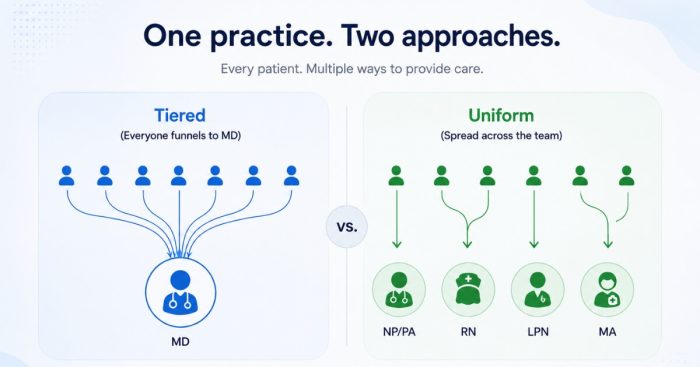
Tiered provider pricing tells the patient that the value is inconsistent and that there is a better option just $100 away — so everyone funnels to the MD, the physician gets busier, and the mid-level provider you hired to create capacity sits underused.
Here is the FAQ on why uniform pricing wins, and how it ties into presenting your membership at the right moment.
Should a Cash-Pay Clinic Charge the Same Price Across All Providers?
Yes — keep consult and membership pricing identical whether the patient sees the MD, the DO, the NP, or the PA.
Uniform pricing is one of the most useful structural lessons a growing clinic can learn.
The reasoning is about where patient volume flows. When every provider costs the same, patients distribute across the team based on availability instead of all chasing the “best” provider.
When the MD costs more, you have signaled that the MD is the superior choice — and a meaningful share of patients will happily pay a little extra to get them, which is the opposite of what you want when you are trying to build capacity.
This is the kind of thing owners only figure out after it has already cost them months of physician bandwidth.
Set pricing flat from the start and you avoid the trap entirely.
Why Does Tiered Provider Pricing Backfire?
Because it tells the patient that value is not consistent across your providers — and that for just a little more money, there is a better choice available.
That single signal does two damaging things.
First, it makes patients prefer the higher-priced provider, so the MD’s schedule fills first and stays full.
Second, it quietly devalues the mid-level provider in the patient’s mind, which makes them harder to keep busy and harder to retain.
You hired the NP or PA to take load off the physician; tiered pricing does the reverse by steering demand straight back to the person you were trying to unburden.
The cleaner the pricing, the less the patient thinks about which provider they are seeing.
When the price is the same, the choice becomes “who is available,” and that is exactly the decision you want patients making.
How Does Uniform Pricing Free the Owner to Scale?
By loading the mid-level provider instead of the physician, uniform pricing creates the owner bandwidth that every other growth move depends on.
The whole point of adding a provider is to take patients off the owner’s plate so the owner can work on the business.
That only happens if patients are willing to see the mid-level — and they are far more willing when seeing the NP or PA does not feel like the “discount” option.
Flat pricing makes the mid-level the default for routine visits, which frees the physician-owner for the high-value work only they can do.
This is the same principle behind removing an owner from day-to-day operations: you cannot scale a person, you scale a structure.
For example, we watched it play out at a regenerative clinic where Dr. Joy Kong hired four additional doctors and scaled herself out of the day-to-day schedule. The structure absorbed the volume so the owner did not have to.
How Should I Present Membership Pricing — and When?
Present the membership after you have established value, not as the opening line — because most clinics get the offer itself right but mispresent it or pitch it too early.
The biggest lever in membership conversion is not the price; it is the presentation of the price and the moment you introduce it.
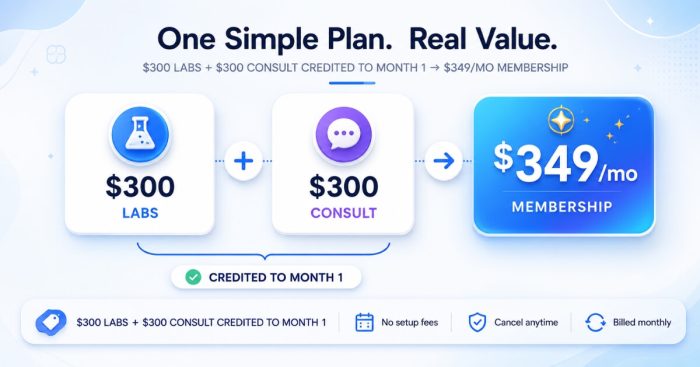
A proven structure charges $300 for labs and $300 for the initial consultation, then prorates that consult cost into the first month of a $349-a-month membership — so the patient feels they are getting a $300 credit back rather than paying twice.
That reframe (“girl math,” as we call it) converts because it turns a sunk fee into a perceived gift.
The sequence matters as much as the numbers.
Walk the patient through the value, let them feel the fit, and only then present the membership as the natural next step with the credit applied.
Lead with the price and you anchor on cost; lead with value and the membership feels like the obvious move.
In fact, the same membership discipline is what built an HRT clinic we grew from $1M to $4M a year on recurring memberships.
How Do I Make a High-Ticket Regenerative Procedure Feel Like a No-Brainer With a Membership?
Attach a member discount to the big procedure — even 5 to 10% off a $5,000 to $6,000 regenerative case is enough to make joining the membership an easy yes.
The math works in your favor.
If a patient is already spending five or six thousand dollars on a regenerative procedure, a 10% member discount is a meaningful, tangible saving that costs you little relative to the recurring membership revenue you gain in exchange.
Even 5% off lands as a no-brainer at that ticket size.
The discount is not the giveaway — the recurring membership it unlocks is the prize.
This is how you convert a one-time, high-ticket procedure patient into an ongoing relationship.
The procedure pays today; the membership pays for years.
Bundling a small procedure discount into membership enrollment is one of the cleanest ways to turn a single regenerative case into durable recurring revenue.
How Did One Clinic Restructure Pricing Into a Membership and Grow?
By converting a pay-per-service model into a low monthly membership — a weight-loss clinic moved from charging about $90 per injection to a $39-a-month membership and built it to roughly 300 members.
The restructure bundled the office visit into the membership and added 15% off weight-loss injections, peptides, and NAD for members.
Instead of nickel-and-diming patients per injection, the clinic gave them a simple monthly price that included the visit and discounted everything else — and patients responded by enrolling in volume.
About 300 members on a recurring plan is a fundamentally more stable business than a stack of one-off injection charges.
That is the throughline across all of this:
Uniform provider pricing, value-first membership presentation, and small procedure discounts all push the same direction — toward recurring revenue and away from transactional, one-off pricing that caps your growth and chains the owner to the schedule.
FAQs About Provider Pricing at a Cash-Pay Clinic
Should I Charge Less for a Nurse Practitioner Visit Than a Doctor Visit?
No — keep the price identical across MD, DO, NP, and PA visits.
Charging less for the mid-level signals that the value is inconsistent and that the MD is the better choice, which steers patients to the physician and overloads the exact provider you’re trying to free.
Why Does Tiered Provider Pricing Hurt My Clinic?
Because it tells patients there’s a better option for just a little more money, so they prefer the higher-priced provider.
That fills the MD’s schedule first, devalues the mid-level in the patient’s mind, and defeats the purpose of hiring a second provider to create capacity.
When Should I Present My Membership to a Patient?
After you’ve established value, never as the opening line.
Most clinics get the offer right but pitch it too early.
Walk the patient through the value first, then present the membership as the natural next step — and prorate the initial consult fee into the first month so it feels like a credit.
How Do I Get a High-Ticket Regenerative Patient to Join a Membership?
Attach a small member discount to the procedure — 5 to 10% off a $5,000 to $6,000 case is enough to make enrolling an easy yes.
The discount is minor relative to the recurring membership revenue it unlocks, and it converts a one-time procedure patient into an ongoing relationship.
Is a Membership Model Better Than Charging Per Service?
Usually, yes.
One weight-loss clinic moved from roughly $90 per injection to a $39-a-month membership that bundled the office visit and added 15% product discounts, and grew to about 300 members.
Recurring memberships create far more stable revenue than a stack of one-off charges.
What’s the Next Step?
If your cash-pay clinic charges more to see the physician than the mid-level, you have quietly built a structure that keeps the owner in the schedule.
Flatten the pricing so patients distribute across the team, present your membership after value rather than before it, prorate the consult into the first month, and attach small member discounts to your high-ticket procedures.
Every one of those moves pushes toward recurring revenue and owner bandwidth.
If you want someone to restructure your pricing and membership presentation with you — and map how to load your mid-levels so you can step back — that is the conversation to book.
We will lay out the pricing structure on the call.