
The 48-Hour Discovery Call Follow-Up Cadence That Closes “Maybe” Patients at a Cash-Pay Medical Practice (And Why “Any Questions?” Loses the Sale)
Most cash-pay clinics give patients a week of space after a discovery call before following up — and watch the motivated patients quietly book somewhere else inside 48 hours. The cleanest discovery-call sales process is faster, sharper, and uses assumptive-close language that does not invite the patient to manufacture logical reasons not to move forward. This is the FAQ on the 48-hour follow-up cadence, the three assumptive closes that replace “do you have any more questions?”, the GoHighLevel pipeline stages that prevent patients from sitting in limbo, and the consult-fee-before-labs policy that stops the provider from working for free.
How fast should a cash-pay medical practice follow up after a discovery call that didn’t close?
48 hours, not a week.
Why Waiting a Week Hurts Conversion
The mistake most cash-pay clinics make is waiting 5–7 days before following up.
Usually, they want to give the patient space to decide.
However, most patients resolve their biggest questions much sooner.
For example, they may need to:
- Find existing lab work
- Talk with a spouse
- Compare providers
- Review finances
If the patient is genuinely motivated, those decisions are typically made within 48 hours.
Wait a week and one of two things usually happens:
- Motivation cools
- Another clinic books the patient first
The Better Window
The 48-hour follow-up catches the patient while the decision is still active.
By that point, they have usually:
- Completed the homework
- Decided to move forward
- Decided not to proceed
As a result, the conversation becomes much clearer.
CRM Implementation
Set a CRM task at booking that automatically triggers 48 hours after every unclosed discovery call.
The same team member who conducted the call should own the follow-up.
From there, the patient moves from:
- Discovery Call Completed
to either:
- Booked Appointment
- Lost
within seven days.
Most importantly, no lead sits in limbo.
Why does “do you have any more questions?” lose the sale on a cash-pay discovery call?
Because it pushes the patient from an emotional state into a logical state right before the close.
Why the Question Backfires
“Do you have any more questions?” is one of the most common closing questions in cash-pay medicine.
Unfortunately, it is also one of the least effective.
The question encourages the patient to start searching for reasons not to move forward.
In many cases, patients who were emotionally ready to begin suddenly start listing concerns they never mentioned earlier in the call.
As a result, momentum disappears.
Replace It With Assumptive Language
Instead of asking:
“Do you have any more questions? Are you ready to get started?”
Ask:
- “Do you want me to send you the next steps to get started?”
- “When do you want to make your appointment?”
Both questions assume the patient is moving forward.
Consequently, the discussion stays focused on logistics rather than hesitation.
The patient who is ready picks a date.
The patient who is not ready surfaces a real objection that can actually be addressed.
What’s the assumptive-close language script for a cash-pay discovery call?
Three assumptive closes, deployed in order of patient readiness.
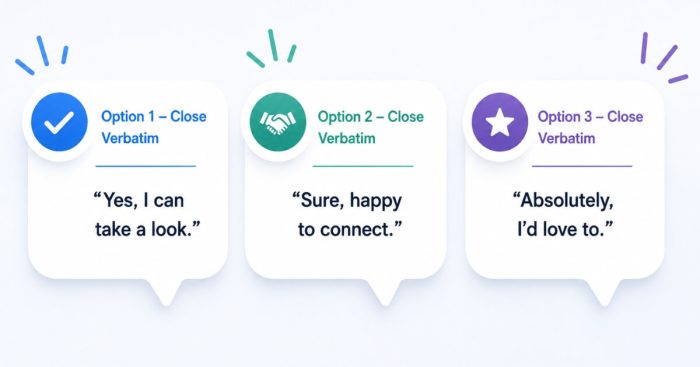
The Mechanics Close
“Do you want me to send you the next steps to get started?”
This is the softest assumptive close.
It assumes forward movement while keeping the commitment small.
The Calendar Close
“When do you want to make your appointment?”
Or:
“Did you see the lab times I sent you? Scheduling labs and making payment is the next step.”
At this stage, the patient is deciding on timing rather than whether to proceed.
The Micro-Commit Close
“Want me to go ahead and order your labs and schedule your initial consult for you?”
This close assumes action immediately.
Therefore, it works best when the patient has already shown strong buying signals.
What Happens When an Objection Appears?
If the patient says:
- “I need to talk to my partner.”
- “I have existing labs I want to send over.”
Handle the objection.
Then return to the assumptive close.
Do not abandon the frame.
The patient should always be brought back to the next step.
As a result, clinics that replace “any questions?” with assumptive closes routinely see first-call close rates increase by 10–25 percentage points within 30 days.
A regenerative medicine clinic we worked with hit a 79.4 percent conversion rate from lead to booked appointment running this assumptive-close discipline.
What pipeline stages should a cash-pay clinic use to track discovery calls in GoHighLevel?
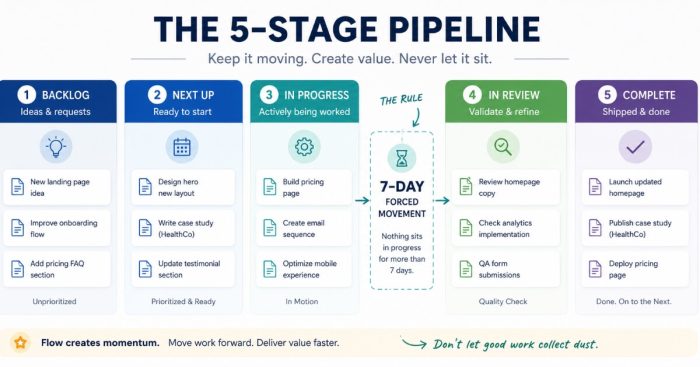
Five stages.
More importantly, every stage should have a movement rule.
Recommended Pipeline Stages
Stage 1 — Inquiry Submitted
The patient filled out a form but has not yet been contacted.
Stage 2 — Discovery Call Scheduled
The consult-prep call is on the calendar.
Stage 3 — Discovery Call Completed
The call happened.
The decision is still pending.
Stage 4 — Booked Appointment
The patient paid the consult fee and secured a provider appointment.
Stage 5 — Lost
The patient declined or stopped responding after follow-up attempts.
The Most Dangerous Stage
Discovery Call Completed is where leads usually get stuck.
Without enforcement, patients can sit there for weeks.
Clinics that implement the 48-hour discovery-call follow-up create a clear timeline for decision-making and prevent qualified prospects from lingering in pipeline limbo.
Therefore, every clinic should have one rule:
A patient must move out of Discovery Call Completed within seven days.
The Seven-Day Rule
Day 2:
- First follow-up attempt
Day 7:
- Final follow-up attempt
After Day 7:
- Move to Lost
- Enter long-term nurture
This prevents pipeline clutter and forces decisions.
Should a cash-pay clinic charge non-member patients a higher follow-up fee to push them into membership?
Yes.
In fact, it is one of the cleanest ways to increase membership conversion.
Why the Math Works
Consider this example:
- Non-member follow-up = $300
- Member follow-up = $150–$250
For a patient who sees the provider quarterly, the difference quickly becomes visible.
The patient starts doing the math.
They realize:
“It’s roughly $1,200 per year either way, but membership includes additional benefits.”
As a result, membership becomes the obvious choice.
The Best Consult Framing
“You can be a patient either way. The membership saves you money because several services are included. Non-member follow-ups are $300 because you’re paying for provider time à la carte. Most patients choose membership once they see the math.”
That framing feels helpful rather than pushy.
Consequently, membership conversion rates often increase by 15–25 percentage points.
An HRT clinic we grew from $1M to $4M in 4 years ran exactly this non-member-versus-member pricing structure across its 250+ active members.
What’s the right policy for patients who order labs but don’t show up to the consult?
Collect the consult fee before ordering labs.
The Problem
Many clinics follow this sequence:
- Patient says they want to move forward.
- Provider orders labs.
- Patient cancels.
- Labs are completed.
- No payment is collected.
Now the clinic has completed work without compensation.
The Fix
Collect the consult fee at booking.
Then order labs.
For example:
- $600 consult fee paid upfront
- Labs ordered after payment clears
This simple policy eliminates most ghosting issues.
The Script
“The next step is scheduling labs and making payment. Once the payment clears, we’ll order the labs for you so they’re ready before your appointment.”
Patients who disappear after hearing that were unlikely to buy anyway.
Meanwhile, patients who pay are demonstrating real commitment.
As a result, provider time is protected and the quality of booked appointments improves.
What’s the next step?
If your clinic is:
- Waiting 5–7 days to follow up
- Asking “Do you have any more questions?”
- Allowing leads to sit in limbo
- Ordering labs before payment clears
then motivated patients are slipping through process gaps that are entirely fixable.
What We Review on the Strategy Call
During the call, we:
- Audit your discovery-call pipeline
- Review current stage movement rules
- Rewrite your closing language
- Install the 48-hour follow-up trigger
- Tighten your consult-fee collection process
- Build a cleaner lead-to-booked workflow
Why These Changes Matter
Most cash-pay clinics that install:
- A 48-hour follow-up cadence
- Assumptive closes
- Structured pipeline stages
- Upfront consult-fee collection
see discovery-to-booked conversion rates increase by 15–30 percentage points within 60 days.
The discovery call is often the highest-leverage 30 minutes in the entire patient acquisition process.
Fortunately, improving it costs very little and typically pays back within the same quarter.