
How Do You Build a Cash-Pay Weight Loss / GLP-1 Patient Pipeline in GoHighLevel? (5-Stage Order-by-Order Tracking + 30-Day Stale Triggers + QR Code Postcards)
Most cash-pay weight loss / GLP-1 clinics manage their patient flow on a color-coded spreadsheet — first appointment scheduled, no-shows in yellow, cancellations in red. That works at 20 patients. It breaks at 200. The Lite Medical pipeline in GoHighLevel replaces the spreadsheet with five order-by-order stages, a 30-day stale-opportunity trigger that auto-creates follow-up tasks, a 1-week / 2-week / 4-week SMS cadence, and QR-code postcards that move the “which spot do I inject?” questions out of the call queue. This is the FAQ on how to build that pipeline, what each stage does, and what the month-4 drop-off retention move actually looks like.
How should a cash-pay weight loss clinic structure its patient pipeline in GoHighLevel?
The pipeline structure
Use:
- Five order-by-order stages
- One inquiry pre-stage
- One maintenance/upsell stage
Pre-Stage
Call Inquired
This is where every new lead enters the pipeline.
Stage 1
First Order Placed / First Visit Attended
The patient has officially started treatment.
Stage 2
Due for Second Order
Patient is approaching refill timing.
Stage 3
Second Order Completed → Due for Third Order
The patient continues moving through the refill cadence.
Stage 4
Third Order Completed → Due for Fourth Order
The patient remains active in the treatment sequence.
Stage 5
Fourth Order Completed → Maintenance or Upsell
Patients transition into:
- Maintenance
- Higher-value programs
- Long-term retention pathways
Why this structure works
Most GLP-1 protocols naturally operate on:
- Four pre-filled syringes
- One weekly injection
- A 28–30 day refill cycle
The pipeline mirrors that real-world cadence.
Automate stage movement
Best practice:
- Automatically move patients after 30 days
- Place them into the next refill stage
- Require a human review of every column
This reduces administrative workload while ensuring no patient falls through the cracks.
Protect against drop-offs
Patients who stop ordering should be managed by:
- Stale-opportunity triggers
- Automated task creation
- Manual patient coordinator follow-up
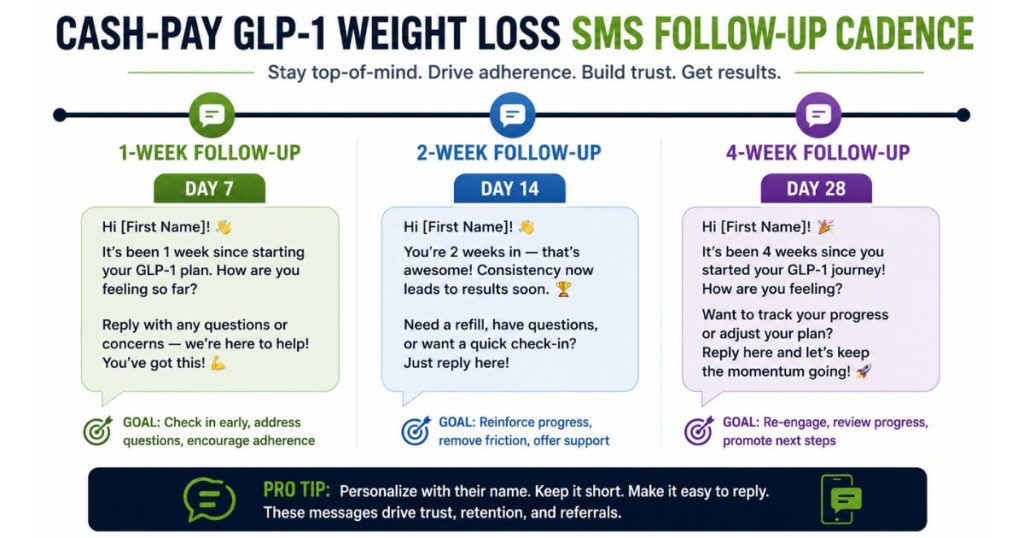
What follow-up SMS cadence should a cash-pay weight loss / GLP-1 clinic run after the first injection?
The ideal cadence
Three touchpoints:
- Week 1
- Week 2
- Week 4
Automated, but personalized enough that patients do not feel like they are reading boilerplate.
Week 1 SMS
The goal is reassurance and support.
Example topics:
- How did the first injection feel?
- Any side effects?
- Any dosing questions?
Week 2 SMS
The goal is early problem detection.
Topics include:
- Progress check-in
- Side-effect management
- Compliance confirmation
Week 4 SMS
The goal is refill scheduling.
Example:
Our records show you may be running low on medication. Would you like priority scheduling for your next refill visit?
Why cadence matters more than copy
Patients who receive:
- Week 1 touchpoint
- Week 2 touchpoint
- Week 4 touchpoint
consistently show lower drop-off rates than patients who only receive a refill reminder.
The hybrid model
The Lite Medical approach:
- Automated Week 1
- Automated Week 2
- Human-assisted Week 4
The Week 4 message generates stronger response rates because patients often want personalized guidance as they make ongoing body-composition decisions.
What’s the 30-day stale opportunity trigger for a cash-pay weight loss clinic?
What it is
A GoHighLevel automation that activates when a patient remains in the same pipeline stage for 30 days without movement.
What happens next?
The automation:
- Creates a task
- Assigns it to the Patient Coordinator
- Triggers manual outreach
The coordinator can:
- Call
- Text
depending on the patient’s communication preferences.
Why it’s important
Patients who disappear for 30 days are at high risk of leaving the program entirely.
Without intervention:
- Retention declines
- Revenue becomes unpredictable
- Patients lose momentum
Why it matters at every stage
Many clinics only monitor early-stage patients.
That’s a mistake.
The stale trigger should exist across the entire pipeline because retention drop-off frequently occurs around month four.
This is one of the most important components of building a GLP-1 pipeline in GoHighLevel because it ensures patients don’t silently disappear between refill cycles. Automated stage monitoring combined with task creation gives the clinic a predictable system for identifying at-risk patients before they become churned patients.
The common scenario
A patient completes:
- Order 1
- Order 2
- Order 3
- Order 4
Then goes silent.
Often they are not quitting.
They’re simply unsure:
- How maintenance works
- Whether they should continue
- What happens next
A single follow-up call often reactivates the relationship.
How do QR code dosing postcards reduce front-desk load at a cash-pay weight loss clinic?
The problem
Patients repeatedly call with questions like:
- Which injection site should I use?
- How do I place a refill order?
- Where do I find dosing instructions?
The solution
Include a postcard in every medication shipment.
QR Code #1
Links to:
- Injection instructions
- Dosing videos
- Administration walkthroughs
QR Code #2
Links directly to:
- Refill ordering
- Appointment scheduling
Why it works
Patients can self-serve at home.
The result:
- Fewer phone calls
- Fewer repetitive questions
- Less front-desk workload
Real-world example
NuLevel Wellness, the medspa where we added $6.7M in revenue across 3,727 new patients in one year, ships medication from its processing center with QR-code postcards included in every shipment.
Eternity Health Partners uses a similar system with:
- Dosing videos
- Welcome content
- Lab-result explainers
ROI of the system
The postcards cost pennies.
The videos are filmed once.
The reduction in support volume typically pays for the system within the first month.
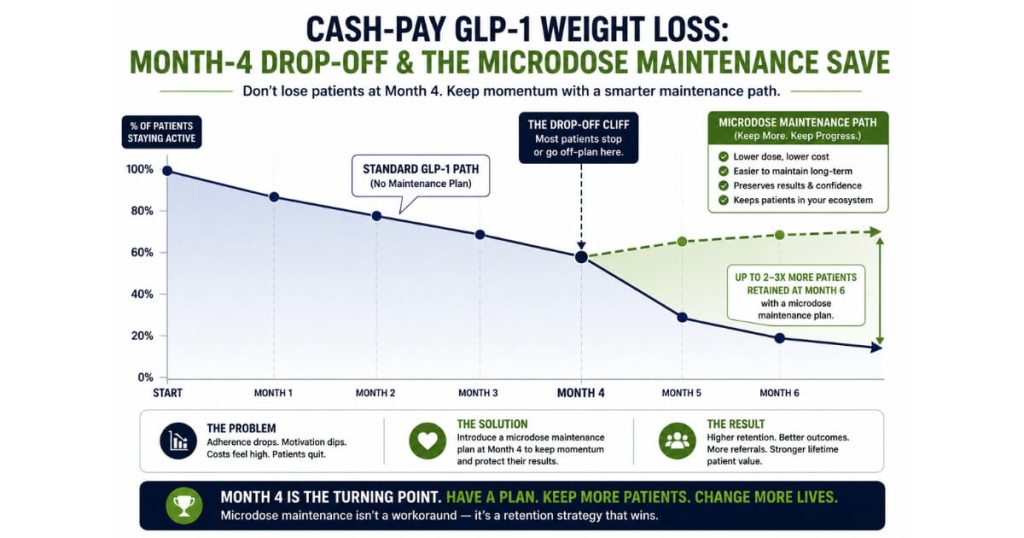
Where do most cash-pay weight loss patients drop off — and what do you do about it?
The drop-off point
Month four.
Most patients leave after:
- Their fourth refill
- Their initial weight-loss goal
- A plateau
- Budget fatigue
Why patients leave
Typically because:
- They think the program is finished
- They don’t understand maintenance
- They don’t see a next step
The retention move
Introduce maintenance before they leave.
Not after.
The maintenance offer
A lower-cost microdose maintenance program.
Benefits include:
- Lower monthly cost
- Ongoing support
- Reduced weight regain risk
- Better retention
Where to introduce it
Mention maintenance through:
- Monthly newsletters
- Week 1 / 2 / 4 SMS messages
- In-person visits
What happens when clinics wait too long?
Patients leave.
Many never return.
What happens when clinics introduce maintenance early?
A meaningful percentage stay enrolled long-term.
Lite Medical has more than 20 patients who have remained on maintenance since the clinic’s earliest days because this conversation happened before they were ready to leave.
Should a cash-pay weight loss clinic offer a membership in addition to per-visit ordering?
Yes.
But the value must be easy for patients to understand.
Example membership model
Lite Medical offers:
- $199/month membership
- 50% off medication pricing
Who benefits most?
Patients on:
- Higher doses
- Longer treatment timelines
These patients see immediate financial value.
Administrative requirements
The membership should include:
- Card-on-file authorization
- Signed membership agreement
- Clear recurring-billing language
Why this matters
One of the most common cancellation disputes is:
“I didn’t realize my card would be charged every month.”
Transparency prevents future friction.
Membership improves forecasting
Membership patients:
- Refill consistently
- Follow predictable timelines
- Stay aligned with the pipeline
Non-members often:
- Stretch 4-week supplies into 5–6 weeks
- Delay visits
- Create forecasting challenges
Real-world example
An HRT clinic we grew from $1M to $4M in 4 years used the same membership-plus-card-on-file model across more than 250 active members to improve retention and reduce cancellation friction.
What’s the next step?
If your cash-pay weight loss clinic is still managing GLP-1 patients with:
- Color-coded spreadsheets
- Manual refill tracking
- No stale-opportunity triggers
- No SMS nurture sequence
the system above should be your next 60–90 days of operational work.
What happens during a strategy call?
We will:
- Audit your current GoHighLevel pipeline
- Replace spreadsheet tracking if needed
- Build the five-stage refill pipeline
- Configure the 30-day stale trigger
- Create the 1-week / 2-week / 4-week SMS sequences
- Customize messaging to match your provider’s voice
- Deliver the QR-code postcard framework
Expected implementation timeline
The Lite Medical implementation required approximately:
- 90 days from planning to launch
- Measurable retention improvements within the first quarter
The earlier the system is installed, the faster patient retention begins compounding.