
How Should a Cash-Pay Medical Practice Email Its Patient List? (Deliverability Stack, “Boxer Not Jiu Jitsu” Nurture Cadence, and the Story Rule)
Most cash-pay medical practices are sitting on five-figure monthly reactivation revenue inside a patient list they never email. The list is qualified. The marginal cost of email is near zero.
Usually, the blocker comes down to one of three issues: the deliverability stack is broken, the cadence is inconsistent, or the writing voice is wrong.
This FAQ breaks down how to run a cash-pay clinic’s email list correctly. On the back end, that means Mailgun, GoHighLevel, and properly configured DNS records. On the front end, it means weekly emails, story-driven content, and a nurture-first approach that keeps patients engaged for years.
How should a cash-pay medical practice email its patient list?
Weekly, story-first, mostly nurture and rarely a hard ask — and only after the deliverability stack is set up correctly so the emails actually reach the inbox.
The Core Framework
For most cash-pay clinics, the formula is simple:
- One email per week
- 80% nurture content
- 20% offer-driven content
- Story-first writing style
What Goes Into Nurture Emails?
Nurture content typically includes:
- Clinical education
- Behind-the-scenes clinic updates
- Patient stories
- Practical health tips
- Provider insights
Meanwhile, offer emails can promote:
- Paid testing consults
- Membership renewals
- Seasonal programs
- Limited enrollment opportunities
How Should the Emails Sound?
Write the way the provider would speak on a podcast.
Use first-person language.
Lead with a story.
Then transition into the takeaway.
As a result, the content feels personal rather than promotional.
Why Consistency Matters
The cash-pay clinics that pull recurring revenue from email are usually the ones that have maintained a weekly cadence for at least six months.
By contrast, clinics that only email when they need business train their audience to ignore them.
Consequently, the reactivation revenue remains trapped inside a dormant list.
What email deliverability stack does a cash-pay clinic actually need?
Three pieces.
Piece #1: The Sending Service
A sending service.
Mailgun is the workhorse.
In addition, the $80/month priority support tier is often worth the investment because of the live chat support when authentication issues arise.
Piece #2: DNS Authentication
A domain provider with correctly configured DNS records.
This includes:
- SPF
- DKIM
- DMARC
Without those records, spam filters become far more aggressive.
Piece #3: The CRM
A CRM stores the patient list and triggers the sends.
GoHighLevel is common among cash-pay clinics.
However, any modern CRM can work.
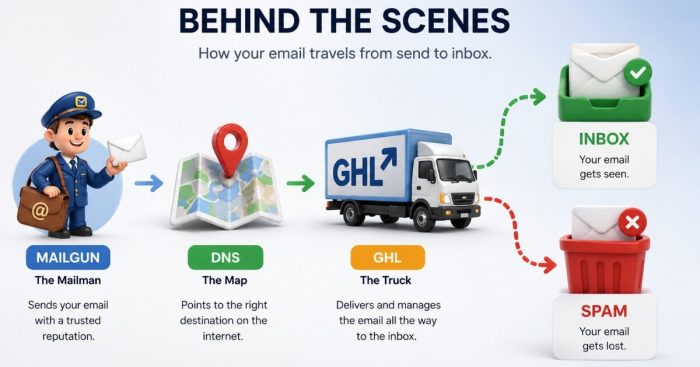
Think of It Like This
- Mailgun is the mailman.
- DNS records are the map.
- The CRM is the truck.
Remove any one of those pieces and deliverability suffers.
Most clinics underestimate this layer because patients never see it.
However, a 10% increase in inbox placement is often worth more than a 50% increase in send volume.
What’s the right email frequency for a cash-pay medical practice’s patient list?
Once a week. Not three times a week and not once a month.
Why Weekly Works
Weekly emails keep the clinic top of mind.
At the same time, they avoid overwhelming the patient.
As a result, the audience stays engaged without feeling bombarded.
The Content Production Process
Most clinics should batch content.
A simple workflow looks like this:
- Outline ten topics.
- Draft one story for each topic.
- Schedule the emails inside the CRM.
- Review and repeat quarterly.
ChatGPT can assist with drafting if the provider supplies several previous emails as voice examples.
The Biggest Mistake
Avoid the empty-week trap.
For example:
- Email for three consecutive weeks.
- Disappear for a month.
- Return with a sales offer.
That pattern trains subscribers to ignore future messages.
Instead, consistency is what compounds.
Over six months, weekly emails to a 2,000-patient list can uncover significant reactivation revenue that previously went unnoticed.
How does a cash-pay clinic write email content that the patient actually reads?
Two rules.
Rule #1: Facts Tell, Stories Sell
Lead every email with a story.
For example:
“2 + 2 = 4” is a fact.
However:
“I had two eggs left, needed four for the omelet, walked next door, asked my neighbor for two eggs, now I have four.”
That creates a picture.
The same principle applies to medical content.
Start with a patient story before explaining the treatment.
Rule #2: Write the Way You Talk
Personality wins.
The provider’s voice consistently outperforms polished marketing copy.
Specifically, it improves:
- Open rates
- Click rates
- Reply rates
- Eventual bookings
Ultimately, patients trust people more than brands.
Therefore, the provider’s personality becomes the trust signal.
What’s the “boxer not jiu jitsu” nurture frame for email marketing at a cash-pay clinic?
Most marketers write like jiu jitsu fighters.
Every move serves the submission.
Every email moves toward a sale.
Eventually, patients notice.
As a result, engagement drops.
The Jiu Jitsu Approach
Every email:
- Builds toward a close
- Pushes for a booking
- Moves the reader toward a transaction
The audience feels the pressure.
The Boxer Approach
A boxer throws jabs all night.
The goal is not the knockout.
The goal is to stay present.
The knockout happens later.
Applying the Concept to Email
For cash-pay clinics, the rule is simple:
- Always nurture
- Always educate
- Always provide value
- Rarely ask
Then, when the patient needs help, the clinic is already the obvious choice.
Authority compounds quietly.
Trust compounds quietly.
Eventually, the booking happens naturally.
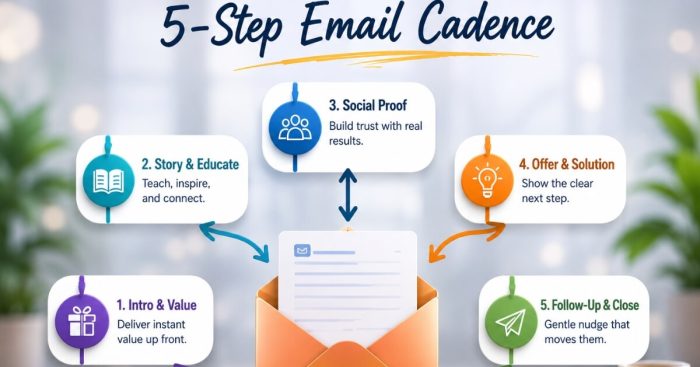
An HRT clinic we grew from $1M to $4M in 4 years ran a weekly nurture cadence to its 2,000+ patient list across the entire arc — and the list became the second-largest source of reactivation and referral revenue behind SEO.
How much recurring revenue can a cash-pay clinic pull out of its email list?
More than the clinic expects, and almost certainly more than the clinic is pulling today.
The Opportunity Most Clinics Miss
Many cash-pay clinics have between 1,000 and 5,000 patient records.
Yet they rarely communicate with those patients consistently.
Consequently, large amounts of revenue remain dormant.
The reason email marketing your patient list is so effective is that these contacts already know the practice, have existing trust in the providers, and require far less persuasion than a cold lead. In many cases, the fastest revenue growth opportunity is not acquiring new patients but reactivating relationships that already exist inside the database.
Example: A 2,000-Patient List
Consider the following scenario:
- 2,000 patients
- 30% open rate
- 3% reply or click rate
- 30% conversion rate from reply to booked follow-up
Under those assumptions:
- Approximately 18 patients reactivate
- Revenue per patient ranges from $1,500–$3,000
- One email can generate $27K–$54K
The Annual Impact
Run that play once per quarter on top of weekly nurture emails.
The result:
- $100K–$200K in annual incremental revenue
- Near-zero marginal cost
- Existing audience
Most clinics have never calculated the opportunity.
A regenerative medicine clinic we worked with hit $309,590 in cash-pay revenue in 10 months from SEO alone, with zero ad spend — and the email-to-list reactivation layer behind that traffic added another tier on top.
What’s the next step?
If you run a cash-pay medical practice and have a patient list of 1,000 records or more that has not received an email in the last 30 days, there is a strong chance that list is producing zero revenue today.
However, it could be producing five figures per month.
Step One: Audit the Infrastructure
Start by reviewing:
- Sending service
- DNS configuration
- CRM logic
- Segmentation
- Open rates
Step Two: Build the First 12 Weeks
Next, create a 12-week email roadmap.
Focus on:
- Stories
- Education
- Provider insights
- Strategic offers
Step Three: Fix the Bottleneck
Email is one of the highest-leverage channels available to a cash-pay clinic.
However, it only works when:
- Deliverability is healthy
- Cadence is consistent
- Voice is authentic
The strategy call identifies which of those three areas needs attention first.