
How Do the Most Profitable Anti-Aging Clinics Scale Without Paid Ads? (Why 27 of Our Top 30 Run Zero Ad Spend)
Most cash-pay clinic owners assume that scaling an anti-aging, hormone, or longevity practice requires a bigger ad budget. The pattern in our actual book of business is the opposite. 27 of our top 30 anti-aging clinics have not spent a single dollar on paid ads in the last 12 months. All 30 do over $1M a year. Half do over $4M a year. Four are on track to sell this year for life-changing amounts. This is the FAQ on what they do instead — and how an anti-aging clinic moves from ad-dependent to ad-free over 12 to 24 months without a revenue collapse.
Do the most profitable anti-aging and hormone clinics actually run paid ads?
No. 27 of our top 30 anti-aging and hormone clinic clients have not spent a single dollar on paid ads in the last 12 months.
All 30 do over $1M a year in revenue.
Half do over $4M a year.
Four are on track to sell this year for life-changing amounts.
The pattern is consistent across:
- HRT
- TRT
- longevity
- functional medicine
Once a cash-pay anti-aging clinic has its system in place, paid ads become a margin drag, not a growth lever.
Paid ads still have a role at the very beginning, or when launching a brand-new offer in a market where the audience does not know you yet — but they are not what scales the most profitable clinics in this category from $1M to $4M.
What scales them is:
- owned audience
- recurring revenue from memberships
- organic search ranking on condition-level questions
- a front-desk operation that converts the leads they already have
If they don’t run ads, how do top anti-aging clinics get new patients?
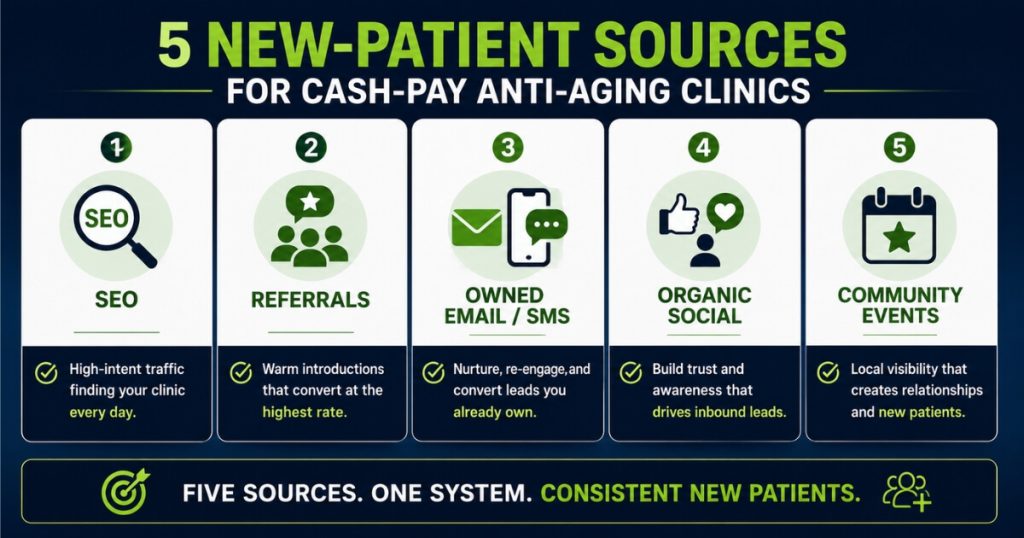
Five sources, ranked by how much new revenue each one produces at a mature cash-pay anti-aging clinic:
- SEO-driven organic search
- patient referrals from existing memberships
- owned-audience email and SMS
- organic social content the provider personally films
- community events
SEO-driven organic search
SEO is the lead horse for the anti-aging category because the buyer is Product Aware — they type “TRT clinic near me” or “bioidentical hormone replacement [city]” and choose the clinic that shows up across blog content, GMB, and review signals at the same time.
The FAQ-format condition pages do the heavy lifting; the Google My Business profile with weekly posts and a steady stream of reviews mentioning the specific treatments closes the loop.
Patient referrals from existing memberships
Referrals are the second-largest source at a mature clinic because the membership model creates a long enough patient relationship that the patient actually has time to refer someone.
Owned-audience email and SMS
Email and SMS to the owned list is where the reactivation revenue lives — most anti-aging clinics are sitting on five-figure-monthly revenue inside their own dormant list and never touch it.
Organic social content the provider personally films
Organic social is slow but produces the highest-quality lead because the prospect arrives already trusting the provider.
Community events
Events at gyms, marathons, Pilates studios, and runners’ clubs work especially well for hormone and longevity because the audience self-selects as active and motivated.
An HRT clinic we grew from $1M to $4M in 4 years runs on this stack — SEO traffic moved from 80 visitors a month to over 1,000, the clinic books 60 new patient inbound calls a month, and $1.7M a year in memberships comes from SEO alone, with zero paid spend.
The retention engine compounds because the membership model means every new patient is worth multiples of their first visit.
What revenue level should an anti-aging clinic be at before it turns paid ads off?
Most anti-aging clinics can turn paid ads off the day their organic and referral lead flow can fill the next 60 days of new-patient capacity without ads — typically when monthly revenue crosses $80K to $150K and the membership base passes roughly 150 active members.
Below that, the clinic still needs ads to:
- seed the funnel
- build a list
- prove the offer works
Above it, ads usually start to drag on margin because:
- the leads they produce are colder
- the front desk has to chase them harder
- the membership conversion rate from cold paid traffic is lower than the membership conversion rate from organic and referred traffic
The math gets worse as the clinic grows, not better.
At $80K a month:
- a $30 cost per lead is acceptable
At $300K a month:
- the same $30 lead is competing for front-desk attention with five inbound referrals a day that convert at three times the rate
The right move is not to turn ads off overnight.
It is to deliberately rebalance, moving spend out of paid acquisition and into:
- content production
- SEO
- owned-audience nurture
- front-desk operations
until paid spend can come off entirely without the new-patient count slipping.
The clinics that pull this off cross that threshold somewhere between $1M and $2M of annual revenue, and never come back.
What does the anti-aging clinic that’s about to sell for life-changing money actually look like?
It looks like a system, not a job.
Of the 30 anti-aging and hormone clinics on this list, 4 are on track to sell this year for life-changing amounts — and the things they share are not glamorous.
Owner is removed from the daily clinical schedule.
The four operational roles are filled and reporting on weekly numbers:
- Office Manager
- Patient Coordinator
- Marketing Lead
- Clinical Director
The membership base is large enough that revenue does not depend on:
- ad spend
- any individual provider’s calendar
Patient retention metrics have been holding steady or improving for at least 12 months:
- average tenure
- monthly churn
- average revenue per patient
SEO traffic and GMB review count are growing month over month from the work done 12 to 24 months earlier.
The buyer is not buying revenue.
The buyer is buying continuity — and continuity is what zero-ads, system-run cash-pay anti-aging clinics are made of.
The clinics that depend on ad spend to hit revenue numbers do not sell at the same multiple, because their revenue evaporates the day the buyer touches the ad budget.
Same revenue. providers. and same town.
Different sale price.
Which paid ad scripts and offers do still work for anti-aging clinics that want to use ads at all?
The ad creative that converts for anti-aging is the creative that punctures the assumption that ads are required in the first place.
The hooks that produce the lowest cost-per-acquisition for cash-pay anti-aging clinics open with a contrarian frame.
Examples:
- “The hormone clinics making the most money in 2025 aren’t running ads.”
- “The clinics growing fastest? They’re spending $0 on ads.”
- “What the most profitable clinics are doing — hint, not ads.”
Then they back the frame with a specific number:
- 27 of 30
- $1M floor
- $4M ceiling
- life-changing exits
And they hand over a free playbook, not a free consult.
The conversion event is a lead-magnet download, not a discovery call, because Problem Aware anti-aging clinic owners do not book a strategy call cold.
They opt in to read first.
Inside the playbook is the SEO-membership-retention system; on the back of the playbook is the call invitation.
The conservative talk radio variation of the same script works for the Low-T-eligible male audience that does not respond to social platforms.
The TikTok variation works for the women’s hormone and longevity audience that consumes most of its medical content on short-form video.
The script is the same — only the platform shifts.
How long does it take to move an anti-aging clinic from paid-ads-dependent to ad-free?
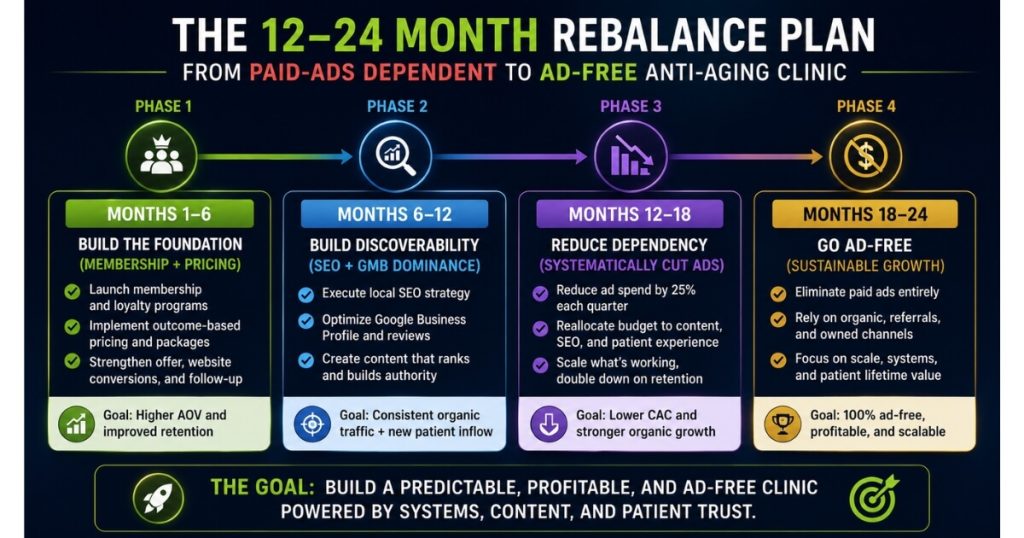
Twelve to twenty-four months, depending on starting list size, SEO content depth at month zero, and whether a membership model is already in place.
The path is sequential, not parallel.
Months 1 to 6
From months 1 to 6 — install the membership model if it is not already in place, raise prices on the consult and the first month so first-touch revenue funds the next 90 days of content production, and document every recurring decision the owner makes so the team can run without them.
Months 6 to 12
Then in months 6 to 12 — ship 30 to 50 FAQ-style condition pages and treatment pages, optimize Google My Business, and build the review and reactivation engine.
Months 12 to 18
Now, in months 12 to 18 — rebalance ad spend down by 25 percent every quarter, replacing the lost lead volume with SEO and referral lead volume that compounds at zero marginal cost.
Months 18 to 24
Finally, months 18 to 24 — paid ads come off entirely; the clinic runs on owned audience, organic search, and patient referrals.
The clinics that try to skip months 1 to 6 — turn ads off before the membership model is in place and the operations are documented — see a revenue collapse within 90 days.
The order is the playbook.
Compress it and the system breaks.
A regenerative medicine clinic we worked with generated $309,590 in cash-pay revenue in 10 months from SEO alone, with zero ad spend — same playbook, different vertical, identical sequencing.
What’s the next step?
If you run a cash-pay anti-aging, hormone, or longevity clinic and you have been wondering whether you really need to keep spending on ads to grow, the answer is in your membership base, your SEO content depth, and your front-desk conversion rate — not in the ad account.
Book a strategy call.
We will pull the membership-conversion math, the SEO content gap, the front-desk leakage rate, and the 12-to-24-month rebalance plan for your specific clinic on the call.
The 27 of 30 clinics on this list did not get there by guessing at it — they had a sequenced plan, a written playbook, and somebody who held them to the order.
If that is what is missing for your clinic, that is the conversation to have.