
How Did Elite Pain Doctors Add $2 Million in Revenue in 10 Months? (And What Cash-Pay Pain Practices Can Copy)
Most cash-pay pain practices spend the first half of every year chasing patient volume — more ads, more lead forms, more discovery calls — and the second half wondering why the revenue line still hasn’t moved. Elite Pain Doctors did the opposite. Over 10 months they added $2,095,039 in revenue and collected $372,039 in cash on a pipeline of just 26 organic website leads per month. No paid-ad blitz. No new locations. Same providers, same town, same insurance contracts. Different operating structure.
So what changed? More importantly, what can other cash-pay pain practices copy? Let’s break it down.
How Did Elite Pain Doctors Add $2 Million in Revenue in 10 Months?
The short answer is simple. They fixed operations before they touched marketing.
The full breakdown of how Elite Pain Doctors added $2M in 10 months reveals a pattern most cash-pay pain practices overlook: conversion systems, patient coordination, and operational discipline often create more growth than additional lead volume.
By rebuilding the inside-sales seat before touching the marketing — installing a dedicated Patient Coordinator, the Real ADvice “4 R’s” framework underneath the role, and a documented qualification + follow-up process that converted every existing organic lead at multiples of the previous rate.
The Revenue Numbers Tell the Story
The numbers tell the story plainly. Elite Pain Doctors did $2,095,039 in additional revenue across 10 months. Of that, $372,039 was net new cash collected — the rest was insurance, financing, and procedure-package billing that flowed through standard practice channels.
Meanwhile, they averaged 26 organic website leads per month over that window. While most pain-practice owners assume results like these require massive ad budgets or hundreds of monthly inquiries, the reality was very different. In fact, Elite Pain Doctors added $2,095,039 in revenue in 10 months on $372,039 in cash collected, with just 26 organic website leads per month. That performance highlights a critical lesson: revenue growth often comes from improving conversion and patient flow rather than simply increasing lead volume.
Twenty-six. That is a number most paid-ads agencies would call “starvation pipeline.”
However, the output was not a function of lead volume. Instead, it was a function of what happened to each lead after it landed.
What Happened During the First 90 Days?
The first 90 days of the engagement were entirely operational.
Hire (or move into the seat) a full-time Patient Coordinator whose only job is converting inbound pain inquiries. Write the qualification script. Write the 24-hour and 72-hour follow-up sequences. Document the consult preparation packet. Document the consult-to-procedure handoff. Stand up the weekly Friday numbers review.
Only after those pieces were in place did marketing touch a single thing. Even then, the changes were SEO and on-page work, not paid spend.
Why This Matters
As a result, the practice created a system where 26 monthly leads produced more monthly procedure revenue than most pain practices generate on 100.
That is the playbook in one sentence.
What Does $372,039 in Cash Collected Actually Mean for a Cash-Pay Pain Practice?
Before looking at growth, it is important to understand what cash collected actually represents.
It means the practice was capturing real cash-pay dollars on top of its insurance book — not just lifting billed revenue that takes 60 to 120 days to come in (and may never fully collect).
Why Cash Collected Matters More Than Billed Revenue
Cash collected matters because it is the metric a buyer, a banker, a partner, or a clinic owner trying to fund expansion can actually use.
Billed revenue is a promise. Cash collected is in the bank account.
As a result, practices that appear to be growing can still feel cash-strapped. In many cases, owners focus on billed revenue while their actual cash position remains flat.
How Elite Pain Doctors Built Its Cash-Pay Revenue Stream
For Elite Pain Doctors, the $372K in cash collected over 10 months was a stack of regenerative procedure payments, paid consults, and out-of-pocket portions on hybrid (insurance + cash) cases.
That mix matters.
A pain practice transitioning toward cash-pay does not flip overnight. Instead, it builds the cash-pay leg one case type at a time.
First come regenerative joint procedures. Next come specialty programs such as SGB, ketamine, and peptides where allowed. Finally, memberships can be layered behind both.
The Long-Term Advantage
Within 10 months a practice can build a meaningful cash leg even while keeping its insurance contracts in place.
That is the model Elite Pain Doctors ran.
Additionally, the follow-on benefit is what makes this strategy durable.
A separate cash-pay pain practice we worked with — Dr. Groysman, an SGB specialist who grew monthly revenue by $40K and cut his insurance dependence in half — used the same staged approach to wean off insurance entirely over a longer arc.
Same playbook. Different exit ramp.
How Does a Cash-Pay Pain Practice Generate $2 Million on Just 26 Organic Leads a Month?
At first glance, the numbers seem impossible.
However, the math becomes much easier to understand when the conversion process is examined.
Step 1: Qualify Every Inquiry
By making sure every inquiry is qualified before it gets to the provider, the practice protects provider time and improves conversion.
Step 2: Convert Consults Into Procedures
Every qualified inquiry shows up to a paid consult.
Then, every consult results in a written recommendation with a same-day enrollment path.
Step 3: Increase Revenue Per Case
The final piece is ensuring the average ticket on each enrolled case is high enough that one case pays for ten marginal leads.
The Math Behind the Growth
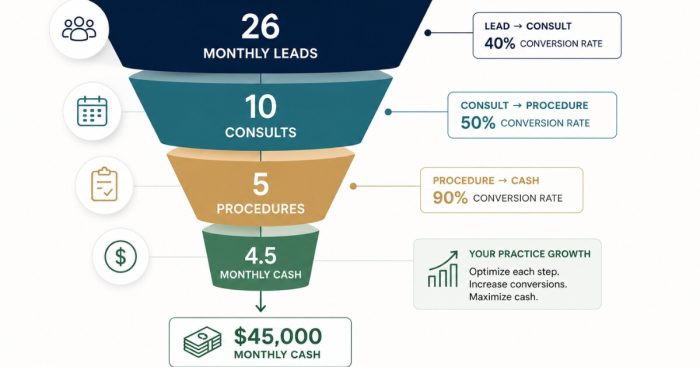
Run the math at the back of the envelope.
26 organic leads per month over 10 months equals 260 inquiries total.
Even at a modest 50% lead-to-booked-consult conversion rate, that is 130 paid consults.
At a 60% consult-to-procedure close rate on a $10K–$15K regenerative pain protocol, that is roughly 78 procedure enrollments over 10 months.
Stack the insurance side of the practice on top of that and the $2,095,039 stops looking miraculous and starts looking arithmetical.
Why Conversion Matters More Than Lead Volume
The arithmetic is unforgiving in both directions.
A pain practice generating 26 organic leads with a 20% lead-to-booked rate ends up with dramatically different outcomes than one converting at 50% or higher.
Therefore, the lead count is not what makes the difference.
The seat between the lead and the provider is.
What Does the Patient Coordinator Role Look Like at a High-Converting Cash-Pay Pain Practice?
A dedicated Patient Coordinator is often the missing link between lead generation and revenue growth.
Core Responsibility
Full-time, dedicated to inbound conversion, sitting on the phones and the CRM — not the front desk, not the billing desk, not the scheduler.
Daily Responsibilities
A Patient Coordinator owns every inbound pain inquiry from the moment it enters the CRM until the patient either books a procedure or formally exits the pipeline.
Compensation and Accountability
Compensation typically sits in the $50K–$70K base range plus a bonus tied to booked procedures.
More importantly, the 4 R’s framework — Roles, Responsibilities, Reporting, Results — turns this from a job title into a system.
Why Don’t Most Cash-Pay Pain Practices Hit Numbers Like This?
The answer is surprisingly straightforward.
The Single Biggest Bottleneck
Because the inside-sales seat is treated as a front-desk responsibility, not a dedicated role.
As a result, the practice’s growth ceiling becomes whatever conversion rate that front desk happens to produce.
Why Paid Ads Often Fail
This is also why most pain practices conclude that paid ads don’t work.
In reality, the conversion engine is usually the problem.

The Correct Sequence for Growth
First, fix conversion.
Next, build a Patient Coordinator seat.
Then, improve lead handling.
Only after those pieces are working should paid acquisition be layered on top.
Where Do Most Cash-Pay Pain Practices Waste Their First $50,000 of Marketing Spend?
Most practices make the same mistake.
The Common Pattern
On Facebook ads pointing at a broken funnel, an undefined offer, or a procedure menu the practice can’t actually deliver at scale yet.
Why the Strategy Fails
The pattern repeats with painful regularity.
Leads arrive. Follow-up breaks down. Consult attendance drops. Procedures fail to enroll.
Consequently, the owner concludes marketing is the problem.
What Actually Works
Facebook ads work for joint pain when four elements are present:
- A Patient Coordinator answering quickly
- A paid consult or credit-card hold
- A documented follow-up sequence
- An average ticket north of $5K
Without those elements, the economics collapse.
What’s the Next Step?
At this point, the opportunity should be clear.
If you run a cash-pay pain management practice and revenue has plateaued despite the lead flow being roughly the same as last year, the move is not more ads.
Instead, focus on the inside-sales seat first.
Install the Patient Coordinator role with the 4 R’s framework. Document the qualification script and the 24- and 72-hour follow-up cadence. Then get conversion above 50% on existing organic flow before spending another dollar on paid acquisition.
Finally, if you want a 60-minute walk-through of where your current pain-practice funnel is leaking, what your Patient Coordinator seat should look like for your case mix, and which of your existing case types should be lifted into cash-pay first, book a strategy call.
We will pull your last 30 days of inquiries and tell you the three operational changes that move revenue fastest.