
What Does the First 12 Months of a Concierge HRT Patient Journey Look Like at a Cash-Pay Medical Practice? (The Onboarding → Optimization → Maintenance Arc)
The cash-pay concierge HRT clinics that retain 70% or more of their members past year one are not running a hormone protocol — they are running a 12-month patient journey. The protocol is the clinical layer underneath. Meanwhile, the journey is the structural cadence of consults, lab retests, communication touchpoints, cross-sells, and retention check-ins that turns a new HRT enrollee into a year-two member. Below is the FAQ on the exact 12-month arc — onboarding, optimization, maintenance — that a well-run concierge HRT membership clinic operates against.
What Does Month 0 of a Concierge HRT Patient Journey Look Like at a Cash-Pay Medical Practice?
During the first week, three things happen:
- The patient pays the upfront program fee or enrolls in the monthly membership.
- A full lab panel is ordered (comprehensive metabolic, lipids, full hormones, thyroid, inflammatory markers).
- A 60-minute initial provider consult is scheduled within 5 to 10 business days.
Why the First Week Matters
The first week sets the rhythm for the entire relationship.
Specifically, the enrollment moment includes:
- A welcome kit
- A pamphlet
- A supplement protocol (if applicable)
- App access (Bio-Canic or equivalent)
- A text-message channel to the front desk
- A calendar invite to the initial consult
Most importantly, the labs are the primary deliverable.
Patients who enroll in HRT without baseline labs often lose trust within sixty days because protocol changes can feel arbitrary.
By contrast, patients who enroll with comprehensive labs arrive at the initial consult with context, questions, and measurable data.
As a result, the provider’s job becomes easier.
The provider simply translates the lab story into a treatment plan while setting realistic expectations about how long meaningful changes typically take.
For example:
- Energy and sleep improvements: 2 to 3 weeks
- Body composition improvements: 6 to 8 weeks
- Cardiovascular marker improvements: approximately 3 months
What Happens Between Weeks 1 and 6 of a New HRT Membership Patient’s Onboarding?
Between weeks 1 and 6, the onboarding cadence includes:
- Three coordinator check-ins (weeks 1, 2, and 3)
- One automated check-in email (week 5)
- One provider follow-up consult (week 6)
Typically, the week-6 appointment becomes the first hormone-titration visit.
Why Early Check-Ins Matter
Unfortunately, the check-in cadence is the most underbuilt part of the HRT patient journey at many clinics.
New members in weeks one through three represent the highest-churn cohort.
At this stage, nothing significant has changed yet.
Labs may still be pending.
Hormones haven’t fully taken effect.
Naturally, patients begin wondering whether they made the right decision.
Fortunately, a simple five-minute coordinator call solves much of this uncertainty.
The Coordinator Check-In Script
The script remains consistent:
“How are you feeling, are the supplements going down okay, anything you need before your week-six follow-up?”
Meanwhile, the week-five automated email reinforces the upcoming consult and asks patients to submit concerns before the visit.
Finally, the week-six provider consult is where meaningful titration begins.
Dose adjustments are based on symptoms.
Additionally, targeted labs such as testosterone, estradiol, and DHEA may be retested if baseline values were significantly outside normal ranges.
What Does the Optimization Phase (Months 2-6) of a Concierge HRT Patient Journey Look Like?
The optimization phase includes:
- Provider consults at week 6, month 3, and month 6
- Dose adjustments during each visit
- Targeted labs at week 6 (if needed)
- A full lab re-panel at month 6
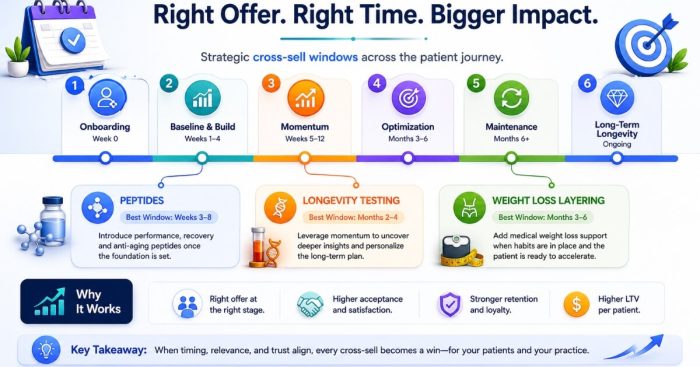
- A cross-sell conversation at month 3 when appropriate
The Goal of the Optimization Window
Months 2 through 6 represent the protocol-optimization window.
During this phase, the provider adjusts the dose based on the patient’s lived experience rather than lab numbers alone.
As a result, two questions become central to every appointment:
- How do you feel?
- What specifically is different from baseline?
The provider then triangulates between:
- Patient-reported symptoms
- Lab markers
- Current protocol settings
Ultimately, the goal is to converge on an optimized dose.
Why Relationships Matter During Optimization
However, the clinics with the strongest retention rates do more than optimize hormones.
They also build relationships.
For example, successful clinics often include:
- Coordinator check-ins between consults
- Personalized provider notes after visits
- Invitations to educational webinars
- Invitations to clinic events
Consequently, the patient feels like a person rather than a chart.
That feeling often determines whether they stay through month 12 and into year two.
How Should a Cash-Pay HRT Clinic Structure Provider Visits Across the First 12 Months?
A well-structured HRT membership includes:
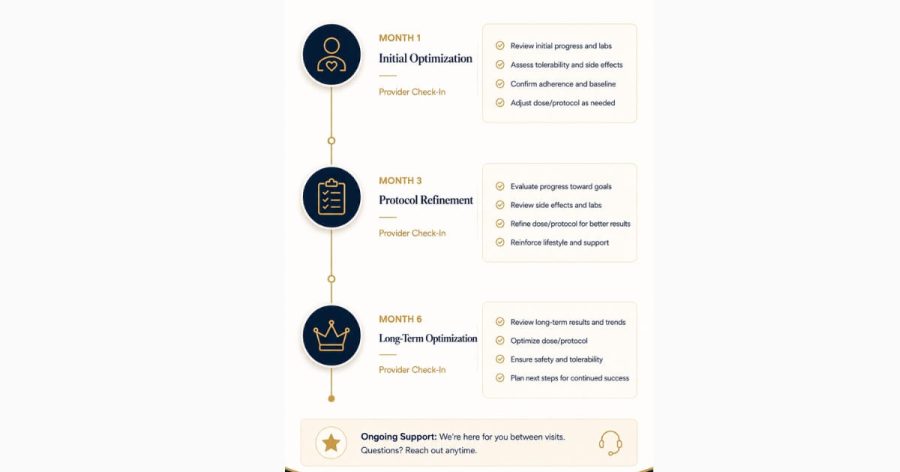
- Week-6 consult
- Month-3 consult
- Month-6 consult
- Month-9 consult
- Comprehensive 12-month anniversary visit
For complex protocols involving hormones, peptides, and weight loss, a sixth visit may be necessary.
Why the Five-Visit Structure Works
The five-visit framework aligns with the clinical rhythm of HRT optimization.
At the same time, it avoids overspending provider time on stable patients.
Week 6: Early Titration
The week-6 visit focuses primarily on early dose adjustments.
Month 3: Lifestyle Integration
By month 3, the protocol is beginning to work.
Therefore, this becomes the ideal time to discuss:
- Sleep
- Exercise
- Nutrition
- Supplement compliance
Month 6: Maintenance Transition
The month-6 appointment focuses on reviewing the full lab re-panel and discussing the transition toward maintenance.
Month 9: Cross-Sell Window
By month 9, the patient has experienced optimization.
As a result, they are often more receptive to additional services such as:
- Peptides
- Longevity testing
- Weight-loss protocols
Month 12: Year-Two Recommitment
Finally, the anniversary visit re-anchors the relationship for year two.
A cash-pay HRT and functional medicine membership clinic we helped scale from $1M to $4M over four years runs exactly this five-visit cadence across its 250-member panel — and the consistency of the cadence is one of the structural reasons year-two retention sits in the 60% to 70% range.
When and How Should a Concierge HRT Clinic Introduce Cross-Sells (Peptides, Weight Loss, Longevity Testing)?
Mention them at month 3.
Sell them at month 9.
Importantly, never introduce them at month 1.
Why Timing Matters More Than the Offer
Patients in month one are still evaluating whether the core HRT protocol works.
Consequently, introducing peptides or weight-loss services too early can feel like an upsell.
That perception weakens trust.
By month 3, however, patients are beginning to feel improvements from hormone optimization.
A brief mention is often enough:
“If you ever want to talk about peptides, BPC-157 pairs really well with what you’re already on.”
This plants the seed without requiring a commitment.
Why Month 9 Is the Best Sales Window
By month 9, the protocol has typically reached a steady state.
At this point, patients are often looking for the next optimization opportunity.
Therefore, month 9 becomes the natural moment to formally present additional services.
The most common HRT cross-sells include:
- Peptides (recovery, sleep, GLP-1 maintenance)
- Longevity testing (NAD, cellular markers, advanced cardiovascular panels)
- Weight-loss programs
As a result, cross-sell conversion rates at month 9 typically range from 30% to 50%.
That performance is meaningfully stronger than month-1 conversion rates because trust has already been established.
What’s the Right Communication Cadence Between Provider Visits in a 12-Month HRT Membership?
Each quarter should include three coordinator touchpoints:
- One human phone call
- One automated email
- One SMS reminder
Together, these touchpoints create ongoing communication without overwhelming staff resources.
The Weekly Concierge Experience
Across a 12-month relationship, the patient typically receives:
- Approximately 12 human phone calls
- Approximately 12 automated emails
- Approximately 12 SMS reminders
In practice, this creates roughly one touchpoint per week.
Additionally, alternating communication channels prevents fatigue.
The Highest-Leverage Retention Activity
The coordinator phone call remains the most expensive staff interaction and the highest-leverage retention activity.
Each call should cover three questions:
- How are you feeling?
- Is there anything we need to fix before your next visit?
- Can we schedule your next refill while we’re talking?
Meanwhile, automated emails handle education and protocol reinforcement.
Similarly, SMS reminders handle logistics.
Together, these channels create a concierge experience rather than a refill mill.
Not surprisingly, many clinics struggling with retention struggle here.
The protocol works.
However, the patient doesn’t feel supported between visits.
What Does Year-2 Retention Look Like at a Well-Run Concierge HRT Membership Clinic?
Most high-performing clinics generate a 60% to 75% renewal rate from year one into year two.
Typically, the strongest renewals come from patients who adopted a cross-sell offer during month 9 and now participate in multiple protocols.
Why Year-Two Patients Are More Valuable
Structurally, year-two patients are significantly more valuable than year-one patients.
They have already:
- Completed onboarding
- Optimized their protocol
- Built trust with the provider
- Built trust with the coordinator team
As a result, lifetime value increases substantially.
In many cases, year-two patient value is 2x to 3x greater than year-one revenue.
Cross-sell adoption compounds value.
Likewise, retention compounds value.
The Importance of the Anniversary Visit
The clinics growing the fastest pay disproportionate attention to the year-one-to-year-two transition.
Most importantly, the 12-month anniversary consult serves as the structural unlock.
This is not primarily a sales conversation.
Instead, it is a relationship conversation.
The provider reviews progress, discusses future goals, and positions the second-year protocol as the natural continuation of the patient’s journey.
Consequently, patients who complete the anniversary visit renew at meaningfully higher rates than patients who simply auto-roll into year two.
What’s the Next Step?
If your cash-pay concierge HRT or functional medicine practice is enrolling new patients but losing too many between month 6 and month 12, the patient journey — not the protocol — is likely the missing layer.
Specifically, the five-visit cadence, the three-touchpoint-per-quarter communication mix, the month-3-mention/month-9-sell cross-sell timing, and the 12-month anniversary visit are structural moves that help lift year-two retention from 30% to 70%.
In a 60-minute strategy call, we’ll audit your current patient journey, identify the cadence gaps, and build the 12-month arc your team needs.