
Why Does a Membership Model Protect a Cash-Pay Medical Practice from Chargebacks, Refund Risk, and Cash-Flow Volatility?
The $400/Month vs. $5,000 Upfront Math
The most valuable cash-pay medical practices in 2026 are not the ones with the highest single-procedure ticket. Instead, they are the ones with stable recurring revenue.
Membership models lower the threshold for patients to start. They also smooth the operational rhythm of the clinic. Most importantly, they protect the practice from the most expensive risk on the credit-card industry’s books — the lump-sum chargeback.
Here’s the FAQ on why every cash-pay clinic — HRT, functional medicine, regenerative pain, longevity — should be running toward a membership model. It also breaks down the specific math that makes a $400-per-month membership safer than a $5,000-upfront program, even when both produce the same annual revenue.
Why is recurring revenue the most valuable business model for a cash-pay medical practice?
Recurring revenue is valuable because business valuation tracks it at three to five times the multiple of one-off revenue.
In addition, a membership-based clinic usually costs less to operate than a procedure-based clinic at the same revenue level.
Most cash-pay clinic owners underestimate the valuation gap.
For example:
- A clinic doing $2 million a year in single-procedure revenue typically sells for one to two times annual revenue.
- A clinic doing $2 million a year in membership recurring revenue typically sells for three to five times annual revenue.
In some cases, the membership clinic sells for an even higher multiple.
Why?
Because the buyer is purchasing predictability.
A membership base of 500 patients paying $350 a month creates forecastable cash flow.
By contrast, a procedure-based revenue stream is harder to predict.
The operational side reinforces the same point.
A membership clinic has:
- A known patient panel
- A known monthly billing cycle
- A known service cadence
Meanwhile, a procedure clinic has to re-acquire every patient from scratch every quarter.
As a result:
- The marketing math is harder.
- Capacity planning is harder.
- Valuation suffers.
How does a monthly membership protect a cash-pay clinic from chargebacks and refund disputes?
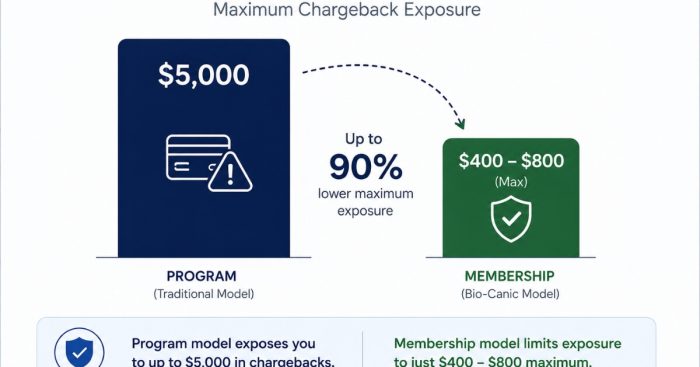
A monthly membership limits the maximum chargeback exposure on any single dispute.
Instead of risking the entire program cost, the clinic usually risks only one or two months of membership fees.
At first, this math feels counterintuitive.
However, the difference becomes clear when you compare the two models.
The $5,000 Upfront Program Model
A clinic that sells a $5,000 six-month program upfront is one unhappy patient away from a $5,000 chargeback dispute.
Once the dispute begins, the credit-card processor withholds the funds while it reviews the claim.
The clinic may win the dispute.
It may also lose.
Either way, the time and cash-flow drag are real.
The $400/Month Membership Model
Now compare that with the same six months of service sold as a $400-per-month membership.
In that model, the clinic usually has only $400 to $800 of exposure on any single dispute.
By month three, the patient has already paid for and consumed three months of care.
Therefore, they have no legitimate claim to the first three months back.
If the clinic chooses to refund month four and cancel the membership going forward, the dispute window becomes much smaller.
The financial exposure is asymmetric.
Even better, smaller membership disputes are easier to handle than rare but catastrophic program-level chargebacks.
Should a cash-pay clinic charge $5,000 upfront for a 6-month program or $400/month for 12 months?
The $400-per-month model usually wins.
It wins on:
- Adoption rate
- Retention
- Lifetime value
- Refund risk
- Chargeback risk
The upfront program model looks attractive because all the revenue arrives in week one.
However, the reality is often uglier.
Patients who pay $5,000 upfront often feel like they bought a six-month outcome.
They do not always feel like they entered a six-month relationship.
As a result, if month three feels slow, they want their money back.
On the other hand, if month four feels great, they finish the program and leave.
The membership model does three structural things differently.
First: It Lowers the Price Objection
A $400 monthly payment is easier to absorb than a $5,000 upfront payment.
Therefore, many patients can say yes without a financing conversation.
Second: It Extends the Relationship
The membership model keeps the patient connected beyond the original six-month program.
That same patient may stay at:
- Month 8
- Month 12
- Month 24
In this case, the membership becomes the relationship.
It is not just a fixed-term program.
Third: It Caps Refund Risk
A membership limits refund exposure to a single month.
By contrast, an upfront program creates the possibility of a full-program dispute.
Across a panel of 500 patients, this difference is significant.
Typically, the membership model produces 30% to 50% higher 12-month revenue per patient.
That happens because retention extends past the original program window.
At the same time, refund losses do not compound.
What price point makes a cash-pay membership most adoptable at first sale?
The best price point depends on the offer.
For HRT, functional medicine, and concierge primary care, the most adoptable range is:
- $300 to $500 a month
For GLP-1 weight loss and lighter peptide programs, the stronger range is:
- $150 to $250 a month
Anything above $500 a month usually requires a paid initial consult first.
That consult helps establish value before the membership is offered.
The reason is simple.
Patients in the cash-pay cohort often have a monthly spending threshold that does not require a family conversation.
For many households, that threshold is roughly $300 to $500 a month.
Above that number, patients often want to:
- Think overnight
- Talk to a spouse
- Review household finances
Below that number, the decision feels much easier.
Therefore, clinics priced at:
- $349
- $395
- $425
often see higher signup conversion than clinics priced at:
- $549
- $649
- $749
The higher tiers may produce more revenue per patient.
However, the volume side often wins because membership LTV compounds.
Most cash-pay clinics get to the right number by anchoring the membership against an $800-to-$900 paid initial consult.
As a result, the monthly fee feels like a relief by comparison.
How does a membership model lower patient acquisition cost math at a cash-pay clinic?
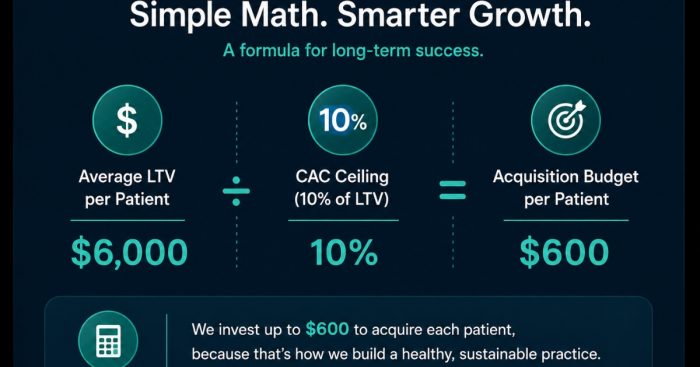
A membership model improves acquisition math because lifetime value drives the acquisition budget.
More specifically, a membership patient often has 3x to 10x the LTV of a one-procedure patient.
The One-Procedure Patient
A clinic acquiring a one-procedure patient at $300 per booked consult has limited room to work.
The patient may come in for a single $500 to $1,000 service.
After that, the relationship often ends.
To keep the math viable, CAC has to stay under 10% of LTV.
That means the CAC ceiling is usually only $30 to $100.
That is almost no acquisition budget.
The Membership Patient
Now compare that with a membership patient.
If the clinic pays $300 CAC for a patient worth $4,000 to $10,000 in lifetime revenue, the math changes immediately.
At 10% of LTV, the CAC ceiling becomes:
- $400
- $1,000
Suddenly, the clinic can outbid procedure-based competitors.
That applies across:
- Google Ads
- Radio
- Every channel where bid prices are set by patient lifetime value
A cash-pay HRT and functional medicine membership clinic we helped grow from $1M to $4M over four years runs exactly this CAC math; the membership LTV is what makes the paid-ad budget defensible.
What’s the operational difference between a one-off-procedure clinic and a membership clinic?
A one-off-procedure clinic re-acquires every patient every cycle.
By contrast, a membership clinic services the same patient panel month after month.
That difference shows up everywhere.
Front Desk Work
At a procedure clinic, the front desk spends most of its time on:
- Inbound lead conversion
- First-visit booking
- New patient logistics
Every patient is a new patient.
At a membership clinic, the front desk spends more time on:
- Existing-patient logistics
- Follow-up consults
- Refills
- Check-ins
Therefore, the operating rhythm becomes more predictable.
Capacity Planning
A procedure clinic running at 80% chair utilization in March may have no idea what utilization will look like in June.
A membership clinic with 250 enrolled members on a six-week consult cadence can project provider demand months ahead.
As a result:
- Hiring decisions get smarter.
- Marketing budgets get smarter.
- Owner stress gets lower.
Ultimately, the clinic becomes a business instead of a procedure factory.
How long does it take a cash-pay practice to convert to a membership-first economy?
The conversion usually takes twelve to eighteen months.
That timeline starts when the membership tier launches.
It ends when membership revenue exceeds procedure or one-off revenue at the practice level.
The pattern is consistent across the cash-pay clinics we’ve worked with.
Month 1
The membership tier launches.
Then, the first 20 to 30 patients enroll.
Months 2 Through 6
Existing one-off patients receive the membership offer during follow-up visits.
Typically, 30% to 50% of the existing panel converts.
Months 6 Through 12
New patient acquisition gets routed into the membership lane by default.
However, the clinic still preserves the procedure-only path for the small percentage of patients who refuse the recurring commitment.
Months 12 Through 18
Membership revenue crosses 50% of total practice revenue.
At that point, the practice becomes meaningfully more stable.
By Month 24
The membership base becomes the practice.
Procedure revenue becomes supplemental.
Because of that shift, the clinic owner can:
- Sell the business
- Hire a second provider
- Take a vacation
without revenue collapsing during their absence.
The conversion is gradual.
It is also low-risk.
However, once it tips, it becomes difficult to reverse.
What’s the next step?
If your cash-pay medical practice still sells six-month programs upfront, single-procedure tickets, or any structure where the entire patient relationship is monetized in one or two transactions, the risk is higher than it needs to be.
Specifically, the practice is carrying:
- More chargeback risk
- More cash-flow volatility
- More operational complexity
The membership model fixes all three at once.
We’ve installed exactly this conversion at:
- HRT clinics
- Functional medicine practices
- Regenerative pain clinics
- Longevity practices
In a 60-minute strategy call, we’ll audit your current revenue model.
Then, we’ll map the membership tier that fits your service mix.
Finally, we’ll chart the 12-to-18-month conversion timeline your team needs.