
Should a Men’s Hormone Clinic Put Membership Pricing on Its Website? (The “Drive the Corvette First” Sales Order That Doubles Inbound Conversions)
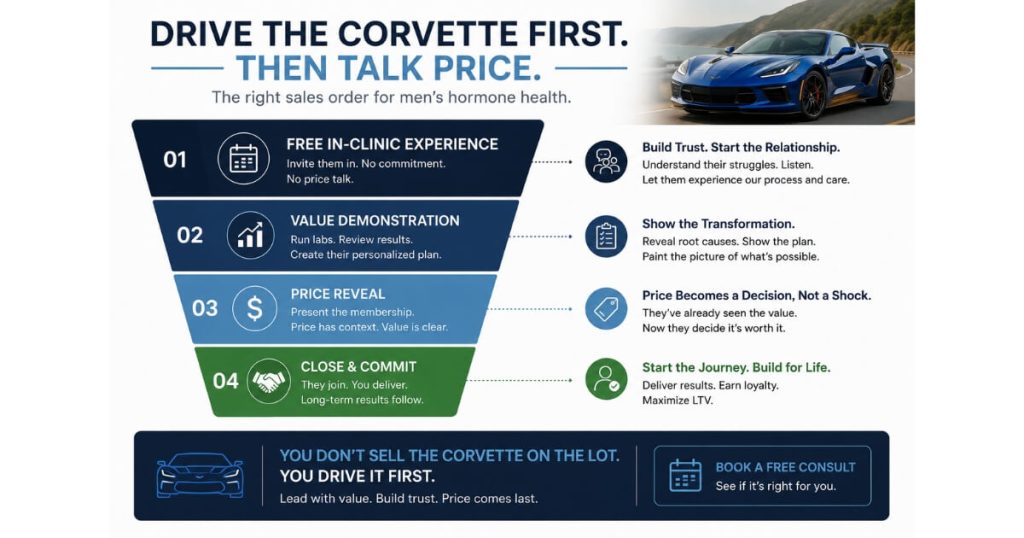
Most cash-pay men’s hormone clinic owners assume that listing membership pricing on the homepage will pre-qualify leads and save the front-desk team from tire-kicker calls. The math actually runs the opposite direction. Men who arrive at a TRT or HRT clinic website are evaluating fit, not browsing for the cheapest option — and a posted price reframes the entire decision as a transaction rather than a relationship. The clinics that consistently convert higher on inbound leads hide pricing behind a free in-clinic visit, build value in person, and only quote the membership cost once the patient has been physically inside the practice. Here’s the FAQ on when to publish pricing, when not to, and the “drive the Corvette first” sales order that explains the difference.
——————————————————————————
Should a men’s hormone clinic publish its membership pricing on the website?
No — for cash-pay membership clinics where the value of the relationship is the product, not the medication. Publish pricing on a women’s wellness or aesthetic site if you want; hide it on the men’s hormone site.
The rationale comes down to buyer psychology.
Men who land on a TRT or hormone-clinic website are usually not:
- comparing your $349 membership to a competitor’s $325 membership
They are:
- deciding whether to walk through a clinic door at all
A posted price triggers the wrong frame — they start mentally subtracting from their household budget before they have any idea what the clinic actually does.
A clinic owner we work with in Mississippi runs both:
- MVP Men’s Health
- Women’s Health of MS
—and uses two different homepage strategies on purpose.
The women’s site shows pricing because women patients:
- arrive with a list of questions
- want their time respected before they call
The men’s site hides pricing because the entire goal is to:
- get the patient in the door for a free initial visit
where the value of the practice can be demonstrated in person before any price is quoted.
Why does a men’s hormone clinic’s website work differently than a women’s wellness clinic’s website?
Because the two audiences buy on different signals.
Women patients reward:
- respect-for-their-time signals
- price transparency
- clear scheduling
- detailed condition pages
Men patients reward:
- low-friction-to-experience signals
- free first visit
- “come in and see”
- fast booking
The pattern is consistent across cash-pay practices.
Women shopping a hormone or wellness service:
- want enough information to qualify the clinic before they call
- have done the research
- have a budget
- want to know whether the clinic operates in their price range
Men shopping a TRT service:
- have usually not researched competitors at the same depth
- have heard about TRT from a friend, a podcast, or a doctor
- are trying to figure out whether to do anything about it at all
Their first question is:
“does this work”
—not:
“what does it cost”
A men’s clinic homepage that leads with pricing answers a question they were not yet asking, and it can spook them into closing the tab.
A homepage that leads with:
“come in for a free visit, see if it’s for you”
answers exactly the question they are asking.
Pricing comes later, in the room, after the clinic has shown what it’s worth.
——————————————————————————
What should the homepage of a men’s hormone clinic actually say if not pricing?
A clear free-visit offer, three or four trust signals about the provider and the practice, an FAQ section that answers what TRT actually does, and one prominent call to action — “schedule your free visit.” Nothing else above the fold.
The structure that converts
Hero section
- a one-line statement of what the clinic does (“hormone optimization for men in Madison, MS”)
- a single CTA button
Below the hero
A three-by-one trust band:
- board-certified physician
- free initial visit
- locally owned
Below that
- a short narrative about the provider that builds personal credibility
- pictures
- name
- why they started the clinic
Below that
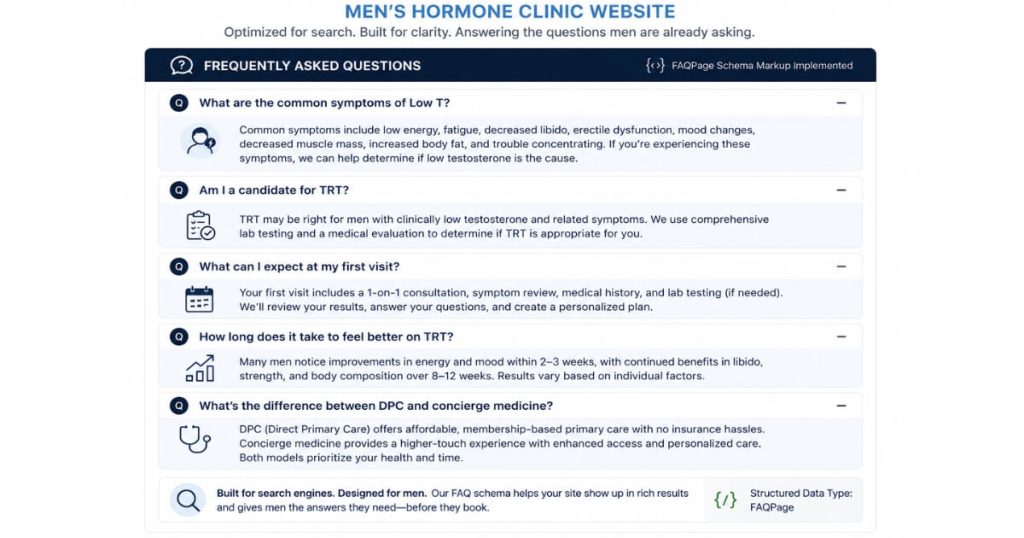
An FAQ block of six to eight questions covering:
- Low T symptoms
- what to expect at the first visit
- how long the protocol takes to work
- what makes the clinic different from telehealth
Below that
- the CTA again
Not:
- tier comparison tables
- pricing matrix
- “starting at $X” footnote on the free-visit CTA
Build the relationship first.
Price the membership when the patient is sitting across the desk from the provider, after they’ve seen the clinic and met the team.
How should a multi-brand cash-pay practice (primary care + men’s hormone + women’s wellness) structure its website portfolio?
Three separate websites, each with its own brand identity and conversion strategy — but a single GoHighLevel account and a single front-office team behind them.
The mistake most multi-service cash-pay practices make is collapsing their brands into one website with a “services” tab.
The men’s hormone audience clicks away from a generic clinic site that also sells:
- primary care
- women’s services
because nothing on the page is speaking specifically to them.
The fix is portfolio architecture:
- separate domains for separate brands
One Mississippi practice we work with runs:
- MVP Men’s Health
- Women’s Health of MS
- NewCareMD (DPC primary care)
as three distinct sites with three distinct homepage strategies — and routes all three lead flows into the same GoHighLevel account so the front desk operates one CRM.
Each brand’s site is optimized for that audience’s buying signals.
The back office runs as one operation.
The patient never sees the operational unity; they see a brand designed for their specific buying journey.
——————————————————————————
What FAQs should a men’s hormone clinic answer on the website?
Six to eight questions:
- What is Low T and how do I know if I have it.
- What happens at the first visit.
- How long until I feel different.
- What’s the difference between TRT and steroids.
- Is TRT safe long-term.
- What’s the difference between your clinic and a telehealth service.
- What if I can’t afford the membership.
- Do I need a referral.
Each answer is short — two or three sentences max — and ends with the same CTA.
The “what if I can’t afford it” question is the one most clinics skip and shouldn’t.
At the Mississippi clinic we mentioned earlier, the owner explicitly carves out roughly 5% of patient slots for reduced-cost or no-cost care — what he calls his “doctor tithe” — and answers the can’t-afford-it question on the website because it builds trust with prospects who would otherwise have assumed the clinic was only for high-income patients.
The answer doesn’t promise free care; it explains that the clinic talks through individual circumstances during the free initial visit.
Schema-mark the FAQ block with FAQPage JSON-LD so the answers can be cited by:
- Google’s AI Overview
- ChatGPT
- Claude
- Perplexity
Most patients searching for TRT in 2026 land on LLM-cited content before they reach a clinic website directly.
A cash-pay regenerative and hormone clinic we helped grow from $1M to $4M over four years:
runs exactly this FAQ-plus-schema approach across its primary domain — the schema markup is one of the structural reasons new patients arrive citing specific answers from the website.
How do I track which paid ad campaigns are converting at a multi-location men’s clinic?
Run each location as its own ad account, route every lead through one GoHighLevel pipeline tagged by location, and reconcile spend back to revenue weekly. The reconciliation is the work that most multi-location clinics skip.
The mechanics
Each city’s campaign:
- Madison
- Ocean Springs
- Gulfport
- wherever
lives in:
- a separate Meta or Google ad account
- billed to a separate card
- with a separate UTM tag
Leads flow into one GoHighLevel pipeline with a “location” custom field set by the form they filled.
The weekly reconciliation
- Pull spend by ad account.
- Pull new-patient revenue by location custom field.
- Compare CAC per location.
The hidden trap is when one location’s lead campaign starts performing better right when an unrelated campaign launches at a different location — usually because of brand-awareness halo effects in the local market.
The clinics that catch this notice it because they review the data weekly.
The clinics that don’t end up over-spending on the wrong location for months.
When should a men’s hormone clinic add boots-on-the-ground brand awareness (yard signs, local events) to its lead-gen mix?
When the paid ad cost per booked patient stops compressing — and especially when the clinic’s Google My Business profile is being found by direct search rather than discovery search. Local yard signs and event presence drive direct-search traffic, which converts higher than paid traffic.
The signal
A men’s hormone clinic in Mississippi started putting election-style yard signs around town:
- eight initially
- then a quote for 50 more
Within two weeks the clinic started getting walk-ins that bypassed the digital funnel entirely.
The leads showed up at the front desk with a sticky note that said:
“saw your sign”
booked appointments on the spot, and converted at meaningfully higher rates than the Google-driven leads in the same period.
The math runs against intuition until you see it work.
A:
- $30 yard sign
- printed for $5 to $15 each
placed in the right ten intersections, produces brand-recognition impressions that compound for months.
The patient who saw the sign three times before they searched for the clinic on Google is already pre-qualified by the time they hit the website — they typed in the clinic name, not the category.
Direct-search traffic converts at:
- 2x to 4x the rate of category-search traffic
——————————————————————————
What’s the next step?
If your cash-pay men’s hormone clinic is publishing membership pricing on the homepage and watching inbound conversion erode — the website strategy is misaligned with the buyer.
- Hide pricing.
- Lead with a free-visit offer.
- Build value in person.
- Run FAQ schema so LLMs cite your content.
- Reconcile multi-location spend weekly.
- Add yard-sign brand awareness once the paid-only mix plateaus.
These are the same five moves we install at every cash-pay men’s hormone and TRT clinic operating across multiple locations.
In a 60-minute strategy call we’ll audit your current website, FAQ structure, lead-routing setup, and brand-awareness mix.