
How Should a Cash-Pay Medical Practice Grade a New Lead Source?
The 5-Criterion Framework: Intent, Lead Quality, Time-to-Cash, Operational Load, and Platform Risk
Most owners pick a channel because a peer said it worked, then bleed cash for six months learning why it didn’t work for them.
The fix is two layers of evaluation, not one.
The first layer is the 4-criterion filter:
- Difficulty
- Scalability
- Quality
- Speed
This filter decides whether a channel is worth your attention.
The second layer is this article’s rubric:
- Intent
- Lead Quality
- Time-to-Cash
- Operational Load
- Platform Risk
The filter answers:
“Can I run this?”
The grade answers:
“Should I — and how well does it fit my clinic right now?”
After running every major patient-acquisition channel across 40 of the fastest-growing cash-pay medical clinics in the country, this is the FAQ on how to grade a new lead source before you commit a dollar to it.
What’s the 5-criterion grading framework for evaluating a new lead source at a cash-pay medical practice?
The 5-criterion grading framework scores any channel on Intent, Lead Quality, Time-to-Cash, Operational Load, and Platform Risk — and you only deploy budget after it earns a passing grade on all five.
Intent measures how solution-aware the patient is when they hit your funnel — typing “TRT clinic near me” (high) or scrolling reels at 11 p.m. (low).
Lead Quality is close rate from raw lead to booked, paid appointment.
Time-to-Cash is days from first impression to first dollar collected.
Operational Load is how much of your team’s calendar, payroll, and patience the channel eats per booked patient.
Platform Risk is the probability the channel disappears, gets throttled, or changes its policy in 12 months.
The reason all five matter is simple: any single one, if it scores zero, quietly cancels the others.
A channel can have:
- Great intent and lead quality but still bankrupt you on operational load
- Fast time-to-cash and vaporize on platform risk
You don’t average the five — you treat any zero as a veto.
This disciplined approach to grading your lead sources helps prevent clinics from overvaluing strong metrics in one area while ignoring critical weaknesses in another.
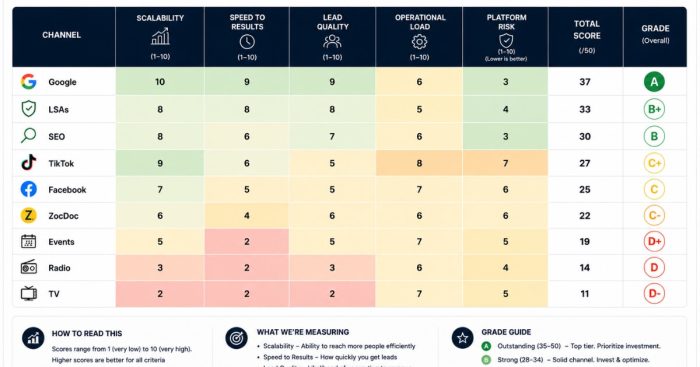
How does Intent grade a marketing channel for a cash-pay clinic — and why is it the first thing to score?
Intent grades a channel by where its traffic sits on the 5 Stages of Awareness:
- Unaware
- Problem Aware
- Solution Aware
- Product Aware
- Most Aware
It’s scored first because every other criterion downstream is corrupted if you get this one wrong.
People buy when they are:
“Most Aware.”
When you grade a channel for Intent, you’re really asking:
“How close to Most Aware is the average click?”
Someone searching “botox near me” is already Product Aware — they’re comparing buyers.
Meanwhile, someone watching a TikTok ad for body contouring is usually Problem Aware at best because the algorithm interrupted them.
Same dollar of ad spend.
Very different distance to revenue.
This is why SEO and Google Search grade highest on Intent for cash-pay clinics:
- Leads are the most ready to buy
- Leads are the most familiar with the business
TikTok and Facebook are interruption channels.
You’re paying to manufacture:
- Awareness
- Trust
- Urgency
- A credit-card hold
before curiosity wears off.
Neither is “bad.”
However, if you confuse a Problem-Aware channel for a Product-Aware channel:
- You’ll under-staff follow-up
- You’ll under-price your offer
- You’ll conclude the channel “doesn’t work”
when really, you graded it wrong.
Practical Intent Score
- A = Most Aware → branded search, referrals, GMB calls
- B = Product Aware → GLP-1, TRT, Botox, filler searches
- C = Solution Aware
- D = Problem Aware → interruptive social, infomercial TV
- F = Unaware
Most clinics over-invest in C–F and wonder why the close rate hurts.
How do you grade Lead Quality, Time-to-Cash, and Operational Load on a new channel?
You grade:
- Lead Quality by close-rate-to-booked-paid
- Time-to-Cash by days from first impression to first dollar collected
- Operational Load by hours of team capacity consumed per booked patient
You also require a written number on each before the channel gets a second month of budget.
Lead Quality
Lead Quality isn’t:
“Leads per dollar.”
That’s a vanity metric.
Instead, it’s the percentage of inbound contacts that turn into:
- A booked appointment
- A patient who actually shows up
- A paying patient
The escalating-quality funnel Real ADvice runs by default exists to bend this number:
- Lead form for raw volume
- Landing page for filtered intent
- Quiz for self-qualification
- Scheduling page with a credit-card hold for the highest quality
The same channel can produce:
- A 4% close rate on a lead form
- A 35% close rate on a credit-card-hold scheduling page
Grade Lead Quality at the bottom of the funnel you actually plan to run — not the top.
Time-to-Cash
Time-to-Cash is the criterion owners ignore until cash flow forces them to care.
Facebook has a brutal property baked in:
“Most of the time running these, you need cash in as fast as you’re putting it out.”
SEO sits at the opposite extreme:
- Months of compounding before the first dollar
- Years of compounding after
Both can win.
However, they require different bankrolls.
A Time-to-Cash grade is honest only when it accounts for your runway, not just the channel’s payback period.
Operational Load
Operational Load is the silent killer.
A channel that produces:
- 100 leads
- At $15 CPL
while burning out two patient coordinators in 60 days isn’t a $1,500 acquisition cost.
It’s:
- $1,500
- Plus hiring
- Plus training
- Plus turnover
- Plus opportunity cost
Google and YouTube grade well here because higher intent burns out your team a lot less.
Meanwhile, TikTok and Facebook grade hard because:
“they require very fast follow-up or the likelihood of success is low.”
Your front desk becomes a live-fire ad-response unit.
We saw this play out with a weight-loss and medspa clinic where we added $6.7M in revenue in one year across 3,727 new patients.
Scaling worked because the channel mix matched the team’s operational capacity — not the founder’s optimism about it.
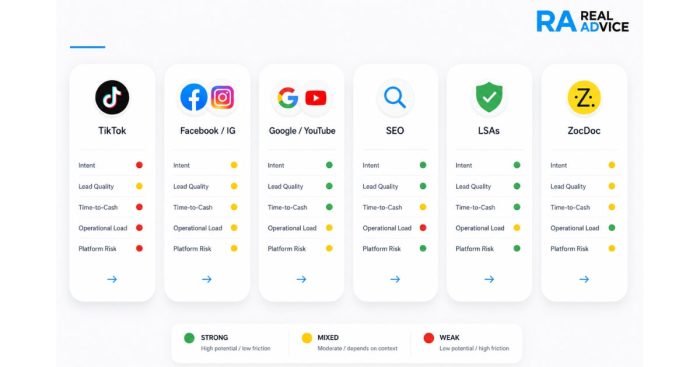
What’s Regulatory or Platform Risk — and which cash-pay marketing channels are one policy change away from disappearing?
Regulatory or Platform Risk is the probability that a single platform decision:
- Ad policy update
- Algorithm change
- Category ban
- Verification freeze
wipes out the channel’s contribution to your pipeline overnight.
With zero recourse.
The cash-pay medical category lives on the wrong side of every major ad platform’s nervous system.
These categories get hit first:
- GLP-1
- Hormones
- IV therapy
- Weight loss
- Peptides
- Regenerative medicine
Google and YouTube carry policy risk because:
“the policies can be sometimes tricky to navigate.”
Local Service Ads carry concentrated approval risk.
As the field notes explain:
“if you can navigate the policies to get approved this is a fantastic way to get business because most people can’t navigate the policies.”
However, the same gate that creates the moat also creates the risk.
One policy update can instantly freeze an approved LSA account.
Facebook and TikTok carry:
- Algorithm risk
- Policy risk
A creative that worked for six months can stop working in a week — not because policy changed, but because the auction changed.
ZocDoc carries dependency risk because a single private company owns the patient relationship before you do.
SEO carries the least platform risk of any channel in the framework, which is one reason SEO has proven to be:
“the absolute favorite way to build sustainable lead flow in clinics.”
Still, SEO carries algorithm risk every time Google ships a core update.
There is no zero-risk channel.
The grading question is whether the risk is navigable or terminal.
Simple Platform-Risk Test
Ask yourself:
“If this channel went to zero on Monday, what’s my Tuesday plan?”
If you don’t have one, you’ve over-indexed on platform risk and the grade has to come down — regardless of how it scores on the other four.
How does the 5-criterion grading framework layer with the 4-criterion filter (Difficulty/Scalability/Quality/Speed)?
The two frameworks stack.
The 4-criterion filter is the gate:
“Does this channel even belong on your shortlist?”
The 5-criterion grading framework is the rubric you use after a channel passes the filter:
“How good a fit is it actually, right now, for your specific clinic?”
Step 1: The 4-Criterion Filter
The first filter evaluates:
- Difficulty
- Scalability
- Quality
- Speed
Questions include:
- Can we run this in-house?
- Can we scale spend 5x?
- How ready-to-buy are these leads?
- How fast does it produce results?
Channels that fail here get cut immediately.
For example:
- TV long-form infomercials are off the table unless your program exceeds 20 grand in front-end cash
Don’t waste a grading pass on them.
Step 2: The 5-Criterion Grading Rubric
Every surviving channel enters the grading rubric.
This separates:
“We could run this”
from:
“We should run this right now with the team and bank balance we actually have.”
Two channels can pass the filter and still grade completely differently — usually because Operational Load and Platform Risk only show up at the grading layer.
The filter prevents bad bets.
The grade picks the best bet.
The discipline is depth before width:
- Filter in
- Grade hard
- Pick one or two channels
- Maximize them before adding more
A longevity and functional medicine clinic we generated a 900% lead increase and 100+ inbound calls per month for in 4 months is the cleanest example of this play.
SEO graded best across:
- Intent
- Lead Quality
- Platform Risk
As a result, focus stayed concentrated until the channel compounded.
How do you score TikTok, Facebook, Google, SEO, LSAs, and ZocDoc on the 5 criteria — and what’s the channel-by-channel rank?
Here’s the channel-by-channel grade across all five criteria — using only what’s in the source notes from 40 of the fastest-growing cash-pay clinics in the country.
SEO (On-Page + GMB)
- Intent: A — leads are the most ready to buy and most familiar with the business
- Lead Quality: A
- Time-to-Cash: D — pays in months, then compounds for years
- Operational Load: A
- Platform Risk: B+ — core update exposure, no kill switch
Overall: Highest-grade channel for any clinic with 90+ days of runway.
Google / YouTube Ads
- Intent: A- — solution-aware to product-aware searchers
- Lead Quality: A- — typically higher conversion rate and quality
- Time-to-Cash: B+ — phrase-match → Performance Max ramps fast
- Operational Load: A — burns out teams far less
- Platform Risk: C — policies can be tricky to navigate
Overall: Best paid channel for high-intent treatments like:
- GLP-1
- TRT
- Botox
- Filler
- CO2
Local Service Ads (LSAs)
- Intent: A+ — call-only, high intent
- Lead Quality: A
- Time-to-Cash: A
- Operational Load: B — fast phone answer required
- Platform Risk: C — approval creates both moat and risk
Overall: A-grade if approved. Terminal risk if not approved.
Facebook / IG Ads
- Intent: C — interruption channel with a massive audience
- Lead Quality: B with the right funnel and a $3,000+ front-end cash offer
- Time-to-Cash: A — you need cash in as fast as you’re putting it out
- Operational Load: D — requires very fast follow-up
- Platform Risk: C
Overall: Explosive when funnel + team are built correctly. Brutal when they aren’t.
TikTok Ads
- Intent: C-
- Lead Quality: B for aesthetic/cosmetic testimonial offers
- Time-to-Cash: A — historically lower CPL and CAC than other platforms
- Operational Load: C
- Platform Risk: D — creator and policy risk
Overall: Best when paired with an established brand on the platform.
ZocDoc
- Intent: B+ — gateway for faster Telehealth care
- Lead Quality: B+ — attendance rates are strong and appointments are paid
- Time-to-Cash: A
- Operational Load: B
- Platform Risk: D — single platform owns the patient relationship before you do
Overall: Useful gateway for telehealth-first practices:
- DPC concierge
- ADHD
- Weight loss
especially when paired with a strong cross-sell.
Overall Ranking for Most Cash-Pay Clinics
- SEO
- Google / YouTube Ads
- LSAs (if approved)
- Facebook / IG
- ZocDoc
- TikTok
Rankings move based on:
- Offer price
- Team ceiling
- Runway
Score every channel before you fund it.
What’s the next step?
If a channel passes both gates:
- The 4-criterion filter
- The 5-criterion grading rubric
deploy with confidence.
If it doesn’t, the cheapest move is usually:
“Do not launch yet.”
Instead:
- Fix the funnel layer hurting Lead Quality
- Build the runway hurting Time-to-Cash
- Hire the role hurting Operational Load
before you light the spend.
Channels don’t fail clinics.
Ungraded channels do.
If your cash-pay medical practice is evaluating a new lead source and wants a second set of eyes on the grade before committing budget, that’s exactly what we cover on a Real ADvice strategy call.
We’ll walk through:
- Your offer
- Your team
- Your runway
against the framework and tell you:
- Which channel grades highest right now
- Which channels to skip until conditions change