
How Do You Pick the Top 2 Lead Sources for Your Cash-Pay Medical Practice in 2026?
Depth Before Width
Most cash-pay clinic owners I meet are running five mediocre channels and wondering why nothing is scaling.
They have:
- A half-built SEO program
- A stalled TikTok account
- A Facebook ad set untouched in six weeks
- A $4K/month radio buy nobody is tracking
- A booth next month
Five channels at 20% effort each will lose to two channels at 100% effort every single time.
Channels are not stocks.
Instead, they are systems that require:
- An offer
- A creative cadence
- A funnel
- A sales process
All of those pieces have to fit before the channel pays off.
This article is the framework I use to pick the top two channels for any cash-pay clinic in 2026.
After running every major patient-acquisition channel across 40 of the fastest-growing cash-pay medical clinics in the country, this is the FAQ on picking your top 2 lead sources in 2026.
Why should a cash-pay medical practice run “depth before width” instead of adding a fifth or sixth marketing channel?
Because every channel has:
- Its own learning curve
- Its own offer-creative-funnel-sales fit
- Its own operational demands
Meanwhile, your team has finite focus.
As a result, two channels run to 100% will always outperform five channels run to 20%.
Width feels like risk management.
However, it actually guarantees mediocrity across the board.
The Real Cost of Adding a New Channel
The cost of a new channel is not the ad spend.
Instead, the real cost is the cognitive load:
- New platform policies
- New creative formats
- New audience awareness stages
- New follow-up speed requirements
- New attribution problems
- New sales scripts
For example:
- Facebook leads need follow-up in minutes or close rate collapses
- SEO leads come in pre-sold and want a calendar link
- Google leads convert better but cost more per click
- TikTok requires story-based creative most Google teams cannot film
You cannot run all of this well at the same time with:
- One marketing manager
- One closer
Why Depth Compounds Over Time
Depth before width also compounds.
The longer you run one channel:
- The more data you collect
- The better your creative rotation becomes
- The tighter your funnel gets
- The better your sales team closes that lead type
As a result, two channels going deep for 12 months will outperform five channels going wide for 12 months by 3 to 5x across cash-pay verticals.
How do you pick the top 2 lead sources for your cash-pay medical practice in 2026?
Pick:
- One channel optimized for intent
- One channel optimized for volume and creative leverage
Then, match each to:
- Your vertical’s awareness stage
- Your front-end cash threshold
These two roles need to be filled separately because they perform different jobs inside the funnel.
Step 1: Use the Source-Evaluation Filter
Start with the source-evaluation filter from the field:
- Difficulty
- Scalability
- Quality
- Speed
SEO
SEO scores:
- Low on Speed
- High on Quality
- High on Scalability
Those leads are usually the most ready to buy and the most familiar with the business.
Facebook/Instagram
Facebook/Instagram scores:
- High on Speed
- High on Scalability
- Lower on Quality
However, it only works if your front-end cash collected is over $3,000.
Google/YouTube
Google/YouTube scores high on Quality.
However:
- Policies can be tricky
- CPL can be higher
TikTok
TikTok scores:
- Low on Difficulty (if you can produce testimonial creative)
- High on Speed
Especially for:
- Aesthetic offers
- Cosmetic offers
- GLP-1 offers
- Hormone offers
Organic Social
Organic social is the slowest channel.
However, it produces the highest-quality leads.
As the field notes state:
“the better your brand is on social platforms, the better everything else will convert.”
That point is why I usually recommend:
- One paid channel
- Paired with organic social as a brand multiplier
Instead of pairing two paid channels together.
Step 2: Match the Awareness Stage
The second filter is awareness stage.
Product-Aware Markets
Botox and filler are product-aware.
People are choosing who to buy from.
As a result:
- SEO works
- Google ads work
because patients are already searching by name.
GLP-1 and TRT have also moved into product-aware territory in 2026.
Problem-Aware Markets
Gut health and functional medicine patients are problem-aware.
They do not yet know solutions exist for what they are feeling.
As a result:
- SEO content
- Long-form education
- YouTube
- Organic social
do the heavy lifting of moving them up the awareness stages.
If your top-LTV service sits in the problem-aware bucket:
- Pair SEO with organic social
If it sits in the product-aware bucket:
- Pair SEO or Google/YouTube ads with FB/IG or TikTok
Step 3: Evaluate the Front-End Cash Threshold
The third filter is your front-end cash threshold.
The minimum I will run Facebook/Instagram ads at is:
- $3,000 in front-end cash collected
Below that, the math usually fails.
The minimum I will run TV long-form on is:
- $20,000+ programs
If your average first transaction is under $3K, your best channels become:
- SEO
- Organic social
- Tight referral motion
Not paid social.
Pick honestly based on your actual numbers.
Not based on the channel you wish you could run.
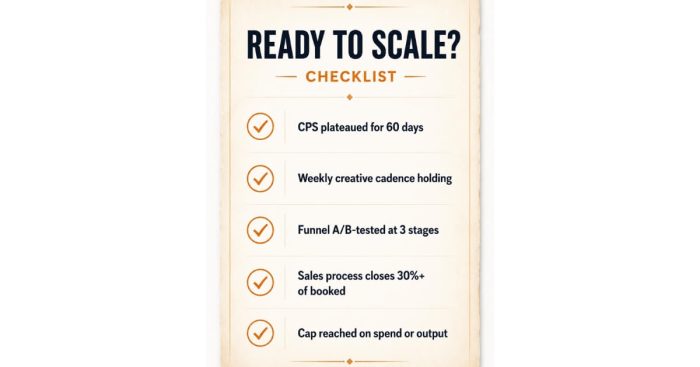
What does it actually mean to “max out” a single marketing channel before adding another at a cash-pay clinic?
Maxed out means:
- Your cost per schedule has plateaued for at least 60 days
- Your creative cadence is saturated
- Your funnel has been A/B-tested
- Your sales process is closing at or above benchmark
Until all four are true, you have not maxed out the channel.
You simply still have upside left on the table.
What “CPS Plateaued” Actually Means
CPS plateaued does not mean:
“it stopped going down for two weeks.”
Instead, it means:
- Same spend
- Same creative cadence
- Same offer
- Same optimization effort
for 60 days without movement in cost per scheduled appointment.
That includes testing:
- New audiences
- New headlines
- New landing-page variants
Most clinics stop optimizing around month 3 and call the channel “maxed.”
In reality, they are often only 40% of the way there.
Proof of What One Deep Channel Can Do
The proof of what one channel can do when you go all in:
That was:
- SEO only
- One channel
- Run deep
Most clinics never see what a single channel is capable of because they bail at month 4 and split focus.
What “Creative Cadence Saturated” Means
Creative cadence saturated means your team is producing at the upper bound of what it can sustain consistently.
Paid Social
For paid social:
- 8 to 15 new creatives per month minimum
Organic Social
For organic:
- 12 to 20 short-form pieces per month
SEO
For SEO:
- At least 8 new posts per month
- Clear topical cluster strategy
If you are below those numbers, you do not need diversification yet.
You still have room to grow.
What “Funnel A/B-Tested” Means
Funnel A/B-tested means you tested the escalating-quality funnel pattern at every stage:
- Lead form vs. landing page
- Landing page vs. VSL/quiz
- Quiz vs. scheduling page with a credit card hold
You should know — with real data — which version your vertical converts best on.
What “Sales Process at Benchmark” Means
Sales-process benchmark means the leads that schedule are:
- Showing up
- Buying
at a rate that justifies the CPL.
If your front-desk close rate is 18%, fix that before spending money on a new channel.
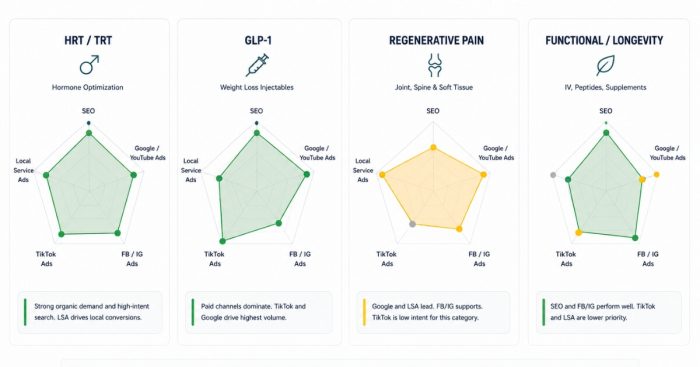
Which channel pairings work best for the four highest-LTV cash-pay verticals (HRT/TRT, GLP-1/weight loss, regenerative pain, functional/longevity)?
The short answer:
- HRT/TRT → SEO + Google/YouTube or talk radio
- GLP-1 → SEO + TikTok or FB/IG
- Regenerative pain → SEO + FB/IG
- Functional/longevity → SEO + organic social + Local Service Ads
The pattern stays consistent across all four:
SEO is always one of the two.
Why?
Because in cash-pay clinics it produces:
“the most ready to buy and most familiar with the business” leads.
HRT/TRT
For HRT/TRT, the audience is product-aware now.
Patients already know:
- What TRT is
- What hormone optimization is
They are choosing between providers.
SEO captures:
- “TRT clinic near me”
- “best testosterone replacement [city]”
Google/YouTube ads stack on top because search intent is already high.
Conservative talk radio with host endorsements can work as a third layer.
However, only after the first two channels are maxed.
GLP-1 / Weight Loss
For GLP-1, the audience is also product-aware in 2026.
However, the buying decision is more emotional and visual.
As a result:
- SEO captures the searcher
- TikTok or FB/IG captures the scroller
Testimonials and patient stories perform best on TikTok.
On FB/IG:
- Aggressive offers
- Audience callouts
- VSL + quiz funnels
- Calendar with credit-card hold
become the standard playbook.
Cost per schedule is the KPI that matters most on FB/IG.
Regenerative Pain
For regenerative pain, the audience is mixed:
- Solution-aware for joint pain
- Problem-aware for neuropathy
SEO is non-negotiable.
FB/IG becomes the ideal second channel.
As the field notes state:
“I really like joint pain, neuropathy, and body contouring on FB.”
The ads require:
- Aggressive offers
- Very fast follow-up
- Front-end cash of at least $3,000
Functional & Longevity Medicine
For functional and longevity medicine, the audience is mostly problem-aware.
SEO handles long-form education.
Organic social handles:
- Storytelling
- Relatability
- Discovery-call traffic
The typical CTA becomes:
- A free discovery call
- With a credit card to reserve the slot
Local Service Ads becomes the correct third channel once depth already exists.
As the field notes explain:
“This can work well for functional medicine, holistic medicine, this can work well for gynecologists and you can upsell people into hormone programs.”
When does a cash-pay medical practice actually earn the right to add channel #3 — and what’s the cost of moving too soon?
You earn channel #3 when:
- Your top two channels have stable CPS for 60 days
- Creative cadence is at sustainable upper bound
- Funnel has been A/B-tested through booking
- Sales process closes at vertical benchmark
The cost of moving too soon is fragmentation of the only resource that matters: your team’s focus. In most cases, picking your top two lead sources and maximizing them first will generate far better results than prematurely adding a third or fourth marketing channel.
Your team’s focus.
What Happens When Clinics Add Channel #3 Too Early
I have watched clinics add channel #3 at month 4 of a Facebook program that was still finding its winning creative.
As a result:
- The Facebook program stalled
- The marketing manager stopped iterating
- The new channel never matured
- Nobody owned execution
Three months later:
- Both channels underperformed
- The owner concluded “ads don’t work for us”
Ads were not the problem.
Focus was.
The Right Way to Add Channel #3
The correct time to add channel #3 is when the first two channels are running so well that the team has obvious capacity.
You should be able to say:
- “My SEO team ships 8 posts a month and we still have backlog.”
- “My FB/IG team ships 12 creatives a month and CPS has been flat at $X for 60 days.”
Only then should you:
- Hire
- Contract
- Build
a third team around channel #3.
Channel #3 should be additive.
Not substitutive.
Real Example of Layering Channels Correctly
A great example of layering channels in the right order over time:
an HRT clinic we grew from $1M to $4M in 4 years
That was not:
- Five channels at once
Instead, it was:
- SEO
- Brand
- Depth first
- Then width layered intelligently
What does the depth-before-width framework cost a cash-pay clinic that runs five mediocre channels instead?
Roughly:
- 40% to 70% of the revenue you could have generated
- 12 to 18 months of lost time
- The morale tax of a marketing team constantly behind
That is the real pattern I see across the 40 cash-pay clinics I have worked with that came in running everything at once.
The Revenue Math
Here is the math.
If:
- Your top channel could generate $100K/month at full effort
- Your second channel could generate $60K/month at full effort
Together, that equals:
- $160K/month
Now compare that to five channels at 20% effort:
- $20K
- $15K
- $12K
- $8K
- $5K
Total:
- $60K/month
Over 12 months, that becomes:
- $1.2M in missed revenue
Then multiply that by your net margin.
That is the real cost of diversifying too early.
The Hidden Team Cost
The second cost is harder to measure:
Your team’s belief that marketing actually works.
When five channels stay mediocre:
- No channel feels like a win
- The team stops iterating
- The owner blames the channels
- The marketing manager quits
Depth before width is not just a math argument.
It is the only reliable way to build a team that understands what winning feels like.
What’s the next step?
If you are currently running:
- Four channels
- Five channels
- Multiple mediocre programs
and none of them is clearly your number one, stop.
Step 1: Score Every Channel Honestly
Pull a board.
Then score every channel against:
- Difficulty
- Scalability
- Quality
- Speed
Step 2: Pick the Best Two
Pick the two channels with:
- The highest current score
- The clearest path to scaling
Then freeze the rest for 90 days.
Step 3: Go Deep
Remember:
Maxed-out means:
- CPS plateaued for 60 days
- Creative cadence saturated
- Funnel A/B-tested
- Sales process at benchmark
Anything less means:
- You still have more channel to mine
- Not more channels to add
If your cash-pay medical practice is running too wide and you want help choosing the right two channels for your vertical and front-end cash threshold — and then actually maxing them out — we’ve done it with clinics ranging from a single regen office to an HRT clinic we grew from $1M to $4M in 4 years.
Book a call and we’ll map your two channels in 30 minutes.