
How Do Google My Business and On-Page SEO Work Together for a Cash-Pay Medical Practice? (The Complete SEO Playbook)
Most cash-pay practice owners treat SEO as one thing. It is not. It is two channels operating in tandem — Google My Business optimization (the local pack) and on-page SEO (the organic blue links) — and the leverage shows up when you build them as one system instead of two siloed projects. The local pack puts you in front of people typing “[treatment] near me.” The organic results put you in front of people researching the treatment by name. The reviews on your GMB profile mention the same services your on-page is optimizing for.
The GMB posts link to and mirror those same service pages. The topical authority compounds across both. Anton’s own framing: “There are two different ways to do this: on page optimization and Google my business optimization… when you couple this with a couple other successful things like good Google reviews and an established brand on social media you can do exceptionally well with SEO.” After running every major patient-acquisition channel across 40 of the fastest-growing cash-pay medical clinics in the country, this is the FAQ on how GMB and on-page SEO work together for a cash-pay medical practice.
What’s the difference between Google My Business optimization and on-page SEO for a cash-pay medical practice — and why do you need both?
GMB optimization ranks your business listing inside the Google Map and local pack; on-page SEO ranks your website inside the organic blue-link results — and a cash-pay practice needs both because they capture different patient intents on the same search.
Google My Business optimization is about your business listing on Google.
It ranks based on:
- Relevance
- Engagement
- Posts
- Reviews
- Descriptions
- The services you have listed
Strong setup means:
- Accurate services
- An accurate description with the keywords people actually type
- Frequent reviews
- Reviews that specifically talk about the services you want to be found for
Then you publish GMB posts on the same themes, so the listing reads as one coherent topical entity.
On-page SEO is about your website.
Google ranks your site based on:
- Domain authority
- Topical authority
- Relevance
- Frequency of contribution
It looks at search-intent match first — how relevant the content is to what the person is looking for — then at:
- Title tags
- Header tags
- Depth of content
- Keyword placement
- Internal linking
- URL structure
- Page speed
- Clear business legitimacy
- Fresh content
The two channels do not replace each other.
- The local pack catches “[treatment] near me.”
- The blue links catch “what is [treatment],” “[treatment] cost,” and “best [treatment] clinic.”
If you only build one, you forfeit half the search-results page on every cash-pay query that matters.
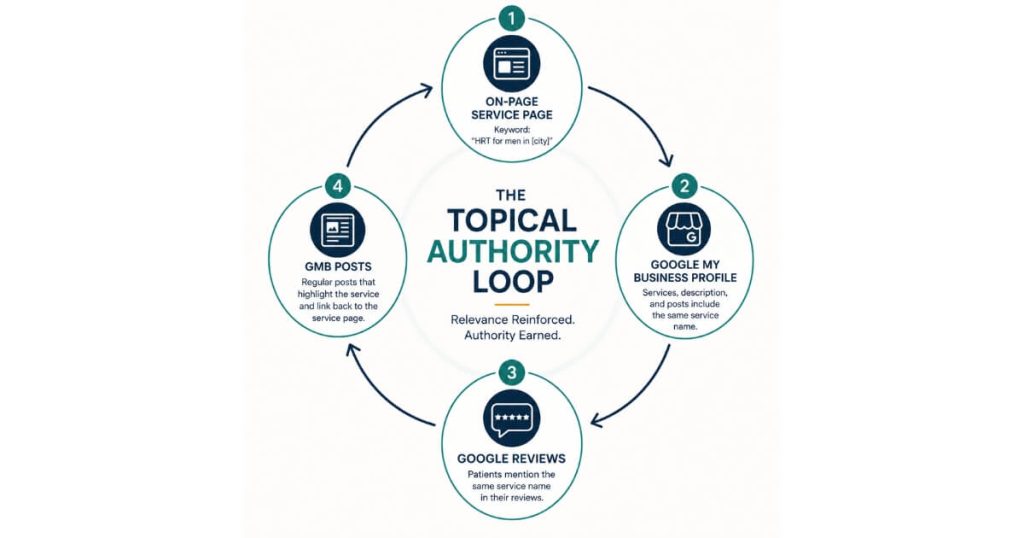
How do GMB and on-page SEO reinforce each other on the same cash-pay treatment keyword?
They reinforce each other by sharing the same keyword set across four assets:
- Your service page
- Your GMB description and services list
- Your reviews
- Your GMB posts
…so Google sees a single, consistent topical entity instead of two disconnected ranking attempts.
Pick a keyword the clinic actually gets paid on.
Example:
- “bioidentical hormone therapy for women”
That phrase should live:
- In the H1 of your service page
- In the title tag
- In two or three subheaders
- In the URL
The same phrase belongs:
- In your GMB business description
- In the services list on the profile
Then you ask satisfied patients for reviews that mention:
- “bioidentical hormone therapy”
…by name — not just “great clinic, friendly staff.”
Then you publish GMB posts on the same topic that link back to that exact service page.
Now four assets are stacking topical signals around the same query.
This is the core of the GMB and on-page SEO playbook. Instead of treating local SEO and website SEO as separate initiatives, the highest-performing cash-pay clinics use the same keyword themes, service pages, reviews, and GMB content to reinforce one another and create a stronger topical footprint across the entire search results page.
This is how an HRT clinic ends up dominating both the local pack and the organic results for the same search.
An HRT clinic we grew from $1M to $4M in 4 years
…went from 80 SEO visits per month to more than 1,000 per month by treating GMB and on-page as one program, and now generates over $1.7M per year in memberships from SEO traffic alone.
The keyword discipline is what made the two channels compound instead of cannibalize.
Should a cash-pay medical practice start with GMB or on-page SEO first?
Start with GMB optimization first because it has the fastest path to leads, then layer on-page SEO as the long-term moat — but begin both in the first 30 days if you can staff it.
Why start with GMB first?
GMB rewards a strong setup quickly.
That includes:
- Cleaning up services
- Writing a description that includes the keywords patients actually type
- Fixing categories
- Adding photos
- Turning on a weekly review-request workflow
These changes can move the listing in weeks, not quarters.
That is your fast money.
The reason to start here is simple:
- A “[treatment] near me” search has the highest commercial intent on the page
- Your local pack listing is the first thing a Most Aware patient sees
You do not want to leave that result blank or weak while you spend six months grinding on blog posts.
On-page SEO is the longer build.
Domain authority, topical authority, and content depth take months to register.
Start it in parallel:
- Rewrite your top three service pages
- Improve title tags
- Improve H2s
- Add depth
- Add internal linking
…in the first 30 days.
But expect the curve to bend at:
- Month four to six
- Not month one
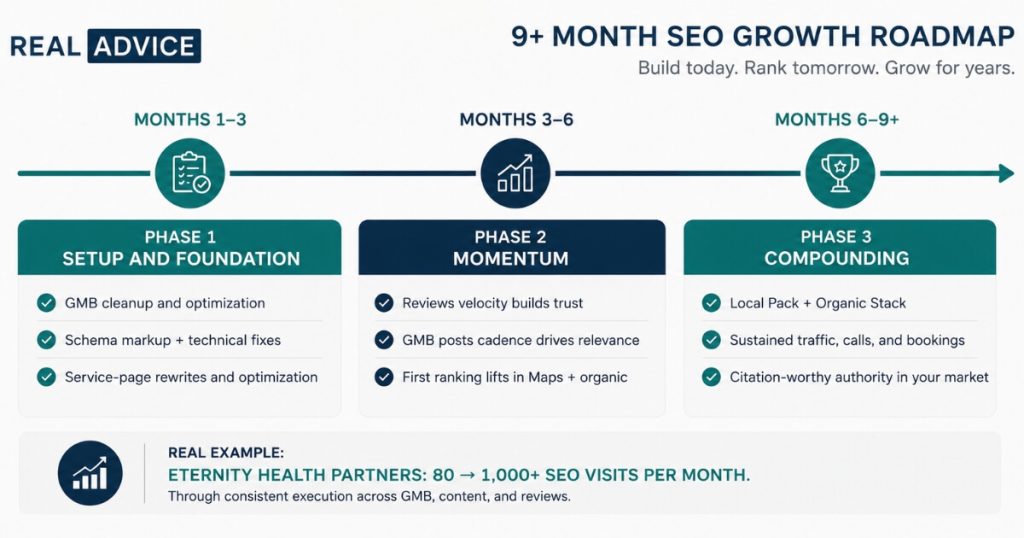
The right sequence:
Month 1
- GMB foundation
- GMB momentum begins
- Initial on-page rewrites
Months 1–3
- Service-page optimization
- Internal linking buildout
- Content structure cleanup
Month 3 onward
- Consistent content cadence
- Topical authority expansion
- Freshness signals compound
Anton’s own line:
“Once you build momentum here it’s an exceptional way to get new business but without momentum it can be difficult.”
What’s the synergy loop between Google reviews, GMB posts, and on-page service pages?
The synergy loop is a four-step compounding cycle:
- On-page service page
- Review request that names the service
- GMB post linking back to the page
- New patient finds the listing, books, and produces the next service-named review
Here’s how it works in practice:
You write a strong on-page service page for:
- “low testosterone treatment”
That page includes:
- Title tag
- H1
- FAQs
- Schema
- Internal links
After a patient finishes their first month of TRT and has results, you send a review request that suggests they mention:
- “low testosterone treatment”
…specifically.
They leave a five-star review with that phrase in the text.
Then you publish a GMB post about TRT that week and link it back to the same service page.
Now Google sees:
- The service page
- The review with the matching keyword
- The GMB post with a matching link
…as one tight semantic cluster.
The next patient who searches:
- “low testosterone treatment near me”
…sees:
- Your local pack listing (powered by the review)
- Your blue link (powered by the page)
…and books.
The loop is what Anton means by:
“make it all tied together and relevant.”
It is not a checklist; it is a system.
Every:
- Review
- Post
- Page
…is feeding the same keyword cluster.
Once it spins, it is exceptionally hard for a competitor to break in, because they would have to:
- Out-review you
- Out-post you
- Out-publish you
…across the entire keyword set.
How long does it take for a cash-pay medical practice to see results from a combined GMB + on-page SEO strategy?
Plan on:
- 90 days for first signals from GMB
- 4–6 months for meaningful on-page lift
- 9–12 months for the two channels to compound into a sustainable lead engine
…assuming consistent execution.
The 90-day mark
By then you have:
- Cleaned the listing
- Accumulated 15–40 new reviews that mention services by name
- Posted weekly
- Started ranking in the local pack on secondary keywords
That is enough volume to start producing booked appointments from the listing alone.
Month 4–6
This is when on-page work shows up in:
- Google Search Console impressions
- Clicks on service-page queries
Month 9–12
This is when:
- GMB
- Reviews
- Service pages
- Keyword clusters
…stack on the same SERP and the implied cost-per-lead from SEO becomes absurdly low.
What does that look like fully ramped?
…is a clean example of a combined GMB + on-page program with zero paid spend supporting it.
The 79.4% conversion rate is part of the story — SEO leads are some of the most ready-to-buy leads you can produce, because they found you on their own at the exact moment they decided they wanted the treatment.
Why does Anton call SEO “my absolute favorite way to build sustainable lead flow” — and what’s the moat?
Anton calls SEO his absolute favorite way to build sustainable lead flow because:
- The leads are the most ready to buy
- The leads are the most familiar with the business
- The moat compounds over time
The moat is:
- GMB momentum
- On-page topical authority
- Reviews
- Brand equity
…and none of those can be bought overnight by a competitor.
Direct quote from the field notes:
“SEO has proven to be my absolute favorite way to build sustainable lead flow in clinics for a lot of different reasons — the leads are probably the most ready to buy and most familiar with the business. And when you couple this with a couple other successful things like good Google reviews and an established brand on social media you can do exceptionally well with SEO.”
A patient who:
- Clicks your blue link
- Reads your service page
- Scrolls to the FAQ
- Sees your GMB profile in the side panel
- Reads 200+ five-star reviews mentioning the exact service
- Then books
…is Most Aware before they ever speak to your front desk.
The sales cycle is short and the show rate is high.
The moat is the part most practice owners underestimate.
- Reviews cannot be backdated
- Topical authority cannot be sprinted into existence
- GMB engagement signals cannot be faked at scale
When a competitor opens across the street and decides to “do SEO,” they are looking at:
- A 9–18 month catch-up curve
…while you keep stacking.
That asymmetry is why Anton pairs SEO with brand:
“I’ve also found that the better your brand is on social platforms the better everything else will convert”
The SEO traffic converts harder when the visitor already half-trusts you.
Build:
- GMB
- On-page SEO
- Reviews
- Brand
…together, and you have the closest thing to a real moat a cash-pay clinic can build.
What’s the next step?
If you are a cash-pay medical practice owner staring at:
- A weak GMB listing
- Three service pages that read like brochures
- A competitor across town pulling patients you should be getting
…the right move is not to simply “do SEO.”
It is to install:
- GMB optimization
- On-page SEO
…as one program, with the:
- Reviews → Posts → Pages → Reviews
…loop wired in from day one.
That is what turned:
an HRT clinic we grew from $1M to $4M in 4 years
…from 80 SEO visits per month into more than 1,000 per month and $1.7M per year in memberships from SEO alone.
If your cash-pay medical practice is ready to build a real SEO moat instead of a checklist, book a strategy call with Real ADvice.
We will:
- Audit your current GMB and on-page setup
- Identify the keyword clusters your competitors have not locked down
- Map the 90-day and 9-month plan to get you compounding on both channels at once.