
TV Infomercials for Cash-Pay Medical Practices — Why $20K+ Programs (Neuropathy, Knee Pain) Convert on Long-Form TV With Inbound-Call Funnels
Every quarter, a clinic owner asks Anton if TV is dead.
The short answer: not for the right offer.
Anton has actually worked for the guy who runs long-form infomercials for neuropathy and knee pain — and the channel still prints money, but only inside a very specific box.
Below is the FAQ on:
- When a cash-pay medical practice should run TV infomercials
- Which offers convert
- What funnel to use
- When to stay away
Anton’s framework comes from his hands-on work with 40 of the fastest-growing cash-pay medical clinics in the country in 2025–2026.
Do TV Infomercials Still Work as a Lead Source for Cash-Pay Medical Practices in 2026?
Yes — TV infomercials still work, but only for a narrow band of cash-pay medical offers built around high-ticket programs aimed at an older audience.
Anton is direct about this:
“I’ve actually worked for the guy who does long form infomercials for neuropathy and knee pain.”
That’s behind-the-scenes experience inside the operator who:
- Buys the media
- Produces the creative
- Runs the call center
The channel hasn’t died; the audience just consolidated.
The people still sitting through a 28-minute infomercial are:
- Predictable
- Older
- More willing to pick up the phone than any other demographic on any other platform
What killed TV infomercials for most clinics wasn’t the medium — it was the offer.
Examples that do NOT survive long-form TV economics:
- Botox specials
- $200 IV drips
But a $20K+ neuropathy program does, because one closed case can pay for an enormous amount of airtime.
If your offer math is right, infomercials are still one of the most predictable inbound-call lead sources in cash-pay medicine.
Why Does Anton Say Only $20K+ Cash-Pay Medical Programs Should Run TV Infomercials?
Because the unit economics of long-form TV only close when each sale is large enough to absorb the production and media cost.
In Anton’s own words:
“Anything that is over 20 grand you can run long form stuff on.”
That’s the threshold he uses.
Long-form TV requires:
- 15-, 28-, or 60-minute paid programming blocks
- A real production crew
- A doctor on camera
- Multiple patient testimonials
- An inbound call center to answer the phones
- Enough volume to keep buying the slot week after week
None of that is cheap, and none of it is fast.
A $20K+ program can justify a high cost per inbound call because the back-end value is enormous.
Examples include:
- Neuropathy bundles
- Advanced knee pain protocols
- Regenerative joint programs
A $300 service cannot.
This is why TV infomercials cluster around:
- Chronic pain
- Neuropathy
- Joint regeneration
- Disease-specific programs older patients pay cash for
Everything else is the wrong medium for the wrong audience.
Which Cash-Pay Medical Offers Convert on TV Infomercials?
Neuropathy and knee pain are the two flagship winners — followed by any high-ticket program targeting chronic conditions in patients 60+.
Anton’s experience pool is specific:
“I’ve actually worked for the guy who does long form infomercials for neuropathy and knee pain.”
Those two offers are perfect for TV because they hit the exact intersection of:
- An older audience watching cable
- A chronic problem that won’t go away on its own
- A program big enough to justify the media spend
The same logic extends to:
- Regenerative joint care
- Advanced pain management
- Balance and fall-prevention programs
- Disease-specific cash-pay bundles aimed at the 60+ market
For social proof that this audience converts when the offer is matched correctly, look at the multi-channel results we drove for:
That clinic isn’t on TV — but it proves the underlying economic point:
The neuropathy and joint-pain demographic will spend serious cash when you put a real program in front of them.
TV is just the highest-leverage way to reach that demographic at scale.
This is exactly why TV infomercials for $20K neuropathy and knee-pain programs remain one of the few long-form advertising models that can still produce predictable ROI in cash-pay medicine.
If your:
- Front-end offer is under $3K
- Audience skews under 50
…this is the wrong channel.
Save the TV budget for:
- Organic social
Those platforms map to a different demographic.
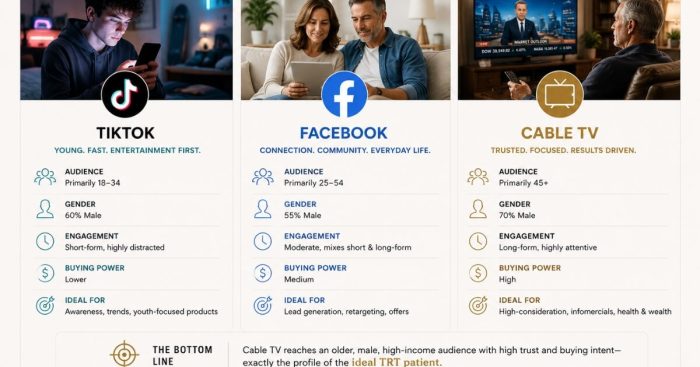
Why Does the Demographic-by-Platform Math Determine Whether TV Works for Your Practice?
Because every platform has a default audience, and TV infomercials sit at the older end of that spectrum — which is exactly where the high-ticket chronic-pain market lives.
Anton’s framing on this is the most important sentence in the whole channel discussion:
“Just think about your audience here no no your audience and like who is really spending the most time on all these platforms.”
That single question:
Who is actually spending the most time on this platform?
…answers most channel-selection questions before you ever look at a CPM.
The TV Audience
“For TV the person who is watching a lot of infomercials is typically older.”
That’s not a knock on the audience — it’s a strategic gift.
Older patients have:
- More disposable income
- More chronic conditions
- More time
They are also dramatically more likely to pick up a phone and call an 800-number than any other demographic.
“If you want to run offers to older folks this is the place to do it.”
TikTok will not deliver that audience.
Instagram will not.
Even Facebook skews younger than late-night and daytime cable.
TV infomercials are the cleanest, most predictable older-audience channel left.
What’s the Right Funnel for a TV Infomercial Campaign?
Long-form video creative driving directly to inbound call ads — that’s it.
No:
- Landing page
- Quiz
- Online scheduler
Anton is blunt:
“Just run them to inbound call ADS it works pretty well.”
The funnel for TV infomercials is intentionally simple because the audience is:
- Older
- Phone-comfortable
- Already warmed up by 15–28 minutes of storytelling
That storytelling includes:
- Patient testimonials
- Doctor authority
- Long-form education
A landing page or quiz funnel adds friction the audience won’t tolerate.
They want:
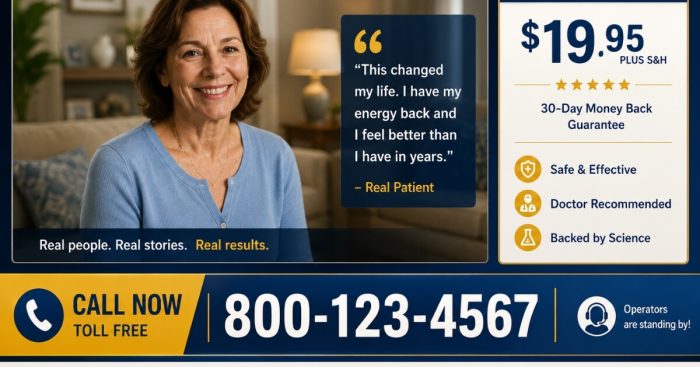
- A number on the screen
- A person on the other end
The Structure That Works
- Open with a relatable patient story
- Neuropathy that ruined retirement
- Knee pain that stopped golf
- Bring in the doctor as the authority
- Walk through the science in plain language
- Stack three to five testimonials
- Present the offer
- Repeat the 800-number throughout
On the back end, you need a real inbound call center staffed by humans trained to book a paid consult.
The infomercial is the marketing; the call center is the funnel.
What Should a Cash-Pay Medical Practice Budget for a TV Infomercial Campaign?
Plan for:
- Production in the tens of thousands
- Weekly media in the tens of thousands
- A fully staffed inbound call center
Only commit if your program is $20K+ with a strong close rate.
This is not a:
“Let’s test $2K and see”
…channel.
You’re buying:
- Paid programming blocks on cable networks that index older
- Broadcast-quality long-form creative
- Staffing for the phone team
Anton’s $20K-program threshold exists because everything below it fails the math when you add up:
- Production
- Media
- Call center
- Close rate
The Smarter Entry Point
The right way to enter TV is to first prove your program converts on lower-cost inbound-call channels such as:
- Radio
- Facebook lead ads with phone follow-up
- Google call-only campaigns
Anton specifically notes that talk radio performs extremely well for TRT clients.
If your inbound-call close rate is strong on those channels, TV becomes a scale lever — not a test.
If your close rate on inbound calls is weak, TV will only magnify the leak.
When Should a Cash-Pay Medical Practice NOT Run TV Infomercials?
Don’t run TV infomercials if:
- Your front-end offer is under $20K
- Your audience skews under 55
- Your inbound-call close rate is unproven
- You don’t have a staffed phone team ready on day one
Channels Better Suited for Younger Audiences
Aesthetics clinics offering:
- Botox
- Filler
- Lasers
- Body contouring
…should stay on:
- TikTok
That audience is younger and lives on those platforms.
GLP-1 weight loss can work on TV in some markets, but the front-end ticket is usually too low to justify the media unless it’s bundled into a multi-month program.
For telehealth, primary care concierge, and most medspa services, better starting points include:
- ZocDoc
- LSAs
- SEO
- Organic social
The Honest Test
Anton asks the same demographic-by-platform question for every channel:
Is the patient who will pay you $20K+ actually watching long-form cable TV?
For:
- Neuropathy
- Knee pain
…the answer is yes.
For most other cash-pay services, the answer is no — and the budget is better deployed on a channel that maps to your real audience.
What’s the Next Step?
If you run a cash-pay program with:
- A $20K+ ticket
- An older patient base
- A phone team ready to answer calls
…TV infomercials may be one of the highest-leverage channels left in your category.
If you’re not sure whether your offer clears the bar — or whether radio, Facebook, or Google is a better starting point — we’ll map the right channel mix to your actual economics before you spend a dollar on production.