
How Should a Cash-Pay Medical Clinic Use Google Local Services Ads (LSA) to Convert Inbound Calls Into Booked Patients?
Google Local Services Ads are the highest-intent paid channel a cash-pay medical clinic can run — a patient who taps an LSA listing is already on the phone with you, often within five minutes of searching. But most cash-pay clinics either set the LSA up wrong, leave 80% of the budget unspent, or hand the inbound call to a coordinator who blows the sale in the first 90 seconds. Here’s the FAQ on how the clinics that book LSA inbound calls at a near-100% rate actually run it.
What Are Google Local Services Ads (LSAs) and Why Should a Cash-Pay Medical Clinic Use Them?
LSAs are the “Google Screened” listings that appear at the very top of Google search results — above standard paid ads — and they send inbound phone calls directly to the clinic.
They cost per lead instead of per click.
For cash-pay medical practices that sell weight loss, hormone replacement, peptides, or any consultative high-ticket service, LSAs do something no other paid channel does: they put a real, live person on the phone with you while their search intent is still hot.
A patient who tapped “weight loss shots near me” five minutes ago and is now ringing your phone is not the same lead as a Facebook form-fill that has to be called back six hours later.
They are ready to ask questions and ready to book.
We had two consecutive LSA inbound calls at a Florida weight-loss clinic last month convert into paid in-clinic memberships the same day — two-for-two on a channel that almost never produces leads that good at the volume LSA can deliver.
The trade-off is that LSAs are unforgiving when the inbound call is handled badly.
There’s no nurture sequence, no retargeting, and no second chance.
If the new patient coordinator picks up and starts pitching the price before they’ve earned the right to, the patient hangs up and books with the next clinic in the listing.
The LSA channel rewards clinics that have already done the work to install a real inbound call script.
How Much Should a Cash-Pay Medical Clinic Spend on Google Local Services Ads?
Most cash-pay clinics should set the LSA daily budget at $80–$150 a day and then track whether Google actually spends it.
Many won’t.
The counter-intuitive thing about LSA budgets is that “top impression rate” doesn’t mean you’re spending the budget — it just means you’re winning every auction Google sees for your category in your geography.
We have an LSA campaign running for a Florida cash-pay clinic with a $100-a-day budget that’s been spending closer to $200 a month total, because the clinic is already at top impression rate and top absolute impression rate inside its current service area.
The campaign isn’t underperforming.
The geography is simply tapped out at current spend.
The right move when you see this pattern — budget room available, impression rate maxed — is to expand the LSA service area to adjacent ZIP codes or suburbs the clinic can credibly serve.
For the Florida campaign, we layered in Plantation, Sunrise, Sunny Isles, Aventura, Hallandale, and Hollywood, and explicitly avoided North Miami Beach because the area’s drive-time and quality didn’t justify it.
The point isn’t to chase volume blindly — it’s to add inventory in markets where the close rate will still hold.
If your clinic can spend $100 per inbound LSA call and book at the same rate you’re booking now, the budget should keep climbing until impression share or close rate breaks.
NuLevel Wellness did $6.7M in revenue in one year on a multi-channel paid acquisition playbook that started from exactly this discipline — track the unit economics on every channel, expand the channels that work, kill the rest.

How Should a New Patient Coordinator Answer an LSA Inbound Call Without Losing Control of the Conversation?
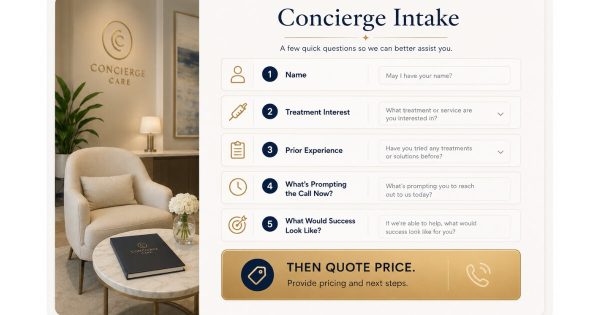
Take control in the first 15 seconds by getting the patient’s name, then asking what they’re calling about, then asking what’s prompting the call now — before quoting price.
The most common mistake we hear when we audit LSA inbound calls is the coordinator who answers, confirms the clinic offers the treatment, and immediately launches into the offer details and pricing.
“Yes, we offer semaglutide, it’s $350 for the first month, includes B12, includes labs, includes…”
The patient is being pushed into a logical evaluation before the coordinator has earned the right to make one.
Patients who book on LSA calls are calling emotionally — they’re frustrated with their weight, their hormones, and their pain — and the moment the conversation moves to price, they shift into shopping mode.
They politely say “thank you” and call the next clinic.
The script that actually books patients flips the order.
Coordinator’s first move is to confirm enthusiastically:
“Absolutely, we offer that. Who am I speaking with today?”
Name.
“Nice to meet you, Christine. Were you looking at semaglutide, tirzepatide, or were you still figuring that out?”
Now the coordinator is gathering qualifying information.
“Have you taken anything like this before, or would this be your first time? What’s prompting the call today — is there a specific timeline or event you’re working toward?”
By the time the coordinator gets to price, the patient has already told them everything the coordinator needs to position the right offer, and the price feels like the answer to the patient’s stated goal — not a sticker shock moment.
The job of the new patient coordinator on an LSA call is to be a consultant, not a menu reader.
That mental model alone changes the close rate.
How Do You Expand Google LSA Geographic Targeting Without Wasting Budget on Bad Neighborhoods?
Add adjacent ZIP codes or suburbs one at a time, exclude the neighborhoods where the patient profile or drive-time breaks down, and watch the cost-per-booked-patient by area for two weeks before scaling.
LSA’s geographic settings let you draw the service area down to individual neighborhoods, and you should use that precision.
Not every adjacent area is worth adding.
In the Florida campaign, we expanded into Plantation, Sunrise, Sunny Isles, Aventura, Hallandale, and Hollywood — all areas where the existing patient base showed strong representation and the drive-time was reasonable.
We deliberately left North Miami Beach off the expansion because the area’s traffic patterns and the surrounding neighborhood quality didn’t match the clinic’s patient profile.
Adding it would have spent budget on inbound calls that wouldn’t convert at the same rate.
The decision rule is:
- The clinic can name three of its existing patients who came from that area.
- The clinic can confidently say the area’s median household income supports a $350–$1,000/month cash-pay membership.
- The drive to the clinic is under 30 minutes in peak traffic.
If any of those three fail, leave it off the LSA service area and revisit in 90 days.
Once new geography is layered in, look at the LSA dashboard for the cost-per-lead and conversion-to-booked-patient by area.
After two weeks, kill any area where the booked-patient cost exceeds your clinic’s LTV-to-CAC threshold and double down on the areas that beat it.
How Do You Tell if a Google Ads Keyword Is Wasting Your Cash-Pay Clinic’s Budget (and What to Do About It)?
If a keyword is using budget and getting clicks but not converting to scheduled appointments, it’s almost always a low-intent search modifier — pull it before it eats the campaign’s daily spend.
In LSA’s sibling product, standard Google Search Ads, the diagnostic is simple:
Pull the search-term report after two weeks and sort by spend descending.
Any keyword burning meaningful budget without producing scheduled appointments is either:
- too broad,
- attracting the wrong intent,
- or matching searches that look right on paper but aren’t ready-to-buy patients.
The classic example is informational searches:
- “what is semaglutide,”
- “how does HRT work,”
- “is GLP-1 safe.”
These look adjacent to commercial intent but produce visitors who are still researching, not booking.
The move is to add those terms as negative keywords and let the campaign rebalance to the converting terms.
On the same Florida campaign, we pulled a cluster of clicks-without-conversion keywords and the next day the campaign spent $7 against two clicks — a sharp drop in volume that looks scary on the dashboard but is the right outcome.
The campaign is relearning where to spend, and during a high-competition week like Black Friday or Thanksgiving, low spend at the right keyword is much better than high spend at the wrong one.
An orthopedic regenerative clinic we generated $309,590 in 10 months of cash-pay revenue for did it almost entirely by relentlessly cutting the keywords that wasted budget and pouring spend into the ones that converted — same campaign architecture applies on the LSA + Google Ads stack.
What’s the Difference Between Google Local Services Ads and Standard Google Search Ads for a Cash-Pay Medical Clinic?
LSAs charge per qualified inbound call and put your listing above standard ads with a “Google Screened” badge.
Google Search Ads charge per click and require the patient to navigate your landing page and fill out a form or call.
For most cash-pay medical clinics, the right answer is to run both.
LSAs catch the highest-intent patients who want to talk to a human now — typically GLP-1, HRT, peptide, and pain inquiries where the patient is symptom-driven and motivated.
Google Search Ads catch the broader intent funnel:
- patients who are comparison-shopping,
- researching,
- or working off a referral and want to see the website before they call.
The two channels are complements, not substitutes.
The unit economics typically run as follows:
- LSAs cost more per lead — $40 to $100 per qualified inbound call is common in cash-pay verticals — but the close rate on a well-handled LSA call is usually 30–60%.
- Standard Google Search Ads cost less per click but require a landing page, a form-to-booking flow, and a follow-up sequence to convert.
The blended cost per booked patient across both channels lands in a place that supports a clinic’s LTV math.
However, cutting either channel cold turkey almost always tanks total booked-patient volume.
Run the LSA dashboard and the Google Ads dashboard side by side.
Review weekly.
Adjust the LSA service area and the Google Ads negative keyword list every two weeks.
The campaign that wins is the one that gets attention every week, not the one with the fanciest ad creative.
What’s the Next Step?
If you own a cash-pay medical clinic and you’re either:
- not running Google Local Services Ads yet,
- running them but not seeing inbound calls convert,
- or running them and watching the budget sit unspent,
book a strategy call.
In 60 minutes we’ll:
- review the existing LSA campaign (or set up the first one),
- audit the inbound call handling,
- and map the geo expansion or negative keyword work that will lift booked-patient volume in the next 30 days.