
How Should a Cash-Pay Medical Clinic Structure Its Google Ads Landing Page and Thank-You Page Funnel for Stem Cells, PRP, or HRT?
Getting Google Ads policy-approved is half the job — the other half is whether the landing page converts and whether the thank-you page does anything besides say “thanks.”
Most cash-pay medical clinics build the campaign and ignore the funnel architecture.
Then they wonder why a $30 cost-per-click produces a $300 cost-per-attended-patient.
Here’s the campaign-naming, conversion-tracking, landing-page, and thank-you-page architecture we use to convert restricted-treatment Google Ads traffic.
How should I name a Google Ads campaign for a cash-pay clinic selling stem cells, PRP, or HRT?
Don’t name the campaign after the treatment.
If your campaign is labeled:
- “Stem Cell Campaign — Knees,”
- “PRP Hair Restoration,”
- or “HRT for Men,”
then you’ve already told Google’s policy classifier exactly what your campaign is selling.
As a result, the classifier may flag it before the auction even runs.
Campaign names are the first input the policy reviewer reads.
Use condition-first naming instead
Name campaigns after the condition you’re treating instead.
Examples include:
- “Knee Pain — Non-Surgical Treatment,”
- “Low Energy Men 40+,”
- “Joint Pain — Alternatives to Surgery.”
The same principle applies to:
- ad sets,
- and individual ads.
The naming convention needs to remain condition-first all the way through the campaign hierarchy because the policy-review system reads every label, not just the ad copy.
Why this matters for compliance
This is the same compliance discipline we built into the Facebook ads playbook for cash-pay clinics operating in regulated verticals.
The principle stays consistent:
- talk about the condition,
- never lead with the treatment.
The in-clinic consult is where the treatment gets named and sold.
How should I set up Google Ads conversion tracking for a cash-pay clinic landing page?
Set the campaign goal to Leads and configure the conversion event to fire when a visitor reaches the thank-you page after submitting the landing-page form.
That sequence is:
- landing page,
- form submit,
- thank-you page reached,
- conversion fired.
This is the only reliable conversion signal Google’s bidder can optimize against.
How to configure the conversion event
The setup process looks like this:
- Go to Tools and Settings inside Google Ads.
- Open Conversions.
- Create a New Conversion Action.
- Choose “Website” as the source.
- Enter the full thank-you-page URL.
- Install the Google Ads tag and event snippet.
- Use the URL-rule trigger:
- “URL contains: /thank-you”
As a result, the conversion fires automatically on page load.
The biggest tracking mistake clinics make
The most common mistake is using the form-submission click itself as the conversion event.
However, that fires before the form validates.
As a result, clinics end up counting conversions that never produced a real lead.
Always fire the conversion event on thank-you-page reach, not button click.
Otherwise, Google’s bidder optimizes against a phantom signal.
That creates the illusion of efficient traffic while cost-per-acquired-patient quietly explodes.
What should the Google Ads landing page actually say for a stem cell, PRP, or HRT campaign?
Lead the page with the patient’s condition, not the treatment.
What the headline should focus on
The H1 should describe the problem the patient is experiencing.
Examples include:
- “Knee pain you can’t get rid of?”
- “Low energy, brain fog, and weight gain after 40?”
Meanwhile, the subhead should imply a non-surgical or non-medication solution exists.
The first body paragraph should describe daily life for someone living with the condition.
What treatment terms to avoid
Do not mention:
- stem cells,
- PRP,
- exosomes,
- peptides,
- HRT,
- TRT,
- or specific treatment names
on the landing page itself.
There are two reasons for this.
First, Google’s policy reviewer sometimes crawls landing-page content the same way it crawls ad copy.
Second, patients at the landing-page stage are usually condition-focused, not treatment-focused.
Across every regulated vertical we’ve tested, treatment-focused copy converts worse at the top of the funnel than condition-focused copy.
Recommended landing-page structure
Build the page around three sections:
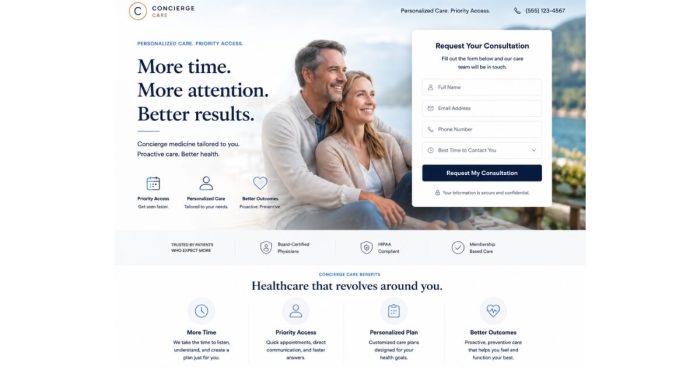
Above-the-fold hero section
Include:
- the condition-focused headline,
- and the embedded opt-in form.
Middle section
Describe:
- symptoms,
- frustrations,
- and available non-surgical solutions in general language.
Final proof section
Include:
- testimonials,
- outcomes,
- and doctor credentials.
We’ve helped an HRT clinic grow from $1M to $4M in 4 years using exactly this architecture — condition-led headlines, no treatment names on the page, and treatment education only after opt-in.
Where should the opt-in form go on a cash-pay clinic Google Ads landing page?
Place the opt-in form in the upper third of the page, embedded directly into the hero section.
Do not place it:
- behind a pop-up,
- below the fold,
- or on a separate page.
Why placement matters
Form-fill rates drop roughly 30% to 50% every time the form moves another fold lower or requires another interaction.
What fields the form should include
The form should ask for exactly four fields:
- first name,
- email,
- phone number,
- ZIP code (only if testing service-area expansion).
Each additional field cuts completion rate by roughly 7% based on our testing across:
- HRT,
- regenerative medicine,
- and weight-loss campaigns.
Why pop-ups underperform
Avoid pop-up forms entirely on Google Ads landing pages.
Mobile users — typically 60-70% of regulated-vertical Google Ads traffic — dismiss pop-ups before they fully load.
As a result, embedded hero-section forms consistently outperform pop-ups by two to three times on identical traffic.
What should the thank-you page do after a cash-pay clinic Google Ads lead opts in?
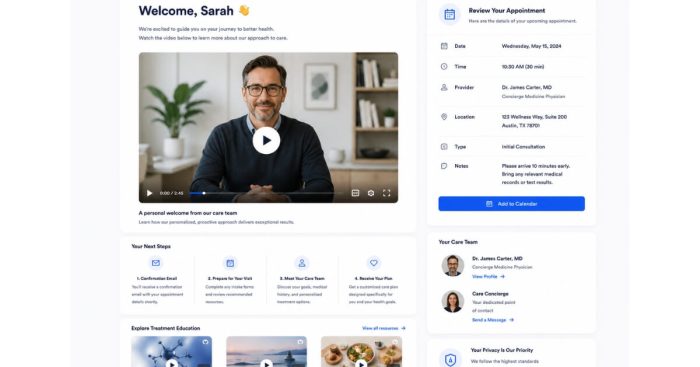
The thank-you page is where the clinic should finally introduce the treatment and educate the prospect.
This is also where the clinic should embed a calendar widget so the lead books immediately instead of waiting for the front desk to follow up later.
Recommended thank-you-page structure
The thank-you page should include:
- a confirmation header,
- an educational video,
- an embedded booking widget,
- and a “what to do next” section.
What the header should say
Example:
- “Thanks — your strategy call is reserved.”
What the education video should cover
The embedded video should run between 90 seconds and 4 minutes.
It should explain:
- what the treatment does,
- how it works,
- and what happens next.
What booking tools to use
Embed:
- GoHighLevel,
- Calendly,
- or a similar scheduling widget
directly on the thank-you page.
Why treatment education belongs here
This is the page where the clinic can finally introduce:
- stem cells,
- PRP,
- peptides,
- HRT,
- or TRT.
At this point, the prospect has already opted in.
Therefore, the policy classifier no longer controls the content flow.
The pre-opt-in page should stay condition-focused.
The post-opt-in page should become treatment-focused.
That transition is one of the highest-leverage conversion points in restricted-vertical Google Ads funnels.
What lead magnet works on a Google Ads landing page for a cash-pay clinic?
A free in-person consultation or a 15-to-20-minute phone consultation is usually the default offer for most cash-pay clinics.
These offers convert best when paired with a tight booking window.
Examples include:
- “Spots available this week”
instead of - “Book any time.”
When ebooks work better than consultations
For higher-ticket or more speculative treatments, an ebook or educational guide may outperform a consultation offer.
We’ve successfully run campaigns for stellate ganglion block treatments — a $3,000+ regenerative pain procedure — using only an educational ebook download.
As a result, the leads arrive more educated and the show-rate improves noticeably.
How to choose the right lead magnet
The decision rule is simple:
- free consult offers maximize lead volume,
- ebook offers reduce lead volume but increase lead quality.
A regenerative clinic we generated $309,590 for in 10 months used the educational-ebook approach to reach a 79.4% lead-to-attended conversion rate.
For most clinics, the best starting point is:
- launch with the free consult,
- then test the ebook variant second.
How should I write the Google Ads copy itself for a restricted-treatment campaign?
Use ChatGPT or Claude for the first draft.
Then edit aggressively for policy compliance.
Recommended ad-copy workflow
Open ChatGPT and paste:
- the keyword list,
- and the condition-focused offer.
Then request:
- 15 headline variants,
- and four description variants.
Remember:
- headlines must stay within Google’s 30-character limit,
- descriptions must stay within the 90-character limit.
What usually happens during generation
Typically:
- the first 5-8 outputs are compliance-safe,
- while later outputs often reintroduce restricted treatment language.
As a result, clinics usually need to rewrite or discard several options.
What the headlines should optimize for
Optimize headlines around the patient’s existing language.
For example:
- “Knee pain alternative”
usually beats - “regenerative knee treatment.”
Likewise:
- “Tired all the time?”
usually outperforms - “TRT for men.”
The closer the language matches how the patient already describes the problem, the higher the click-through rate and the lower the CPC.
Google rewards higher CTRs with cheaper clicks over time.
How to optimize ad performance
Run at least three headline variants per ad group.
Then allow Google’s Responsive Search Ad system to rotate them.
After 14 days:
- pause the bottom performers,
- and iterate on the strongest variant.
This is one of the simplest optimizations that consistently reduces CPC by 20-30% during the first month of delivery.
What automation should fire when a Google Ads lead opts in on a cash-pay clinic landing page?
Build a three-step automation that fires within 60 seconds of opt-in.
Step 1: Send confirmation text
Immediately text the lead:
- a confirmation message,
- and the calendar link.
Step 2: Alert the new patient coordinator
Trigger:
- an SMS,
- or a call notification
to the coordinator.
Step 3: Start the nurture sequence
Enroll the lead into:
- a four-email nurture sequence
that drips treatment education over the next 7 days.
Why speed-to-lead matters
The 60-second trigger matters because Google Ads leads decay quickly.
The cost-per-lead becomes irrelevant if nobody follows up for hours.
Speed-to-lead is one of the biggest variables affecting show-rate.
We’ve measured:
- 40% show-rates on five-minute follow-up,
versus - 12% show-rates on 24-hour follow-up
using identical ads and offers.
Recommended automation platform
Most clinics we work with run this automation inside GoHighLevel.
Importantly, the automation should not depend on the front desk being available.
The sequence should:
- automatically send the SMS,
- pre-populate the calendar link,
- and make the coordinator the second touchpoint rather than the first.
That sequence preserves speed-to-lead without overwhelming the front desk.