
What Is a Good Cost Per Scheduled Appointment at a Cash-Pay Medical Practice? (And the 80% Attendance Rate Benchmark)
Most cash-pay clinic owners track cost per lead and stop there. That’s a mistake. Cost per lead doesn’t tell you whether the lead actually scheduled an appointment, and it doesn’t tell you whether the scheduled appointment ever turned into a person in the chair. The two metrics that actually measure lead nurture — the second of Real ADvice’s five core business functions — are cost per scheduled appointment and new-patient attendance rate. Both have benchmarks. Both can be bonused. Here’s how to calculate them and what “good” looks like for a cash-pay clinic.
Why is cost per scheduled appointment a better KPI than cost per lead at a cash-pay medical practice?
Because a lead that never schedules is worthless — and cost per lead lets the team off the hook for that gap.
When a clinic only tracks cost per lead, the marketing team can claim a great month while the Patient Coordinator burns through 40 cold leads and only schedules 8 of them.
As a result, the marketing budget looks efficient while the schedule looks empty.
Cost per lead said the month was a win.
However, the actual revenue says otherwise.
Why cost per scheduled appointment matters
Cost per scheduled appointment forces the math to include the lead nurture step.
Specifically, it rolls up everything the clinic spent to get someone on the books:
- ad spend,
- SEO retainer,
- organic content costs,
- plus the Patient Coordinator’s salary or commission.
Then the clinic divides that total by the number of new patient appointments actually booked that month.
Because of that, the metric makes the front desk and the marketing team jointly responsible for the schedule.
If cost per scheduled appointment drifts up, either the marketing is bringing in worse leads or the nurture process is leaking.
Therefore, the owner immediately knows which conversation to have first.
How do you calculate cost per scheduled appointment for a cash-pay clinic?
Take every dollar the clinic spent to get appointments booked that month, divide by the number of new patient appointments scheduled, and that’s the number.
The formula is:
(Ad Spend + SEO Spend + Patient Coordinator Salary or Commission + Any Other Booking-Related Costs) ÷ Total New Patient Appointments Booked
What costs should be included?
The pieces that get forgotten are the non-ad spend.
For example, SEO retainer counts.
Likewise, the Patient Coordinator’s salary counts because that role exists specifically to convert inbound interest into scheduled appointments.
If you’re running paid ads, the ad spend counts too.
Meanwhile, if you’re not running ads, the inbound calls from SEO and Google My Business still cost money — they cost whatever you pay to maintain those channels.
Why the Patient Coordinator salary matters
Awareness changes behavior.
When a Patient Coordinator knows the clinic spent $4,200 in marketing this month plus $3,800 of their salary to book 60 appointments — and that’s $133 per scheduled appointment — every inbound call gets treated like the $133 opportunity it is.
On the other hand, when the team doesn’t see the number, every call feels like just another phone ringing.
Eternity Health Partners built its $1M-to-$4M growth on a Patient Coordinator team trained to treat every inbound call like a paid lead, even when SEO drove the call — the cost-per-schedule math was the framework that anchored that training.
What is a good cost per scheduled appointment for a cash-pay medical practice?
It depends on patient lifetime value.
For a high-LTV HRT, functional medicine, or regenerative pain clinic, $100-$200 per scheduled appointment is healthy.
For a high-touch concierge or longevity practice, $300-$500 is fine.
Meanwhile, for a low-LTV one-off cosmetic or single-procedure clinic, anything over $80 starts to break the math.
Why patient lifetime value matters
The number itself is less important than whether it’s stable and whether the downstream conversion rate justifies it.
For example, a $400 cost per scheduled appointment is a great number if those scheduled patients become $13,000 longevity members.
However, the same $400 is a disaster if those patients are $300 weight-loss scripts that churn at month four.
How to calculate the right number
The way to know the number is right for your clinic is to back into it from patient lifetime value.
For example, if a new patient is worth $4,000 of revenue and $2,000 of gross margin, a cost per scheduled appointment of $200 still leaves $1,800 of margin per attended visit — which is healthy.
Therefore, the right number is whatever gives you a clean 5-to-10x return after the patient attends.

How do you calculate new patient attendance rate, and what’s a good benchmark?
Take the number of new patient appointments that actually showed up, divide by the number that were scheduled, and that’s the attendance rate.
Generally, 80% is solid for a cash-pay clinic.
Meanwhile, 70% is workable.
Anything below 70% usually means something is broken.
Why attendance rate matters
If 10 new patients were booked and 7 actually showed, that’s a 70% attendance rate.
The remaining 30% no-showed, cancelled at the last minute, or rescheduled and never came back.
As a result, every percentage point matters.
A clinic with a $5,000 average revenue per new patient and 60 booked appointments a month loses $30,000 of revenue for every 10-point drop in attendance rate.
How clinics improve attendance rate
The fix is operational.
Examples include:
- confirmation calls 48 and 24 hours out,
- SMS reminders,
- credit card on file to discourage casual no-shows,
- online rescheduling,
- a scripted “looking forward to seeing you” call from the Patient Coordinator the morning of the appointment.
Each one of those moves the attendance rate by 2-5 percentage points.
Consequently, a clinic at 65% attendance becomes a clinic at 85% attendance — same marketing spend, 30% more revenue.
This is why cost per scheduled appointment and attendance rate should be viewed together rather than as separate metrics. A clinic can appear efficient on paper by booking appointments cheaply, but if patients fail to show up, the true acquisition cost skyrockets. The clinics that grow most predictably are the ones that improve both numbers simultaneously, turning more scheduled appointments into attended visits without increasing marketing spend.
How do I bonus my Patient Coordinator on cost per schedule and attendance rate?
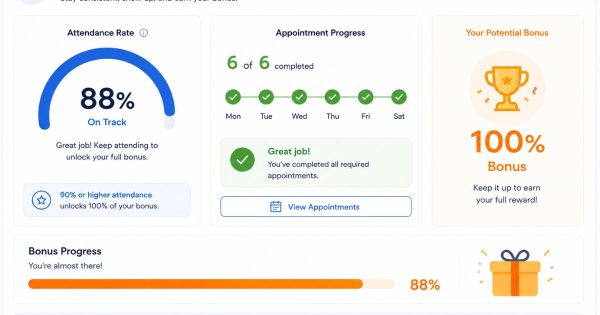
Bonus on two numbers:
- new-patient appointment attendance rate,
- and total new-patient appointments attended that month.
Not booked.
Attended.
Why attended appointments matter more than booked appointments
Bonusing on booked appointments alone creates the wrong incentive.
The Patient Coordinator books anything that moves and lets the no-show rate run away.
However, bonusing on attended appointments aligns the role with the actual revenue.
Because of that, the Patient Coordinator now cares whether the patient shows up.
That means they care about:
- the confirmation call sequence,
- the credit-card-on-file policy,
- and whether the appointment time actually fits the patient’s schedule.
Example bonus structure
A clean structure includes:
- a base salary,
- plus a per-attended-appointment bonus that kicks in above the monthly attendance target.
For an HRT clinic averaging 60 attended appointments, the target might be 60 per month at 80% attendance, with the Patient Coordinator earning $20 per attended appointment above that target.
A great Patient Coordinator who can push attendance from 60 to 80 attended appointments per month earns an extra $400.
At the same time, the clinic earns 20 attended appointments at $5,000 average revenue equals $100,000 of incremental revenue.
Therefore, the math is wildly favorable for both parties.
How do cost per schedule and attendance rate fit into the five core functions of a cash-pay clinic?
They are the two KPIs that measure the lead nurture function specifically — the second of five Real ADvice tracks:
- lead generation,
- lead nurture,
- conversion,
- delivery,
- upsell/resell/cross-sell.
How the five functions are measured
Lead generation is measured by cost per lead and lead volume.
Lead nurture is measured by cost per scheduled appointment and attendance rate.
Conversion is measured by the rate at which attended appointments turn into paid first treatments.
Delivery is measured by patient satisfaction, retention, and clinical outcomes.
Finally, upsell/resell/cross-sell is measured by average revenue per patient and the cross-sell rate from one service into another.
Why most clinics struggle with lead nurture
Most cash-pay clinics measure lead generation well, completely miss lead nurture, and assume the rest will sort itself out.
However, the clinics that systematically grade themselves across all five functions every month — and bonus the right team member against the right KPI — are the ones that grow without the owner constantly intervening.
Orthobiologics Associates ran this exact framework with a 79.4% lead-to-booked-appointment conversion rate — the lead nurture function was the leverage point that produced $309,590 in cash-pay revenue from SEO alone over 10 months.
What’s the next step?
If your cash-pay clinic only tracks cost per lead, you’re flying with one instrument.
Book a strategy call with Real ADvice.
In 60 minutes we’ll calculate your current cost per scheduled appointment, audit your attendance rate, identify the two operational fixes that will move it most, and walk through the Patient Coordinator bonus structure we use across HRT, functional medicine, and regenerative pain clinics.
If it’s a fit, we’ll build it with your team over 90 days.