
How Do I Reactivate Dormant Leads at My Cash-Pay Medical Practice?
Most clinic owners would rather spend $3,000 on new ads than send a single email to the existing patient list. The instinct is wrong — and expensive. Here’s the Real ADvice playbook for reactivating dormant leads with value-first emails, a monthly newsletter cadence, and a mini-course that costs you a Saturday morning to produce.
Why is reactivating dormant leads the cheapest dollar at a cash-pay medical practice?
Because the leads have already crossed the trust threshold.
They booked a consult, attended an appointment, paid for a service, or signed up for a newsletter at some point.
The expensive part of acquisition — convincing a stranger that your clinic is a safe place to spend cash — is already done.
All that’s missing is a reason and a moment.
A dormant lead reactivated via email costs the practice roughly $0 in media spend.
A new lead at a $50 CPL costs $50 before you’ve earned a single appointment.
On any given month, the cheapest 10 patients you can add are sitting in your CRM right now, waiting for the right message.
Why are clinic owners hesitant to email their existing patient list?
Because they feel embarrassed.
There’s pride and shame baked into the relationship — most owners worry that next time the patient walks in, the patient will mention the email and the owner will feel “salesy.”
The clinical relationship and the marketing relationship feel like they shouldn’t mix.
That instinct disappears the moment the email leads with value instead of a pitch.
Patients are not allergic to hearing from their clinic.
They’re allergic to being sold to in a way that feels gross.
If your monthly email is genuinely helpful — a useful guide, a short video, a clinic update — almost no one ever complains.
How do I lead with value (not “$100 off”) when emailing my existing list?
By spending the two-to-three hours it takes to build content the patient actually wants to consume — and then giving it away.
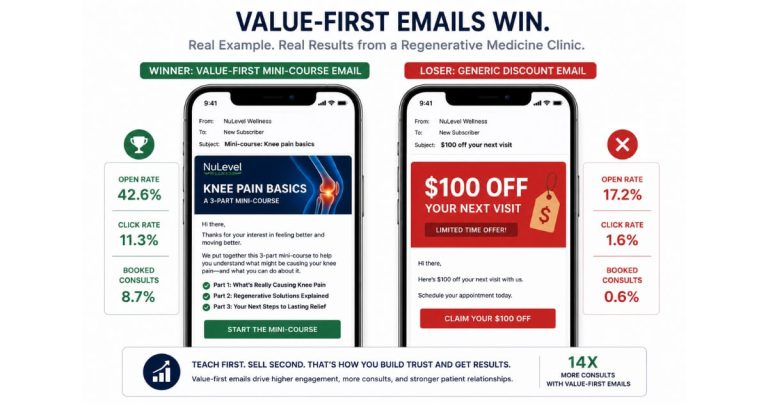
A four-part mini-course on medical weight loss, knee pain, hormones, or peptides will outperform a “$100 off treatment” offer by a wide margin.
Same list, same channel, completely different result.
The reason value-first content wins is that it does two jobs at once.
1. It re-anchors the clinic as the trusted expert
In the patient’s mind.
2. It self-qualifies the patient for a follow-up
Clicking through to a weight-loss mini-course is a much stronger intent signal than ignoring a discount.
Discount emails sell once.
Value-first emails build a relationship that monetizes over years.
How often should I email my existing patient list at a cash-pay clinic?
Monthly.
A monthly newsletter is the sweet spot — frequent enough that the practice stays top-of-mind, infrequent enough that nobody feels spammed.
Consistency is critical when reactivating dormant leads, since many patients simply need the right message at the right time to re-engage with the clinic.
Weekly emails work for clinics with strong content engines and dedicated marketing staff, but they’re a treadmill most practices can’t sustain.
Quarterly is too infrequent — patients forget you exist.
Monthly is the cadence that pencils out without burning the front desk’s time.
What should I put in a monthly cash-pay clinic newsletter?
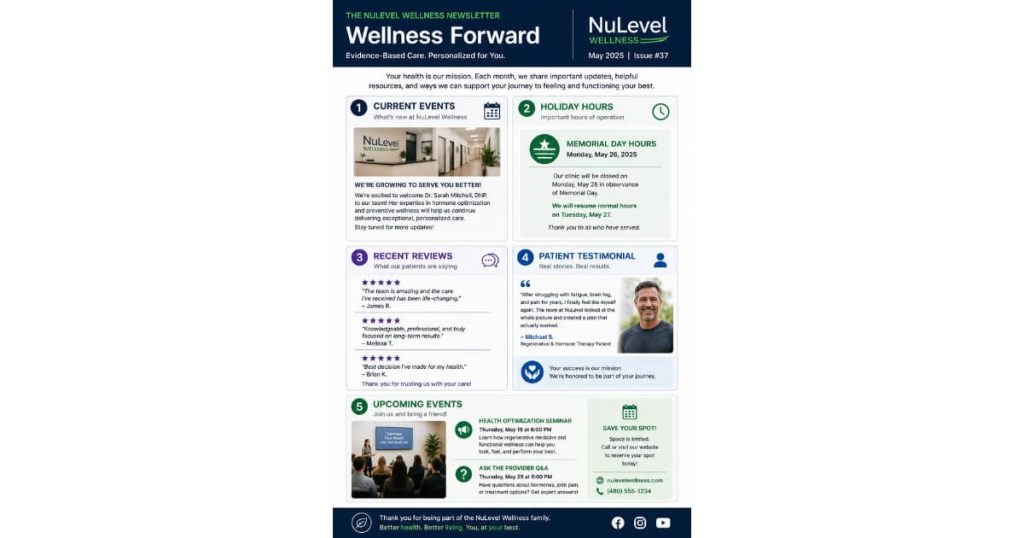
Five recurring sections, none of which require new writing.
1. Current events at the practice
A new service line, a new hire, a new piece of equipment.
2. Upcoming holidays and dates of closure
3. A recent patient testimonial or 5-star review
Something you’d love prospective patients to see.
4. Events you went to or are running
5. A short note of thanks to the patient community
The mistake clinics make is treating the newsletter as a sales channel.
The newsletter is a relationship channel.
The patient should close it feeling like they got a quick update from someone they trust — not like they got pitched.
If the patient also happens to remember they’ve been meaning to book a follow-up, the email did its job.
What tools make writing newsletters fast and easy?
Two we lean on at Real ADvice:
- Fathom
- Otter.ai
Both transcribe spoken audio into text, so the owner or marketing lead can just talk through the month’s update for 5 minutes, paste the transcript into the email template, lightly edit, and send.
Add a CRM with email automation (GoHighLevel and the like) and the entire monthly newsletter workflow costs the practice 15–20 minutes a month after the first one.
Compared to producing one paid ad campaign, the ROI math is absurd in your favor — and it stays absurd because the audience is already pre-qualified.
How does a mini-course outperform a discount offer for reactivation?
Because a mini-course gives the patient a reason to engage that has nothing to do with spending money.
A four-video, 5-minute-per-video course on:
“How Hormone Optimization Actually Works”
…is a piece of standalone value the patient watches because they’re curious about themselves — not because they’re being pushed to buy.
At the end of the course, the call-to-action lands inside an already-warm audience.
The conversion math:
- The same audience that converts at 2–3% on a generic discount email
- Tends to convert at 8–15% on a mini-course-anchored sequence
Inside Orthobiologics Associates, where Real ADvice generated $309,590 in cash-pay revenue in 10 months with a 79.4% lead-to-booked conversion rate, the engine was content-first nurture — not paid ads.
The same dynamic compounds across recurring-revenue practices.
Inside an HRT clinic Real ADvice grew from $1M to $4M with 250 active members paying $1,000/month, list nurture (newsletter + mini-course + monthly reactivation) is a material piece of how the membership base grew — not cold acquisition alone.
If you want Real ADvice to help you build the monthly newsletter template, scope your first mini-course, and wire up the reactivation automations in your CRM,