
How Do I Build a No-Brainer Offer for My Cash-Pay Medical Practice?
The patient acquisition game at a cash-pay clinic isn’t won at the close. It’s won the moment your front-door offer makes saying “no” feel financially irrational. Here’s the framework Real ADvice teaches operators inside HRT, GLP-1, functional medicine, and regenerative practices.
What is a “no-brainer offer” at a cash-pay medical practice?
A no-brainer offer is an entry-point package where the perceived value to the patient so heavily outweighs the cash they pay that saying “no” feels like leaving money on the table.
At a cash-pay medical practice, that almost always means:
- Making the front-door consult free or steeply discounted
- Loading it with deliverables
- Including lab panels, guides, mini-courses, or prorated credit toward a program
- Adding items that cost you little but feel substantial to the patient
The mindset shift required is bigger than the tactic.
Stop protecting “your stuff” like it’s scarce.
There is plenty of business to go around.
The only durable way to win in a saturated cash-pay vertical — HRT, functional medicine, regenerative pain, GLP-1, longevity — is to give more value, faster, than the clinic across town is willing to.
How much should I give away in a no-brainer offer?
Give away exactly as much as you can afford to and still hit your gross margin target on the back end.
The math sets the number, not your fear.
Here’s the example we walk clients through at Real ADvice.
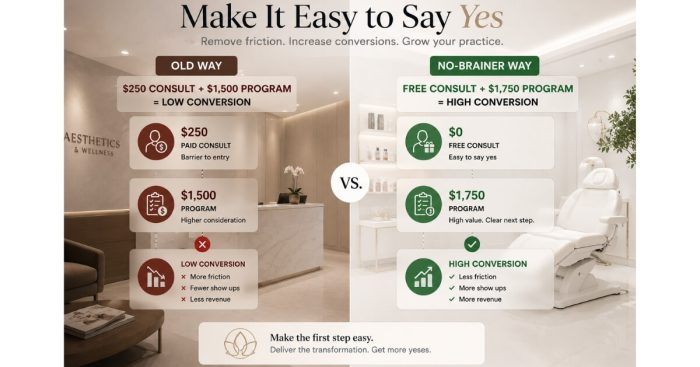
If your standard initial consult is $250 and your downstream program sells for $1,500, you have two clean moves:
- Give the consult away free and raise the program to $1,750 — you’ve recovered the entire give-away on the same patient.
- Charge a small consult fee ($49–$99) so the patient has skin in the game, and prorate that fee against the program.
Either move ports the patient over the price ceiling.
The version that loses is the one where you protect the $250 fee and lose the conversion.
Should I make my initial consult free at a cash-pay clinic?
Sometimes, but only when your front-end qualification is strong enough to keep your provider’s calendar clear of tire-kickers.
A truly free consult invites every browser.
A “free with refundable booking fee” or a $49 stepping-stone consult filters for intent.
The deciding question is whether your team can stack offer types:
- Free intro call screened by a New Patient Coordinator
- Paid consult with the provider
- Program close
Inside “an HRT clinic Real ADvice grew from $1M to $4M with 250 active members paying $1,000/month”, the front end isn’t a single offer — it’s a sequence of low-friction touches that pre-frames the membership close.
What can I include in a no-brainer offer that costs me nothing?
Anything that’s already bundled into your program, plus content assets you create once and give away forever.
The two cheapest, most over-performing additions are:
- Services already inside your program (lab panels, body composition scans, in-office testing) repackaged as a “bonus” the patient receives at the consult
- Educational assets — a PDF guide, a 20-minute mini-course, or a recorded webinar — that cost you nothing per delivery
Patients don’t know your program already includes lab work.
When you put a dollar value next to a “free hormone panel” or “free symptom-mapping guide” in your offer copy, you’ve shifted thousands of dollars of perceived value at zero marginal cost.
The clinics that out-convert their zip code are the ones willing to name and price every bonus, not the ones running a generic “schedule a consult” form.
Why is the “we can’t make money if we give it all away” mindset killing cash-pay practices?
Because it’s measuring the wrong unit.
Every dollar of “free stuff” gets spread across the lifetime revenue of the patient, not the first visit.
A free $250 consult given to a patient who joins a $300/month HRT membership and stays 22 months is a $6,600 transaction with a 96% gross margin on the back end.
The math only looks scary on the first invoice.
The clinics that win in cash-pay aren’t the cheapest and aren’t the most expensive.
They’re the ones whose entry offer is so generous that the patient pre-commits emotionally before the provider walks in.
The scarcity mindset — “we can’t give it away for free, that’s our IP” — is how marketing budgets get spent on traffic that bounces off a paid consult page.
The clinics that consistently outperform their competitors understand that building a no-brainer offer is not about discounting services—it’s about increasing perceived value at the point of first contact. When patients feel like they’re receiving significantly more value than they’re risking, conversion resistance drops, consult attendance improves, and the entire acquisition funnel becomes more efficient.
How do I price the rest of my services around a no-brainer offer?
Anchor the rest of your menu against the give-away, not the other way around.
If you’ve decided to give a $250 consult away free, raise the program by $250, or add $500 of newly-named “bonuses” (90-day follow-up, group coaching call, supplements at cost) into the program so the price hike is invisible to the patient.
Two anti-patterns to avoid:
- Don’t run a loss-leader consult without raising the program — you’ll discount your way to bankruptcy.
- Don’t make the bonuses contingent on closing the program.
Let the consult deliverables stand on their own.
The patient should leave the free consult feeling they got real value even if they buy nothing.
That’s what makes the next step feel like a no-brainer instead of a sales pitch.
How do I know my no-brainer offer is working?
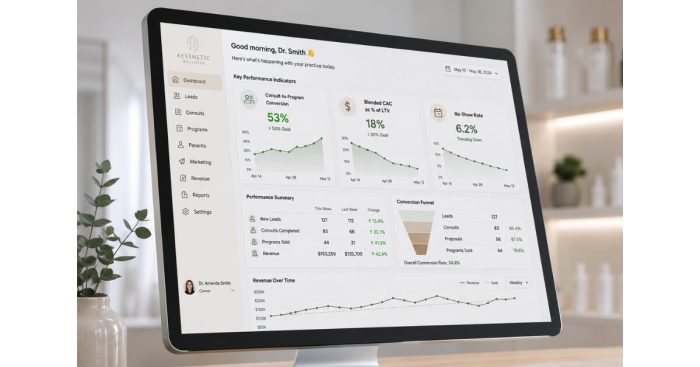
Three numbers, all measured weekly.
- Your consult-to-program conversion rate should sit above 50% — under that, the offer isn’t doing the heavy lifting and your provider is closing on charm.
- Your blended cost per acquired patient (ad spend + give-away cost + staff time) should land below 20% of patient lifetime value.
- Your no-show rate on the consult should drop, because a high-value free package creates the same psychological commitment as paid skin in the game.
If you’re watching “a regenerative medicine clinic Real ADvice added $2,095,039 in revenue to in 10 months”, the lever wasn’t more leads.
It was tightening the offer so every consult slot converted at near-2× the prior rate.
Same calendar, same provider, different offer — different P&L.
If you want Real ADvice to audit your current offer, build the no-brainer version, and rebuild your front-end pricing so the math holds,