
How Does a Cash-Pay Medical Practice Build Paid Ads for a High-Ticket Program?
The Offer-First Framework, Lead Magnet Sequence, and Creative Anatomy
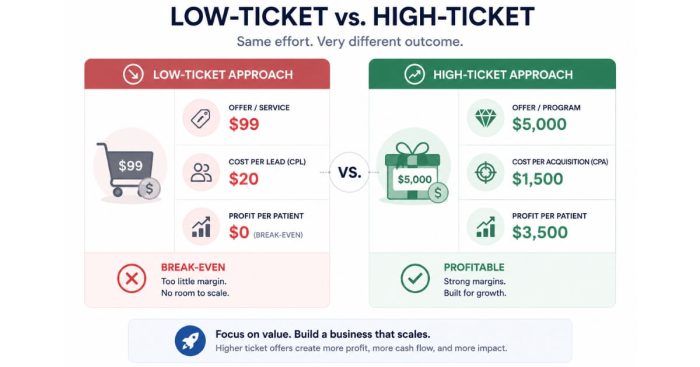
Most cash-pay clinic owners who try paid ads start with the wrong unit — they try to sell a $99 initial consult or a $300 service against a $20 cost-per-lead, and the math never works. Instead, the clinics that scale on paid ads sell programs worth $5,000 to $15,000 from day one, use lead magnets instead of cold consult asks, and compete on value rather than on price. As a result, this high-ticket framework makes a $1,000 to $2,000 patient acquisition cost profitable on the first booking and cheaper on every subsequent one.
How do I build paid ads for a high-ticket cash-pay medical practice?
You build paid ads for a high-ticket cash-pay medical practice by:
- Selling a $5,000 to $10,000 program rather than a single low-ticket service
- Leading every ad with a free lead magnet instead of a direct consult ask
- Competing on value rather than price
However, the single biggest reason cash-pay ad campaigns fail is that owners try to sell their cheapest service first, then “upsell” later.
Because of that, the math does not survive contact with realistic CPL.
The clinics that scale flip the order — they sell the program upfront and offer free value (lead magnet) as the entry point.
Typically:
- Cost-per-lead stays around $20 to $40
- Cost per booked patient lands at $1,000 to $2,000
- Revenue per patient reaches $5,000 to $15,000
Therefore, the unit economics work from day one.
Why does paid advertising work better for high-ticket programs than low-ticket consults?
Paid advertising works better for high-ticket programs because the unit economics tolerate real customer acquisition cost.
For example, when the program is $5,000 to $10,000, spending $1,000 to $2,000 to acquire the first patient still nets several thousand dollars per booking.
In addition, the second patient from the same campaign almost always costs less than the first — the algorithm has learned, the creative has compounded, and the audience has refined.
By the tenth patient, the cost-per-acquired is often half what the first patient cost.
Ultimately, the flywheel works at high-ticket prices.
Unfortunately, it does not work at low-ticket.
What high-ticket programs work best for paid ads at a cash-pay medical practice?
Six program structures consistently work for paid ads at cash-pay practices:
- Neuropathy programs
- Knee or joint pain regenerative programs (PRP, prolozone, shockwave, stem cell)
- Functional medicine programs
- Thyroid programs
- Hormone optimization programs (TRT, HRT, peptides)
- Membership models
Among these, membership models are the strongest because they convert a single paid acquisition into 12 to 24 months of recurring revenue.
For example, a patient acquired for $1,000 on a paid ad who pays $300 to $400 per month for hormone optimization for 18 months produces $5,400 to $7,200 in LTV — and the ad spend was paid back inside the first quarter.
Why use a lead magnet instead of asking patients to book a consult directly?
Use a lead magnet — checklist, quiz, ebook, short video, PDF roadmap — because giving the patient something of value first triggers the law of reciprocity and builds authority before you ask them to do anything.
As a result, patients who:
- Download a Low T checklist
- Complete a 90-second menopause quiz
- Watch a 5-minute video about knee pain treatment options
…arrive at the consult already familiar with the clinic, already convinced the provider is an authority, and already pre-disposed to buy.
Because of that familiarity, the lead-magnet-first funnel typically converts 2 to 3x better than a cold consult ask.
What lead magnets work best for HRT, regenerative, and longevity ads?
For HRT and TRT, the strongest lead magnets are:
- A Low T quiz
- A Low T checklist for men
- A Menopause checklist
- A Menopause quiz for women
Meanwhile, for regenerative or joint pain:
- A “do-you-qualify-for-PRP” quiz
- A treatment roadmap PDF
For longevity:
- A baseline assessment scorecard
Additionally, for functional medicine:
- An ebook on hidden hormone, thyroid, or gut health issues
The construction trick is simple: the quiz or checklist should reuse the questions you would already ask in the first consult — formatted as a self-serve 90-second form.
As a result, the patient does the work that your front desk used to do, conversion rate goes up, and the provider has a clean intake sheet before the consult.
For a practice that built a high-ticket HRT membership program and scaled it from $1M to $4M annually on this exact framework, see how Eternity Health Partners grew from $1M to $4M in 4 years on a $1,000-per-month HRT membership model with 250 active members — the membership math is what makes the paid ads profitable.
How should a cash-pay clinic price a high-ticket program against the competition?
A cash-pay clinic should not price a high-ticket program against the competition at all.
Instead, compete on value, not price.
The dentist membership model is the cleanest example to copy:
- $350 per year
- Two cleanings
- An annual exam
- An X-ray
- 10 percent off all treatments
Importantly, the dentist did not look at what other dentists charged.
Rather, they bundled the patient’s recurring needs into a single annual package and added experiential touches that did not show up on a price comparison spreadsheet:
- Sunglasses to wear in the chair under the overhead light
- Chapstick to take home after the appointment
Ultimately, the patient remembers how they were made to feel.
How big should the audience be for a local high-ticket ad on Facebook or TikTok?
For a local high-ticket ad on Facebook or TikTok, target an audience of 150,000 to 225,000 people.
If the audience is bigger than that, the algorithm spreads thin across irrelevant cohorts and produces too much waste.
On the other hand, smaller audiences create too narrow an optimization signal.
Layer in gender and age based on the program:
- Men only for ED treatments
- Women only for aesthetics or female-HRT
- Age 50+ for osteoarthritis or longevity
- Age 25-50 for athletic regenerative or sports recovery
Then, use radius from the clinic as the geographic constraint and start wide on the radius before tightening.
Once you have 2,000 to 3,000 existing customers in your CRM, upload them as a lookalike audience seed.
What are the three components of a high-ticket cash-pay clinic ad?
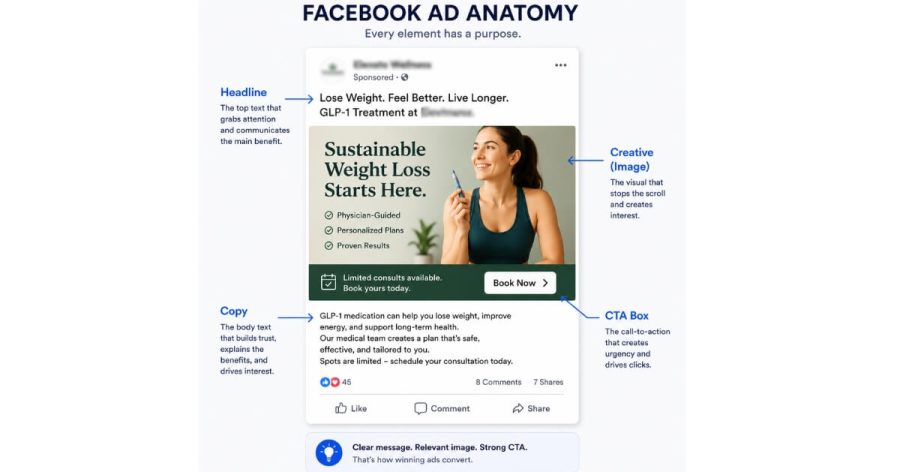
Three components:
- The creative
- The headline
- The copy
First, the creative is the static image or video — for high-ticket cash-pay, it depicts either the outcome the patient wants or the pain they are escaping.
Outcome-led:
- A 60-year-old playing with grandkids for osteoarthritis
- A confident woman walking outdoors for weight loss
- A couple on a beach for HRT
- A golfer mid-swing for joint pain
Pain-led:
- Inflamed knees
- Feet on fire
- Disappointed couple in bed for ED
Second, the headline names the patient by city or demographic:
- “Residents of Exeter, New Hampshire”
- “Women of Irving, Texas”
- “Moms of Atlanta”
Finally, the copy acknowledges the patient’s struggle, makes them feel understood, then offers the free lead magnet.
The bottom CTA box adds scarcity:
- “Limited consults available”
- “Click the link to apply”
For a cash-pay orthopedic surgical practice that turned Facebook ads into $2,000,000 in revenue using exactly this anatomy, see how an Orthopedic Surgical Center added $2 million in revenue from Facebook ads alone — the creative, headline, and copy structure are the same patterns that work in HRT, GLP-1, and regenerative campaigns.
Should I test a high-ticket cash-pay offer before running paid ads?
Yes.
Before spending a dollar on paid ads, test the offer on your existing email list.
Take your:
- Headline
- Ad copy
- Offer
Then, paste them into an email and send it to your past patient list.
If patients who have already done business with you do not respond, cold paid traffic will not either.
Fortunately, the email test costs nothing, takes one afternoon, and saves $2,000 to $5,000 in misallocated ad spend.
What’s the right Facebook lead-form setup for a cash-pay clinic just starting on paid ads?
For a cash-pay clinic just starting on paid ads, use Facebook’s native lead forms rather than building a landing page.
The native form requires:
- No pixel setup
- No landing page design
- No separate hosting
As a result, Facebook captures the lead, you receive it via Zapier or CRM webhook, and your automation sends the promised resource (ebook, quiz result, video link) within seconds.
In addition, the native form converts at higher rates than most homemade landing pages because Facebook pre-fills the fields with the user’s existing profile data.
Once volume and budget justify it ($5,000+ per month in spend), graduate to a custom landing page.
What should a cash-pay medical practice do this month to launch a high-ticket paid ad campaign?
A cash-pay medical practice should do five things this month to launch a high-ticket paid ad campaign.
- Build or productize a $5,000+ program if one does not exist yet.
- Build the lead magnet that pairs with the program (Low T quiz, menopause checklist, joint pain roadmap, longevity scorecard).
- Test the headline, copy, and offer on the existing email list and confirm it gets opens and clicks.
- Launch a Facebook or TikTok campaign with:
- A 150-225K audience
- Age and gender filters appropriate to the program
- The lead magnet as the conversion event
- Facebook’s native lead form
- Run for 21 to 30 days at $50 to $150 per day and evaluate against the $5,000 to $15,000 LTV — not against the discomfort of mid-spend.