
Why Aren’t My Regenerative Medicine Clinic Leads Picking Up the Phone? (Urgency, Offer Termination Dates, and the Joint Pain Google Ads Playbook)
- A regenerative medicine clinic we work with came to a strategy call with the exact problem most pain and regen practice owners eventually hit: 13 leads in two weeks from a paid campaign with strong keyword targeting, every lead from a local area code, and zero booked consults. The new patient coordinator was calling within four minutes, leaving voicemails, sending follow-up SMS — everything by the book. The leads still weren’t answering. Here is the diagnosis and the urgency + SMS fix that addresses it. *
Why aren’t my regenerative medicine clinic leads picking up the phone?
Most regenerative medicine clinic leads who don’t pick up the phone are not unqualified — they are unurgent.
They submitted a form during a busy moment, lost the emotional momentum, and now treat your callback as a low-priority interruption.
The fix is not more education, not more polished video, and not a longer voicemail.
It is adding an urgency mechanism — a dated financial offer, a limited number of consult slots, or a deadline-bound incentive — and rewriting the first automated SMS so it sounds like a real human instead of a robot.
The pattern we saw on the call:
- 13 inbound leads in two weeks
- Every one from a local area code
- Every keyword bottom-of-funnel (“avoid knee surgery,” “PRP for joints,” “Fargo non-surgical joint pain care”)
- Only 4 of the 13 ever picked up the phone
The leads were good. The urgency layer was missing.
How do I tell if my regenerative medicine ads are producing good leads even when they don’t answer?
You tell if your regenerative medicine ads are producing good leads by checking three signals before changing anything about the campaign.
1. The keyword that triggered the conversion
Google’s dashboard shows you the exact search term.
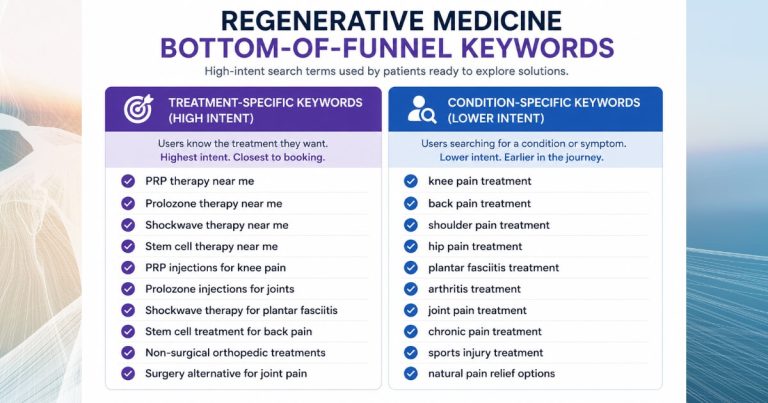
Bottom-of-funnel terms like:
- “PRP therapy near me”
- “stem cell treatment”
- “shockwave therapy for knees”
- “alternative to knee surgery”
- “Lipo near me”
…are high-intent.
Top-of-funnel terms like “knee pain” or “arthritis” are not.
2. The area code on the lead’s phone number
Local area codes mean the patient is within driving distance and could realistically book.
3. The area-of-interest field on your intake form
If the form captures:
- “PRP for shoulder, lower back”
- “fat removal without surgery, lipo near me”
…the lead has self-identified the exact service they want.
When all three signals check out and the leads still don’t answer, the lead quality is fine.
The problem is urgency and SMS tone.
Understanding why regenerative leads don’t answer the phone is critical before making changes to your ads. In many cases, the targeting and keywords are working exactly as intended — it’s the follow-up experience, urgency, and messaging that determine whether the patient re-engages.
How do I add urgency to a regenerative medicine offer to get leads to call back?
Add urgency to a regenerative medicine offer by attaching a termination date to the financial incentive.
A $1,000-off offer becomes meaningfully more urgent when the SMS reads:
“Claim your $1,000 off within 30 days”
or:
“$1,000 off ends June 1.”
The financial stake creates the pressure that seasonal angles (summer, swimsuit, healing-window) do not, because seasonal angles ask the patient to imagine themselves three months in the future — financial deadlines ask them to act today.
Limited consult slots — “we have only two openings between now and June 1st” — work for a portion of the patient base but produce a smaller phone-answer increase on their own.
The deadline-bound discount is the cleanest single move.
For an example of a pain and regenerative practice that compounded this kind of urgency-driven funnel into real revenue, see how Elite Pain Doctors added $2,095,039 in revenue in 10 months on 26 organic leads per month — the offer structure, the SMS cadence, and the urgency framing were the operational levers.
What should the first automated SMS to a regenerative medicine lead say?
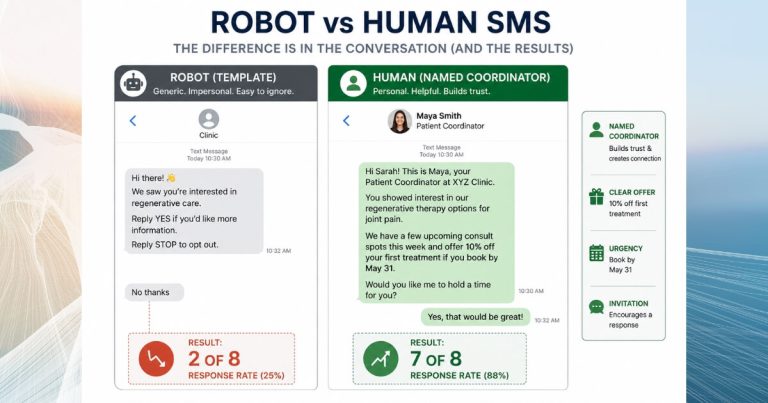
The first automated SMS to a regenerative medicine lead should sound like a real human, mention the offer with its termination date, and include one specific action.
The bland robotic template:
“Thanks for your interest, a team member will reach out shortly”
…gets a 2 out of 8 response rate (25 percent).
A human-tone replacement runs more like:
“Hi, it’s Tabby from Everest. Saw you’re interested in PRP — quick heads-up the $1,000-off offer ends this month and we have two openings this week. Want me to text or call to book?”
Three elements changed:
- Named sender (“it’s Tabby”)
- Specific reference to the patient’s interest (“interested in PRP”)
- A binary action question (“text or call”)
The response rate on the human-tone SMS typically runs 2 to 3x the robotic version.
How much should a regenerative medicine clinic spend daily on a new Google Ads campaign?
Start at $50 per day on a new regenerative medicine Google Ads campaign.
At $50 per day, the campaign collects roughly 21 days of conversion data — enough to optimize keyword bidding, ad copy, and landing page conversions — for about $1,000 in spend.
Always evaluate against the lifetime value of the regenerative patient.
A single regenerative patient typically spends $5,000 to $7,000 with the clinic over their care journey (PRP series, prolozone follow-up, shockwave maintenance, peptides, and ancillary services).
One new patient acquired from $1,000 of ad spend is a profitable campaign on day one.
Should I launch treatment-specific or condition-specific Google ad groups first?
Launch treatment-specific ad groups first.
Keywords like:
- “PRP therapy near me”
- “stem cell treatment”
- “prolozone injection”
- “shockwave therapy for knees”
- “alternative to joint surgery”
…are bottom-of-funnel — the patient is searching for the solution by name, which means they are educated, motivated, and ready to evaluate a specific provider.
Condition-specific keywords like:
- “knee pain”
- “shoulder pain”
- “hip pain”
- “arthritis”
- “osteoarthritis”
…attract a broader top-of-funnel audience that still has to be convinced regenerative medicine is the right answer.
Start where the buying signal is strongest.
After 21 days of data on treatment-specific ad groups, expand into condition-specific keywords with a slightly lower bid and a more education-heavy landing page variant.
For a regenerative practice that ran a similar bottom-of-funnel-first strategy and converted at exceptional rates, see how Orthobiologics Associates generated $309,590 in cash-pay revenue in 10 months without paid ads — at a 79.4 percent conversion rate from leads to booked appointments — the treatment-specific keyword focus is part of why the conversion math compounds.
What does a “complimentary consultation + $1,000 off” offer convert at in regenerative medicine?
On a regenerative medicine clinic running a complimentary-consult + $1,000-off offer properly, the lead-to-answer rate on Google search leads typically runs about 50 percent.
From answered calls, booked-consult rate runs 50 to 70 percent.
From booked consults, consult-to-paid-procedure converts another 40 to 60 percent.
The clinic in question saw 13 search leads with only 4 answered (31 percent) — the signal that the SMS and urgency layers needed the rewrite, not the offer itself.
Two changes — termination date on the offer and human-tone SMS — typically pull the answer rate from 31 percent into the 50 to 65 percent range inside two weeks.
How long should a regenerative medicine clinic test a new paid ads campaign?
A regenerative medicine clinic should test a new paid ads campaign for at least 21 days at $50 per day.
That is $1,000 of spend, which delivers enough conversion volume on Google to evaluate:
- Keyword performance
- Ad copy resonance
- Landing page conversion rate
- SMS response rate
…together.
Killing the campaign before 21 days is the most common mistake — the algorithm has not finished its learning phase, the SMS data is too thin to optimize, and the clinic ends up restarting from zero two months later.
Hold the test for the full 21 days.
What should a regenerative medicine clinic do this week to fix lead conversion?
A regenerative medicine clinic should do four things this week to fix lead conversion.
1. Audit the last 30 days of leads
Confirm the keywords, area codes, and form interest fields look right — if they do, the lead quality is not the problem.
2. Rewrite the first automated SMS
Use a human tone, name the new patient coordinator, reference the patient’s stated area of interest, and include a binary action question (text or call).
3. Add a termination date to the offer
Attach a 30-day termination date to the existing financial incentive and mention it inside:
- The SMS
- The landing page
- The voicemail script
4. Launch a treatment-specific Google Ads campaign
Run the campaign at $50 per day for 21 days and evaluate against the $5,000 to $7,000 LTV of a regenerative patient — not against the discomfort of mid-spend.