
How Does a Multi-Location Cash-Pay Practice Launch a New HRT Marketing Campaign (The $50/Day-Per-State TikTok Playbook)
- A multi-location cash-pay HRT practice we work with came to a strategy call with one number on the wall: 50 new HRT patients per month, growing from there. The campaign they were about to launch — TikTok ads, three states, one practice — needed a clean budget structure, a per-source attribution model, and a speed-to-lead path their three-person sales team could actually run. Here is the launch playbook with the real numbers and the exact CRM stack. *
How much should a multi-location cash-pay practice budget to launch a new HRT campaign?
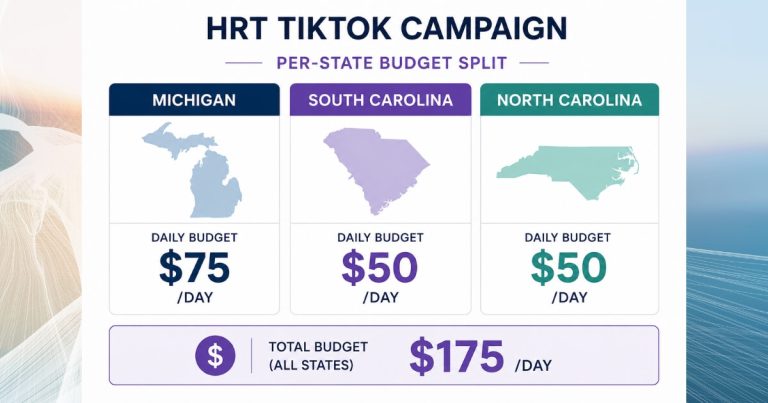
A multi-location cash-pay practice should budget $50 per day per state on TikTok to start, with each state set up as its own campaign so spend and results can be tracked by market.
For a three-state launch — say Michigan, South Carolina, North Carolina — that is $150 per day in total.
Larger metros like Detroit can absorb $75 per day from day one because of their search and audience volume; smaller markets should hold at $50 per day until conversion data confirms the funnel is working.
The benchmark we use comes from a comparable optimized HRT campaign in our portfolio: $100 per day produces leads at roughly $10 each after four months of optimization.
Plan for $20 leads in the first eight weeks. The algorithm settles, the creative iterates, and the cost per lead drops by roughly half over the first quarter.
What’s a realistic HRT lead-to-paid-consult conversion rate from paid social?
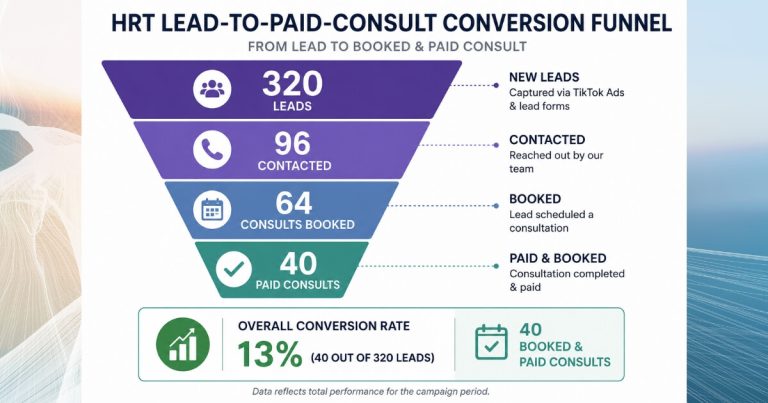
A realistic HRT lead-to-paid-consult conversion rate from paid social is about 13 percent on a telehealth funnel that asks for a credit card to book the consult.
The proof point from a comparable practice we work with: 320 leads in a single month produced 40 paid, credit-card-secured consults.
That is roughly 1.5 out of every 10 leads converting to a booked, paid consult.
The conversion rate is lower than a free-consult or free-discovery-call model — the credit card adds friction — but every booking is a qualified buyer, and the front-desk time per booked patient is dramatically lower.
Should each HRT ad have its own landing page and form?
Yes. Each HRT ad should have its own dedicated landing page and form.
The reason is attribution.
Clone the funnel for every ad source — TikTok, Meta, Google Search, organic — and build a separate form for each.
If only one ad points to a form, every submission is unambiguously attributed without UTMs, hidden fields, or source-medium-campaign parameters.
The cleanest framing is:
“The only way to get to this form is from this ad. Nobody else will see it. So anyone who fills this form out already came from that ad.”
Add a CRM tag at form submission, named for the platform — for example, “HRT Quiz – TikTok” — so the tag survives every downstream Zap into the patient CRM, Microsoft Teams, and any tracking spreadsheet.
For a practice that ran a similar HRT-first marketing playbook to compound recurring revenue, see how Eternity Health Partners grew from $1M to $4M per year in 4 years, building 250 active HRT members and turning SEO traffic from 80 to 1,000-plus visitors per month into $1.7M of annual membership revenue — the per-ad-source attribution discipline is part of why the numbers compounded.
How fast do you have to respond to an HRT lead from TikTok or Meta?
You have to respond to an HRT lead from TikTok or Meta within seconds.
The ideal model is an automated text that fires the moment the form is submitted, while the prospect’s phone is still in their hand.
Social leads come in during lunch breaks, decompression moments, or downtime — once the prospect goes back to their life, the emotional commitment from the ad is gone and they will not pick up the call later.
The text should ask whether the prospect prefers to schedule by text or by call.
Most will pick text.
The downstream cost of slow speed-to-lead is hidden but large.
A clinic spending $150/day and responding to leads four hours later is often paying for full ad delivery while only converting 20–30 percent of the leads a fast-response team would convert.
What if I don’t have a dedicated call center to handle inbound HRT leads?
If you do not have a dedicated call center to handle inbound HRT leads, add a “best time of day” radio field to the form and route submissions into Microsoft Teams plus a shared spreadsheet.
The five-option radio that works at multi-location practices:
- 9am-noon
- noon-2pm
- 2pm-5pm
- 5pm-7pm
- anytime
The team — even three people — can then call out during the prospect’s chosen window.
A small-scale internal trial showed exactly how strong even a moderate-response setup can be:
- Five out of five leads picked up the phone
- Four of five scheduled an appointment
Expect to graduate to full speed-to-lead automation once volume justifies a dedicated responder.
How should I target women for an HRT campaign on TikTok?
For an HRT campaign on TikTok, target women, age 45 and older, inside a driving radius of each clinic location, and layer on TikTok’s “engaged shoppers” audience — women who actively shop online.
Engaged shoppers click and convert at meaningfully higher rates than broad interest audiences.
The pattern is consistent across HRT, GLP-1, and adjacent cash-pay verticals.
Run one campaign per state so you can attribute leads, patients, and revenue to each location market — that way an underperforming state can be paused without dragging the whole funnel down.
For a practice that scaled a women’s HRT and longevity offer with the same audience approach, see how VYVE Wellness increased website leads by 900 percent and added 100-plus inbound calls per month in just four months — the targeting precision compounds when the consult and follow-up systems are equally tight.
What CRM and automation stack do I need to launch HRT ads at a multi-location practice?
The CRM and automation stack for launching HRT ads at a multi-location practice has four layers.
1. High Level funnel and form
Fast to clone, attribution-clean, and built for paid-social form-fill funnels.
2. Zapier webhook into the patient CRM
Push each lead into the patient CRM (Keap, Hubspot, or equivalent) with:
- Name
- Phone
- The “best time of day” radio mapped radio-to-radio
- A source tag
3. Secondary Zap into internal tracking systems
Fan the record into:
- Microsoft Teams
- A shared Excel tracker
- Or a Google Sheet tracker
4. Consistent source-tag naming convention
Include the source platform in the tag so when you clone the funnel for Meta, the tag becomes:
“HRT Quiz – Meta”
This keeps attribution unambiguous through every downstream system.
How long does it take for a new HRT TikTok campaign to optimize to its target cost per lead?
A new HRT TikTok campaign optimizes to its target cost per lead in about four months.
A comparable campaign in our portfolio launched at roughly $20 per lead and optimized down to $10 per lead over four months of continuous spend, creative iteration, and audience refinement.
Plan for higher cost per lead in the first eight weeks and resist the urge to kill the campaign before the algorithm finishes its learning phase.
Set the budget you can sustain for 90 days minimum.
What should a multi-location cash-pay practice do this month to launch its HRT campaign?
A multi-location cash-pay practice should do five things this month to launch its HRT campaign.
1. Build one TikTok campaign per state
Pick three to five states and build one TikTok campaign per state at $50 per day each (larger metros at $75 per day).
2. Dial in targeting
Target women 45-plus, driving radius of each location, layered with TikTok’s engaged-shoppers audience.
3. Clone funnels by ad source
Clone your High Level funnel for each ad source and add a “best time of day” radio field to the form.
4. Wire the CRM and automation stack
Wire form submissions into your patient CRM via Zapier with a source tag, and mirror the record into Microsoft Teams plus a shared tracker.
5. Commit to the 90-day optimization window
Set the budget for a 90-day minimum window and accept $20 leads in the first 8 weeks.
The cost per lead halves by month four. The lead-to-paid-consult conversion rate stabilizes around 13 percent.