
Should a Cash-Pay Medical Practice Build a Brand Before Scaling Paid Ads? (Why Branded Clinics Pay $6 Per Lead, Unbranded Pay $30)
A performance medicine clinic we work with was sitting on a problem most owners would love to have. Two new providers, one already booked solid in a single quarter, the second open and ready for patients, and a referral plus Google Business Profile pipeline that was working. The question on the strategy call was the question every growing cash-pay practice eventually asks: do we scale paid ads, or do we build a brand first? Here is what the data and the call-by-call experience say.
Should a cash-pay medical practice build a brand before scaling paid ads?
Yes.
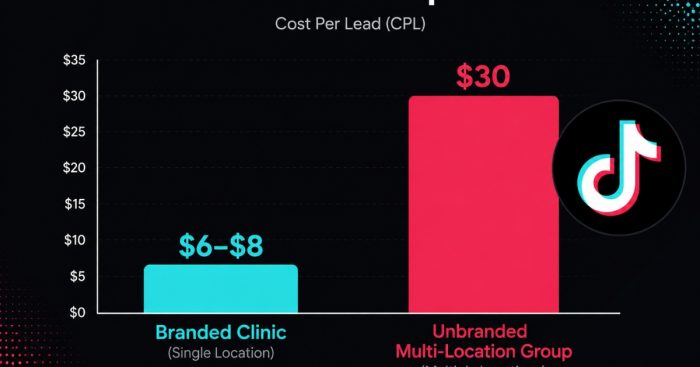
A small branded clinic pays $6 to $8 per TikTok lead while a larger 15-location unbranded medical group pays $30 per lead in the same market.
The branded clinic is not winning on creative or bid strategy.
It is winning because warm audiences cost paid platforms less to reach and convert more reliably once they land on the website.
Every paid ad sits on top of a base level of recognition.
When the base is zero, the ad has to manufacture trust from scratch and the cost reflects it.
When the base is a real human-led brand, the ad is a reminder and the cost drops by 3 to 5x.
The math is the same whether the clinic is HRT, functional medicine, regenerative pain, or GLP-1.
Why does cost per lead drop when a cash-pay clinic builds a brand first?
Cost per lead drops when a cash-pay clinic builds a brand first because paid platforms reward recognition.
Meta, TikTok, and Google all reward ads that convert.
Ads that convert are usually ads served to audiences who already know the brand.
The ad creative is the same.
The bid is the same.
The targeting is the same.
The only variable that changed is whether the patient saw the provider’s face on Instagram three weeks ago.
That single piece of pre-exposure is the difference between a $6 lead and a $30 lead.
Brand-led close rate improves on the same mechanism.
A patient who watched four 60-second videos of the provider explaining hormone optimization treats the consult as confirmation, not as a sales call.
The consult-to-program close rate goes up.
The cost per booked patient — not just per lead — drops in proportion.
What does having a brand actually mean for a cash-pay medical practice?
Having a brand means a real human-led presence on Instagram, TikTok, YouTube, and Google Business Profile.
It does not mean a polished website with stock photography.
The marker we use to tell whether a clinic has a brand: search the practice name on Instagram.
If the only result is a provider’s personal page with 200 followers, the practice does not have a brand yet.
If the result is a clinic page with weekly provider-led content, it does.
A specific example from the call: a clinic Instagram with 50 followers, all of them acquired through paid ads, is not a brand — it is an ad-funnel side effect.
The same provider’s personal Instagram, with two years of consistent posting and 5,000 followers, is the brand.
Patients click through to the personal page, not the corporate page, when they want to verify the provider is real.
How do I build a brand if my providers hate social media?
Build a brand even if your providers hate social media by outsourcing the production and minimizing the on-camera commitment.
The model we use ourselves: a content team interviews the provider for one hour on Riverside, then produces 16 posts per month across LinkedIn, TikTok, Instagram, YouTube, and Facebook from that single recording.
The provider’s time commitment is one to two hours per month.
Everything else — editing, scheduling, captioning, thumbnails — is outsourced.
The high-end version of this service runs about $5,000 per month with an experienced operator.
A capable local videographer doing the same job is usually cheaper.
The objection we hear most often is “I have always hated this.”
We agree.
For three years the only thing on one of our personal Instagrams was captionless pictures of fish.
The pivot came when the cost-per-lead math forced the issue.
Once the content was out there, the impact on lead cost and close rate was clear inside one quarter.
Which provider should be on camera, the owner or one of the doctors?
The provider who should be on camera is whoever will commit to consistency.
Polished tone, perfect lighting, and a film studio matter less than showing up on a schedule.
The two practical patterns from tested ad creative: female providers outperform male providers, and within female providers, blonde tends to outperform dark-haired in this data set.
Take that as a tiebreaker, not a rule — the bigger variable is who reliably films.
The second filter is liability.
If a provider is mid-noncompete-negotiation, planning to leave, or carrying any pattern of unprofessional behavior, do not build the clinic’s brand on their face.
The brand is durable infrastructure.
The provider you put on camera should still be there two years from now.
For an example of how a single provider’s brand carried an entire practice through scaling, see how Dr. Joy Kong became the #1 stem cell expert on YouTube, hired four more doctors, and scaled herself out of the day-to-day business — the personal brand was the recruiting magnet, the patient magnet, and the exit lever simultaneously.
What kind of content does a cash-pay medical practice actually post?
The content a cash-pay medical practice should post is the answer to whatever patients ask in consults.
Pros and cons of tirzepatide versus semaglutide.
What testosterone replacement actually does for energy and mood by week 6 versus week 12.
How often labs need to repeat on an HRT protocol.
What the typical 6-month patient journey looks like from intake to first re-evaluation.
Why naturopathic medicine intake forms feel overwhelming and what the provider does to simplify them.
The content rule we share with every clinic: if a patient asks you the question in a consult, film the answer that same week.
The questions repeat across patients.
The video answers compound across followers.
Within 90 days the clinic has a library of 30 to 50 short answers that are simultaneously a brand asset, a hire-attractor, and a consult-deflection layer for the front desk.
Should I double down on the marketing that’s already working before adding a new paid channel?
Yes.
Double down on what is working before adding a new channel.
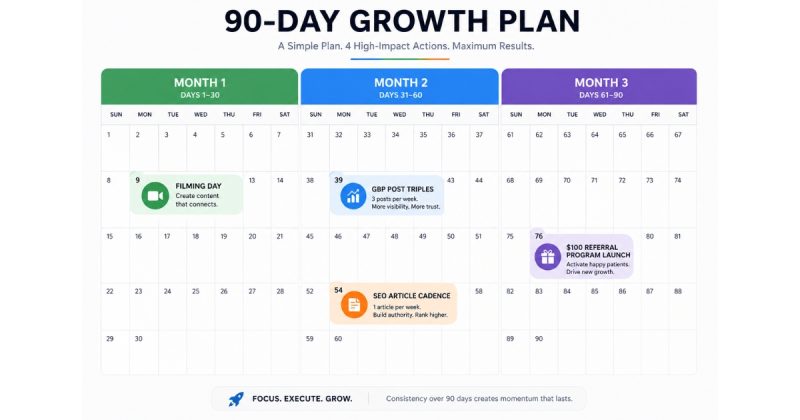
The rule from the call: if referrals, Google Business Profile, and Google Search already produce booked patients, triple posting frequency on Google Business Profile, launch a $100 referral or affiliate program with a public landing page, and increase SEO content velocity by 2x for the next three to six months.
After that horizon, returns diminish and adding a new channel makes sense.
The mechanism: each existing channel has a known cost per booked patient.
Doubling the volume on that channel is the highest-confidence growth lever available, because the conversion math has already been proven.
A new channel — TikTok ads, a YouTube show, a podcast — requires brand to convert and a 60-to-90-day learning curve before cost per lead stabilizes.
This is exactly why building a brand before paid ads creates such a significant advantage. When patients already recognize the provider, have seen educational content, and trust the practice before clicking an ad, every paid channel starts with a lower trust gap, a higher conversion rate, and a lower cost per booked patient.
Stack the new channel on top of compounding old channels, not in place of them.
How long until brand-led content shows up in cost per lead?
Brand-led content shows up in cost per lead within six to twelve months on paid channels.
Close-rate improvement shows up sooner — usually inside one quarter — because patients who watched the provider’s videos before their consult walk in already convinced.
The internal effect compounds the same way: branded clinics also start to recruit better providers.
Nurses and mid-levels who watched your content on Instagram apply directly, which lowers recruiting cost and closes the talent loop.
The talent loop is part of the brand return.
For a practice that ran the same playbook from $1M to $4M in 4 years, see how Eternity Health Partners grew SEO traffic from 80 to 1,000+ visitors per month and turned $1.7M of memberships per year into a brand-led recurring revenue engine — the inbound calls and the membership math both compounded on the same brand foundation.
What should a cash-pay medical practice do this quarter to start the brand-first move?
A cash-pay medical practice should do four things this quarter to start the brand-first move:
(1) pick one provider who will commit to one filming session per month and confirm they will still be at the practice in two years;
(2) hire or partner with a content team that can take a single one-hour interview and produce 16 posts per month across five platforms;
(3) launch a public $100 patient referral program so every existing patient knows it exists;
(4) triple Google Business Profile posting frequency and audit the existing SEO content calendar to add 2x more articles per month for the next 90 days.
None of these moves require new ad spend.
All of them lower the cost of every ad dollar you spend in Q1 of next year.