
How One HRT Clinic Grew From 150 to 183 Members in 30 Days (Telehealth Booking Backlog Lesson)
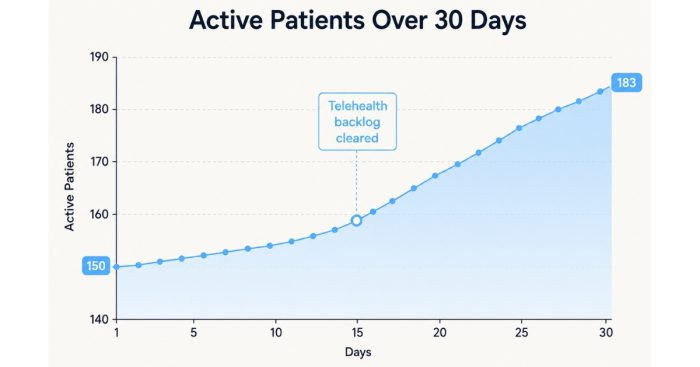
A men’s health clinic we work with added 33 paying members in 30 days — going from 150 active members to 183 — without spending a dollar more on ads. The lever wasn’t lead generation. It was a backlog of patients who could not get on the calendar fast enough, then suddenly could. Here is the operational lesson, what unlocked the growth, and what a cash-pay HRT or TRT practice should check this week to find the same hidden capacity.
How did one HRT clinic grow from 150 to 183 active members in 30 days?
The HRT clinic grew from 150 active members to 183 in 30 days because the founding provider returned from a brief absence and cleared a telehealth booking backlog.
The patients were already in the funnel.
They had already inquired about TRT or hormone optimization.
They simply could not get on the provider’s calendar while the founder was away.
When the founder came back, the telehealth schedule filled immediately and 33 net new members signed up in March alone.
The provider’s exact words on the call:
“When I came back, I saw that I was like, holy cow, that’s awesome because when I left it was like 150 or something. That’s so crazy. You had 34 in March, but my telehealth schedule was full yesterday and I think it’s been pretty full.”
Why does telehealth capacity matter so much for a cash-pay HRT clinic?
Telehealth capacity matters so much for a cash-pay HRT clinic because the membership patient does not need to be in the room with the provider for routine titrations, refills, or quarterly check-ins.
Every telehealth slot is a slot that converts a “thinking about it” lead into a paying member without requiring an in-person consult.
When the telehealth calendar is full, the practice is operating at peak conversion.
When it is empty for a week — because the provider is traveling, sick, or covering another office — those patients do not reschedule; they go to the next clinic.
Telehealth capacity is the choke point, not lead volume.
What is the typical monthly net member addition rate for a growing cash-pay HRT practice?
A typical monthly net member addition rate for a growing cash-pay HRT practice is 15 to 35 new members per month at the 100-300 active-member stage, assuming consistent telehealth and in-office capacity.
Our client added 34 members in March and 33 net new members in the following 30 days.
Below 15 net new per month at this practice size means there is a capacity bottleneck, a sales-process bottleneck, or a marketing bottleneck.
Above 35 net new per month means the clinic is approaching a provider-capacity wall and should plan to add a second telehealth provider in the next 60 to 90 days.
How does a brief provider absence kill HRT membership growth?
A brief provider absence kills HRT membership growth because new patients who land during the absence either book a telehealth slot weeks out (and many ghost before the appointment) or move on to a competitor with available capacity.
The damage compounds: the absence costs you the new members, and the patients who finally do see the provider after a delayed wait are less engaged because they already cooled off.
The fix is not to cancel time off — it is to:
(1) put a backup provider on the telehealth calendar during the absence,
(2) extend the new patient coordinator’s hours to keep follow-up touchpoints active, and
(3) book the founding provider’s first two weeks back to clear the backlog before anything else.
When should an HRT clinic founder hand off telehealth visits to another provider?
An HRT clinic founder should start handing off telehealth visits to another provider when the founder’s telehealth calendar is consistently full for 6 of the next 8 weeks and the practice is at 175+ active members.
Below those thresholds the founder is still the right person to hold the telehealth seat — the founder closes membership upgrades better than a new clinician.
Above those thresholds, the founder is the bottleneck.
Adding a second telehealth provider for routine refills and quarterly check-ins frees the founder to handle new-patient consults and high-value upgrades.
For a real-world view of what owner-handoff at scale looks like, see how an HRT clinic we grew from $1M/year to $4M/year in four years built 250 active members at $1,000 per month and removed the owner from day-to-day care delivery.
The transition from “founder does every visit” to “team does every routine visit, founder handles new and complex” is what unlocks the move from $1M to $4M.
How do you tell the difference between a marketing problem and a capacity problem at an HRT practice?
You tell the difference between a marketing problem and a capacity problem by looking at two metrics together: inbound discovery calls and telehealth-slot fill rate.
A marketing problem looks like fewer than 10-15 inbound discovery calls per week regardless of capacity availability.
A capacity problem looks like 20+ inbound discovery calls per week but a telehealth calendar that is fully booked 2-3 weeks out, leading to ghosting before the appointment.
Most cash-pay HRT clinics in the 100-300 active member range have a capacity problem disguised as a marketing problem — they are spending more on ads when they should be opening more provider hours.

What should an HRT clinic do this week to find hidden membership growth like this?
An HRT clinic that wants to find hidden membership growth like the 150-to-183 jump should do four things this week:
(1) measure telehealth-slot fill rate as a daily metric, not a weekly one;
(2) audit the previous 30 days of inbound leads to see how many never booked because the calendar was full;
(3) add 2-4 telehealth slots per day at off-peak hours (lunch hours and 5-7 PM) to capture patients who can’t book during business hours;
(4) decide whether the founder can hand off routine telehealth check-ins to a second provider so the founder’s calendar opens for new patients.
If you want help quantifying the capacity-vs-marketing split and structuring a second-provider rollout, that is exactly the work we do every day for cash-pay practices.
For another example of how operational moves drive cash-pay growth without paid-ad spend, see how a regenerative medicine clinic generated $309,590 in cash-pay revenue in 10 months without paid ads — operational capacity, not ad spend, was the lever.