
How Does a Functional Medicine Practice Add 100 New Members Without Spending on Ads?
A membership-model functional medicine practice in northern California added more than 100 new members in Q1 2025 with zero ad spend. The growth was not driven by a slick funnel, a launch, or a viral video. It was driven by four small things their front desk and providers do every day. Below is the exact playbook.
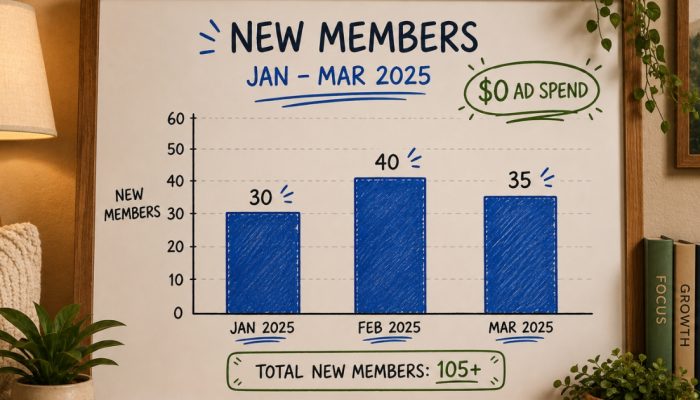
How does a functional medicine clinic add 100 new members in a quarter without running ads?
The clinic added 100+ new members in Q1 2025 by treating patient experience as the marketing channel, not as a back-office function. They did four specific things every day: greeted every patient by name at the door using same-day appointment notes, replaced “sorry for the wait” with sincere thank-yous, proactively called patients before lab work, and intentionally avoided text and email as primary touchpoints because patients can tell when a message is automated.
Membership-model practices grow on referrals. Referrals grow on remembered feelings. The four moves below directly engineer the kind of small, repeated, emotional moments that turn a patient into a referral source.
What patient-experience moves drive new member referrals at a membership-model practice?
The four moves that work, in order of how much leverage they produce:
First, name-on-walk-in. The front desk pulls up the appointment list every morning and reviews quick notes about each person. When the patient walks in, they are greeted by name immediately. The receptionist already knows the patient’s spouse, kids, or last conversation topic.
Second, the “thank you for waiting” reframe. No “sorry for the wait,” no “I have to put you on hold.” Instead, when the patient gets off hold the staff says, “Thank you so much for waiting patiently” I just had to wrap up so I can be 100% present with you and take care of you wholly and fully.”
Third, proactive outreach by phone or voicemail (not text or email). Before blood work, before a refill, before the patient asks — the clinic reaches out by phone and checks in. A real voice does almost the same work as the call itself.
Fourth, the deliberate absence of automation in primary touchpoints. The clinic treats automated text and email as the “lazy” default that patients see through immediately. Automation is used for operational confirmations only, not for relationship-building.
Should I greet patients by name when they walk in?
Yes — and the operational system behind it matters more than the gesture itself. Greeting by name is what the patient experiences, but what makes it sustainable is the daily appointment review where the front desk skims notes from the prior visit. The clinic above keeps short, specific notes about each patient’s family, last conversation, or any concern raised on the previous call.
This is not optional polish. Membership practices are essentially in the business of remembering people. A patient who feels remembered tells two or three friends about the clinic over the next year. A patient who feels forgotten quietly cancels their membership the next time a credit card hits a tight month. “When we worked with VYVE Wellness, a longevity and functional medicine clinic, the move that produced a 900% lead increase and 100+ inbound calls per month was tightening this exact piece of the patient experience”.
What’s the right way to put a patient on hold at a cash-pay clinic?
Don’t apologize for the hold. Reframe it as “I want to be 100% present with you.” The exact script the northern California clinic uses: “Thank you so much for waiting patiently. I just had to wrap up with somebody else so that I can be 100% present with you and take care of you wholly and fully.”
Two reasons this works. First, “sorry for the wait” trains the patient to feel that they have been inconvenienced — even if the wait was 90 seconds. Second, the “100% present” framing tells the patient explicitly that their attention is being protected by the staff. That signals a level of care that almost no insurance-based practice ever signals.
Train every front desk staff member to run this script verbatim for the first 30 days. After that, the pattern becomes natural.
How does proactive outreach grow a membership-style functional medicine practice?
Proactive outreach — a real phone call before a touchpoint the patient was already expecting — lifts member retention and referrals more than almost any other single tactic.
The specific timing: call (not text) 3-5 business days before scheduled lab work, before any provider visit, and at the 30-day mark after enrollment. The call does not need to accomplish anything operationally. It is “how are you doing, how is the protocol going, anything I can help you set up before you come” — 90 seconds, end the call.
If the patient doesn’t answer, leave a voicemail. Voicemails do almost the same work as a live call because the patient hears the voice. A text or email feels automated by default, and patients write it off — even when the message was hand-written.
Why do text and email check-ins fail compared to phone calls?
Patients have been trained by every brand they interact with to assume that text and email touchpoints are automated. Even when a staff member personally writes the message, the patient’s default assumption is that it’s coming from a workflow tool. That assumption strips the message of its relationship-building power.
A phone call cannot be faked. Even a 45-second voicemail cannot be confused with automation. The patient knows a real human took the time to dial. That is the only thing that consistently moves the “they remember me” needle — which is the entire premise of a membership model.
Texts and emails still have a role: appointment confirmations, intake forms, billing receipts. They are not the right channel for retention work.
Is patient experience or marketing more important for a cash-pay functional medicine clinic?
For a membership-model functional medicine practice, patient experience IS marketing. The clinic in northern California spent zero on ads and added 100+ new members in one quarter because every existing member became a small, compounding referral engine. A typical cash-pay member at this kind of practice produces 1-3 referrals per year if the experience is dialed in.
If you have a fixed marketing budget and a membership-model practice, the first dollar should be spent on tightening patient experience, not on a new ad creative.
Ready to install this patient-experience playbook in your functional medicine practice?
If you are running a cash-pay functional medicine, longevity, or membership-style practice and your monthly referral count is below 10, the four moves above will move it within 60 days. We help membership-model practices install operational changes like this without disrupting the existing patient base.