
How Do I Improve Lead Flow at a Men’s Hormone Clinic? (200 Leads → 80 New Members Math)
INTRO:
A cash-pay men’s hormone clinic owner asked us a direct question on a recent strategy call: “How many leads do I need to add 80 new members a month?” The answer is 200 to 250 — assuming the clinic converts the way ours do. This is the FAQ on the math behind that number, the conversion benchmarks at every step of the funnel, and the five places leads silently die between the form fill and the paid membership.
——————————————————————————
How many leads does a men’s hormone or TRT clinic need to add 80 new members a month?
200 to 250 leads. The math is “to put 80 new members in the clinic at an 80% close rate, I need 96 new patient visits, which means 200 to 250 leads per month.”
The 200-to-250 number comes from a clinic running at scale. MVP Men’s Health (Madison, MS) currently has roughly 625 active members at $150 per month and converted 78% of September consult visits — 35 of 45 — into paid memberships. Owner Micah Walker uses 80% as the planning baseline. To reach his target of 80 new members per month at one location, the math works backward: 80 ÷ 0.80 = 100 visits → factor in no-shows and qualified-but-not-attended → 96 visits booked → roughly 2.5 leads per booked visit → 240 leads.
That mix isn’t all paid form fills. MVP’s current 100-to-120 monthly lead volume breaks down as ~80 form-fill leads, ~40 inbound phone calls, and a separate referral stream (30 referrals from a single referral partner generated 12 new members in September). The right total for your clinic depends on which channels you can actually run profitably — but the per-stage conversion math holds across the channel mix.
What close rate should a men’s hormone clinic expect on in-clinic consults?
Around 78 to 80%. If you’re not in that range, the consult script — or the offer — is the problem, not the lead source.
The benchmark from one of our cash-pay clinic clients: 35 paid memberships out of 45 in-clinic visits in a single month at $150/month. The clinic’s own working model treats 80% as the planning number. That number is achievable because the prospect has already been pre-qualified before the visit — they came in for a free testosterone check, the lab pulled the testosterone level, the result confirmed clinically that they’re a candidate, and the offer presented at the end of the visit is a single-tier $150/month membership rather than a confusing menu.
If your in-clinic close rate is below 60%, three usual suspects: the consult script depends on the doctor closing the deal (and the doctor isn’t always available or doesn’t enjoy the sales conversation), the membership offer is too complex or has too many tiers, or the prospect wasn’t pre-qualified before they walked in. A patient coordinator with a clean script, a one-page offer sheet, and a clinically-validated qualifier (the free-T result) converts at 70 to 80% without the doctor in the room.
——————————————————————————
Should a men’s hormone clinic use a free testosterone check as a lead magnet?
Yes. It’s the cleanest qualifier in the category and the math on the back-end is excellent.
MVP’s September funnel: 40 free-T bookings → 25 of those came in for the full lab visit (~62%) → 20 of the lab visits converted to paid memberships (~80%). End-to-end, 50% of free-T bookings became paying members at $150/month. The free-T does two jobs at once. It pre-qualifies the prospect medically (men with normal T levels self-screen out before the clinic spends staff time on them), and it converts the prospect emotionally (a result in hand at the visit is much more persuasive than a hypothetical conversation).
The free-T also surfaces the cost-of-customer-acquisition math cleanly. At a $40 cost per lead, 200 leads = $8,000 in ad spend → 100 free-T bookings → 50 paying members → $7,500 in first-month revenue and roughly $90,000 in annualized membership revenue from one month of acquisition spend. The acquisition cost pays back inside 30 days at the per-member level — but only if the free-T → visit → close conversion math actually holds. The clinics that try to skip the free-T and “just sell the membership on the consult call” close at 20 to 30% and burn through their ad spend in the first quarter.

What’s a reasonable cost per lead on paid ads for a TRT or men’s-health clinic?
About $40 per form-fill lead is where our cash-pay men’s-health Google Ads campaign stabilized after Real ADvice did a negative-keyword and keyword-reallocation pass. The owner’s working target is $20 to $30 over the next 90 days.
The price-per-lead caveat from Anton on the call: “Depends on the service. Depends on the lifetime value. Money’s got to make sense.” A $40 lead is excellent for a $150/month membership with 50% free-T-to-member conversion — that’s a $20 customer acquisition cost on $1,800 of annualized revenue. The same $40 lead would be a disaster for a clinic selling a single $250 consult with no recurring component. The right per-lead price is the one that produces a payback period under 60 days and a 6+ month LTV-to-CAC ratio of at least 5:1.
Bringing the cost-per-lead down from $40 to $25 is usually a keyword-mix problem, not a creative problem. Adding negative keywords (steroid-related searches, free-only intent, generic “low T” without buyer signal), pausing keywords that produced clicks but no bookings, and concentrating spend on the 3 to 5 phrases that consistently convert tightens the cost per lead without sacrificing volume. The campaign math improves before the creative changes. That optimization process is only one piece of men’s hormone & TRT clinic marketing, where paid search, organic traffic, referrals, and conversion systems all work together to lower acquisition costs over time.
——————————————————————————
What’s the biggest reason men’s hormone clinic leads fall through the cracks?
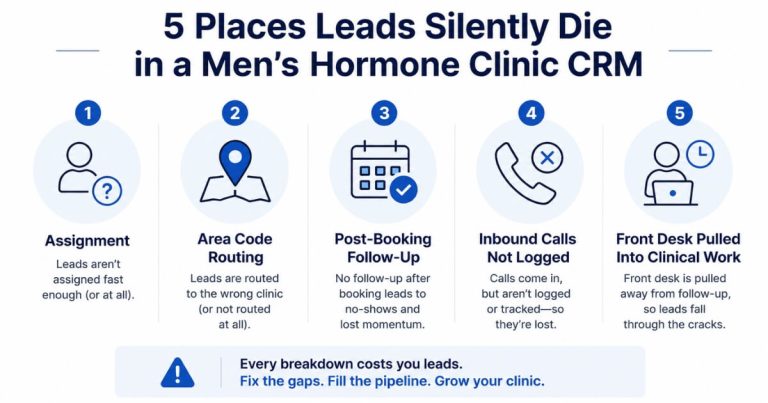
Five recurring failures, in order of frequency.
**1. Leads get silently unassigned in the CRM.** A prospect gets routed to a rep, the assignment quietly clears, and no one notices until next month’s dashboard shows the gap. Audit your CRM weekly: every lead older than 48 hours should have a named owner.
**2. Area-code routing failures.** A clinic operating two locations had inbound leads with the second city’s area code routed to the first city by default — and roughly 10% of paid-ad leads silently dropped because the wrong location was responding. Set the routing rule on form source, not on phone number.
**3. No defined follow-up after the appointment is booked.** Most clinics use their CRM to book the visit and then “there’s nothing else.” A booked visit without a confirmation text, a reminder text 24 hours out, and an automated “you missed your appointment, here’s how to rebook” workflow loses 15 to 30% of bookings to no-shows.
**4. Inbound phone calls never get into the CRM.** A clinic generating 80 form leads might also be getting 40 inbound phone leads — but if the receptionist isn’t entering each call into the CRM, the 40 phone leads are invisible to every report. The reports look like 80 leads. The reality is 120. The dashboard is lying to the owner.
**5. The lead-response role is doing clinical work part-time.** A front-desk lead who answers inbound inquiries and also helps with Botox injections is going to miss inbound responses. Either dedicate the role to lead response 100% of the time, or build automated first-touch replies that don’t require a human to be at the desk.
How should a men’s hormone clinic structure its CRM dashboard?
Per-source rows, with leads, bookings, and new members as columns. Not “total leads this month.”
The version that matters has every lead source on its own row: paid Google ads, paid Facebook ads, website organic, walk-in / phone-in, referral partner, internal referral. Three columns: leads received, bookings produced, paid members closed. One conversion rate column at the end (members ÷ leads).
This view changes which channel gets next month’s budget. The Madison clinic above was running paid Google ads, paid Facebook ads, a website form, and a single referral partner. The per-source dashboard surfaced that the referral partner — at zero ad spend — produced 12 of the 35 new members for the month (34%). Paid Google produced more raw leads but a lower per-lead close rate. Budget moved toward referral partnership expansion the next quarter without a single ad budget change. “An HRT clinic we worked with for four years now sees roughly 60 inbound calls per month and 40 website leads per month, with $1.7M a year in membership revenue produced purely by SEO traffic that scaled from 80 visitors a month to 1,000+” — but they only moved budget toward SEO once the per-source dashboard made the channel’s relative performance unambiguous.
——————————————————————————
When should a men’s hormone clinic open a second location?
Only after the first location is converting 70%+ on visits, the CRM dashboard is clean, and the per-source math justifies it. Most clinics open the second location to fix the first one. It never works.
Both of MVP’s locations are instructive. The Madison clinic, opened years earlier, is at 625 members and growing — the operational system is solid. The newer Coast clinic, opened in August, was at 18 members three months later, with paid-ads conversion sitting at roughly 33% — well below the Madison number — because the lead-response operation hadn’t been rebuilt for the new location yet. The fix was operational, not geographic: dedicate one named human to live response, log every inbound call into the CRM, automate first-touch replies, and route Madison overflow demand to the Coast clinic via telehealth so the location capacity at Coast filled before the clinic opened a third.
The right second-location math: the first location must be running at 70%+ visit close, the first location’s per-source dashboard must show which channel scales, and the second location must be opened with a dedicated patient coordinator from day one. “A pain-management specialist we work with grew monthly revenue by $40,000+ and cut insurance dependence in half by getting the cash-pay operation right at one location before expanding capacity” — same playbook applies to men’s hormone clinics.
——————————————————————————
What’s the next step?
If you’re a cash-pay men’s hormone, TRT, or low-T clinic owner and you’re trying to scale lead volume without watching the new leads disappear into a leaky CRM — book a strategy call. In 60 minutes we’ll audit your per-source dashboard, your free-T-to-member funnel, your consult close rate, and the five lead-leakage points listed above. If it’s a fit, we’ll fly to your clinic and rebuild the lead-response system with your team.