
Why Does Experience Accelerate Cash-Pay Clinic Growth? (Your Scaling Problem Is a Patient We’ve Already Treated)
Medicine is called a practice for a reason. When a physician meets a presentation they’ve never treated, they consult colleagues, literature — or now ChatGPT — and work it out. Growing a medical practice works exactly the same way. Every problem a cash-pay clinic hits between $20K a month and $2M a month is a problem somebody has already diagnosed and solved. The owners who grow fastest aren’t smarter. They just refuse to pay the trial-and-error tax. Here’s the FAQ.
Why does experience accelerate growth at a cash-pay medical practice?
Because almost nothing that happens while scaling a clinic is new — and someone who has seen the pattern before can skip straight to the fix.
A clinician who has treated a condition a hundred times doesn’t re-derive the protocol for patient number 101.
They recognize the presentation, they know what works, and they act.
Growing a cash-pay practice is the same discipline applied to a business instead of a body.
Leads that book but don’t show, a front desk that quotes price like an apology, memberships that churn at month three, and ads that produce inquiries the team can’t close are all presentations with a known treatment.
An owner solving these alone has to run experiments on their own revenue: try a fix, wait a month, read the numbers, then try again.
By contrast, an owner working with someone who has already helped dozens of clinics through the exact same stage skips the experiments.
That’s the entire mechanism.
Experience doesn’t make the problems easier.
Instead, it makes the diagnosis instant.
What does “your scaling problem is a patient we’ve already treated” mean?
It means the problems that feel unique to your clinic are, almost without exception, repeat cases.
At Real ADvice we’ve helped clinics solve just about every problem you can encounter scaling from $20K a month to $2M a month.
The booking system that leaks leads, the associate provider who won’t fill their schedule, the membership price that’s $100 too low, and the ad account that gets flagged for a hormone offer each felt like a crisis to the owner living through it.
However, each one was a case we’d already treated somewhere else.
That’s not a boast about intelligence.
Instead, it’s an observation about sample size.
A single owner sees one clinic’s problems in one market, once.
Meanwhile, a growth partner working across dozens of cash-pay clinics sees the same twenty problems on repeat, in every specialty and every market.
As a result, they get to watch which fixes actually hold up.
A pain practice we worked with added $2,095,039 in revenue in just 10 months — not because we invented anything new for them, but because nothing they hit was new to us.
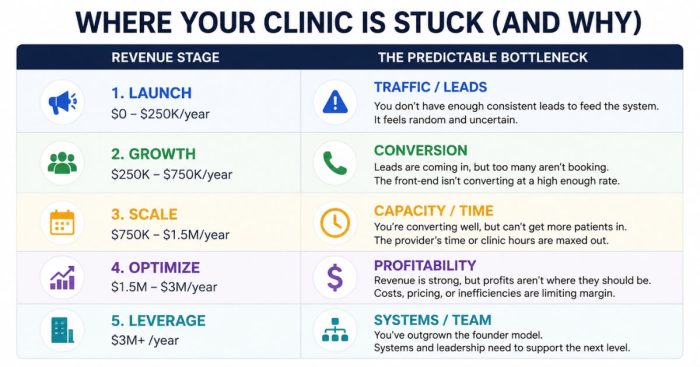
What problems repeat at every revenue stage from $20K to $2M a month?
The bottleneck changes with the revenue, but it changes predictably.
Around $20K–$50K a month, the problem is almost always lead handling: inquiries sit unanswered, the front desk treats the phone as an interruption, and follow-up lives on post-it notes.
From $50K–$200K, it’s usually pricing and offer structure — the clinic is busy but under-charging, selling visits instead of programs and memberships.
From $200K–$500K, it’s people: the owner is still the best salesperson and the only real manager, and every hire either relieves them or multiplies their workload.
From $500K to $1M+, it’s systems — CRM, tracking, documented processes — because what worked on willpower stops working at volume.
Past $1M a month, it’s structure: org chart, second location, provider capacity, and owner removal.
An experienced partner knows which of these your clinic is actually in.
That matters because owners routinely misdiagnose the stage.
The most common call we take starts with, “I need more leads.”
However, a clinic’s real problem is often that it converts the leads it already gets at half the rate it should.
Solving the wrong stage’s problem is the most expensive mistake in clinic growth.
More importantly, it’s the one experience prevents first.
How much does learning by trial and error actually cost a clinic owner?
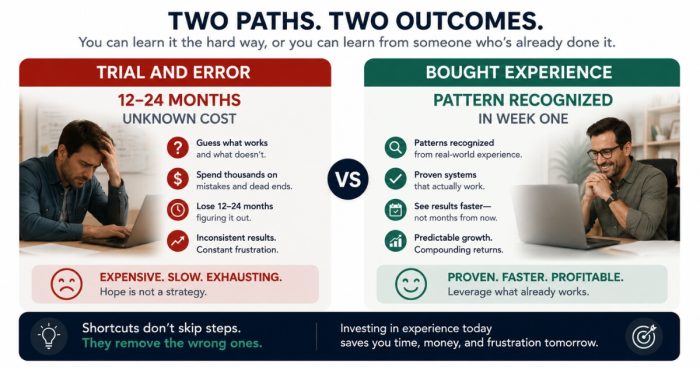
Usually 12 to 24 months and the compounding revenue those months would have produced — which makes it the most expensive education an owner will ever buy.
Think about what one wrong experiment costs.
A mispriced membership doesn’t just lose margin this month; it anchors every future patient at the wrong number.
A bad front-desk hire doesn’t just underperform.
Instead, they quote price badly on hundreds of calls before the reports reveal it.
Likewise, six months of ads pointed at the wrong offer isn’t just wasted spend.
It’s also six months of competitors compounding while you reset.
None of these show up as a line item called “tuition,” which is why owners underestimate them.
Now compare the timelines experience produces.
An HRT clinic we work with grew from $1M a year to $4M a year by installing systems that were already proven at other clinics — membership structure, inbound engine, org chart — rather than inventing them from scratch.
Imagine you could simply buy the experience without having to go through the hardships yourself.
That’s not a hypothetical.
It’s literally what working with an experienced operator is.
Can’t I just ask ChatGPT instead of hiring someone with experience?
You can — and for defining terms and generating checklists, you should.
However, an LLM gives you the median answer, and clinics don’t grow on median answers.
Ask ChatGPT how to fix low lead conversion and you’ll get a competent generic list: respond faster, train the front desk, add follow-up sequences.
All true.
What it can’t tell you is which one is YOUR bottleneck, what the fix looks like in a GHL pipeline at a two-provider hormone clinic in a mid-size market, or whether your specific numbers are actually bad for your specialty.
Experience isn’t knowing the list.
It’s having watched the list play out enough times to know which line matters in this exact case — and then implementing it, which no chat window does for you.
The practical move isn’t either/or.
Use AI to get oriented.
Then, before you spend a year testing its suggestions on your own revenue, borrow pattern recognition from experienced medical practice marketing consultants who have already watched those suggestions succeed or fail inside real clinics.
How do I verify that a consultant or agency actually has the experience they claim?
Ask for specific, same-vertical proof — named case studies with real numbers — and ask them to diagnose you before they pitch you.
Anyone can say “we work with medical practices.”
The test is specificity.
Ask:
- Which cash-pay clinics?
- Which verticals?
- What starting revenue?
- What ending revenue?
- Over what timeframe?
Vague answers (“we drove great engagement”) are a no.
Numbers with names attached are a yes.
Then flip the interview.
Describe your clinic’s situation and ask what they’d look at first.
Someone with genuine reps will start asking about your conversion rate, your show rate, and your membership churn because they’re matching your presentation against cases they’ve treated.
Meanwhile, someone without reps will jump straight to the deliverables they want to sell you.
This is the same filter that separates a real medical practice marketing partner from a vendor with a medical page on their website.
Experience shows up as better questions before it ever shows up as better answers.
FAQ’s About Buying Experience Instead of Learning by Trial and Error
Why do experienced consultants grow clinics faster than owners working alone?
Because they’ve already seen the problem.
An owner working alone has to experiment on their own revenue and wait for results.
By comparison, a consultant who has helped dozens of clinics through the same revenue stage recognizes the pattern immediately and applies a fix that’s already proven, which removes months of testing from the timeline.
What does it mean that scaling problems are “patients someone has already treated”?
It’s the medicine analogy.
Just as a physician who has treated a condition many times recognizes it instantly, a growth partner who has worked with many cash-pay clinics recognizes booking leaks, pricing mistakes, churn patterns, and hiring failures on sight.
Nearly every problem between $20K a month and $2M a month is a repeat case with a known treatment.
Is it worth paying for a consultant when the information is free online?
Free information tells you what generally works.
Paid experience tells you what will work in your specific clinic, in what order, and then helps you implement it.
The real cost comparison isn’t the consultant’s fee versus free content.
Instead, it’s the consultant’s fee versus 12 to 24 months of trial-and-error on your own revenue.
How do I know if a marketing partner has real cash-pay clinic experience?
Ask for named case studies with specific numbers in your vertical.
Then ask them what they’d diagnose first at your clinic.
Real experience shows up as specific proof and better questions.
By contrast, fake experience shows up as vague results and an immediate pitch.
What’s the next step?
If your clinic is stuck at a plateau and you’re tired of running experiments on your own revenue, book a strategy call.
In 60 minutes we’ll tell you which revenue stage you’re actually in, which problem is the real bottleneck, and what the proven fix looked like at the clinics that already solved it.
You’ll leave with the diagnosis either way — because your problem is almost certainly a patient we’ve already treated.