
What’s the One Metric That Actually Predicts Cash-Pay Clinic Growth?
Cash-pay clinic owners obsess over revenue, lead counts, and close rates — all of which tell you what already happened. There’s a single metric that tells you what’s about to happen, and almost nobody tracks it deliberately: whether patients leave happy after every interaction. Here’s the FAQ on why patient happiness is the leading indicator of growth, and how a patient who said “no” can be worth more than one who said “yes.”
What’s the one metric that actually predicts cash-pay clinic growth?
Whether your patients leave happy after every interaction with your clinic—even if they don’t become paying patients.
As one clinic owner we work with put it:
“If your patients are happy after talking to them, that’s the only metric that matters up front.”
At first, that sounds subjective.
Follow the results, however, and it becomes clear why it matters.
Happy patients:
- Stay longer
- Refer more people
- Leave positive reviews
- Bring new patients into your clinic
Unhappy patients do the opposite.
They leave.
They warn others away.
They quietly limit your growth regardless of how much you spend on advertising.
Patient happiness sits upstream of every financial metric you care about.
That’s why it’s the most important number to monitor early.
It comes before the membership.
It comes before the revenue.
It even comes before the sale.
When the patient experience is excellent, the financial results usually follow.
When the experience is poor, marketing alone can’t solve the problem.
That’s why patient satisfaction is the foundation of any successful patient acquisition system.
Acquiring new patients becomes dramatically easier when your current patients actively recommend your clinic.
Why is patient happiness a better predictor than revenue or lead count?
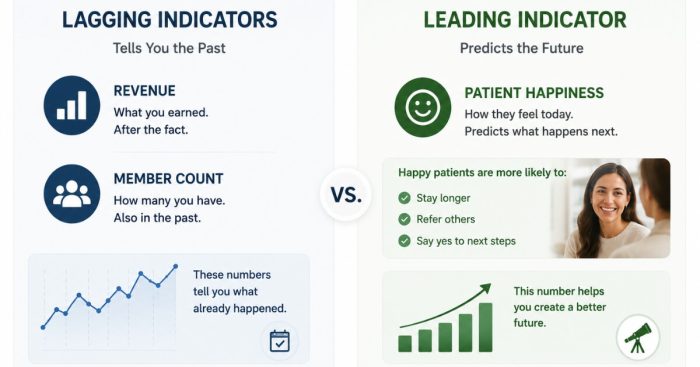
Because revenue and lead volume measure the past.
Patient happiness predicts the future.
Revenue declines only after problems have already existed for months.
Likewise, rising revenue reflects excellent patient experiences that already happened.
Looking only at financial numbers is like driving while watching the rearview mirror.
Patient happiness gives you a view of what’s ahead.
Satisfied patients are already renewing.
They’re already referring friends.
They’re already strengthening your future revenue.
That’s why leading clinics monitor patient experience as carefully as financial performance.
A clinic with growing revenue but declining patient satisfaction may soon experience problems.
Meanwhile, a clinic with steady revenue and improving patient happiness is often preparing for significant growth.
Leading indicators provide time to act before financial performance changes.
Doesn’t a lost sale mean I did something wrong?
No.
A patient can decline your offer and still become one of your clinic’s most valuable advocates.
One clinic we work with experienced exactly that.
A couple visited with a strong chance of joining a membership.
Instead, they left without purchasing.
The team immediately assumed something had gone wrong.
They wanted to analyze every detail of the appointment.
The clinic owner responded differently.
He simply told the team:
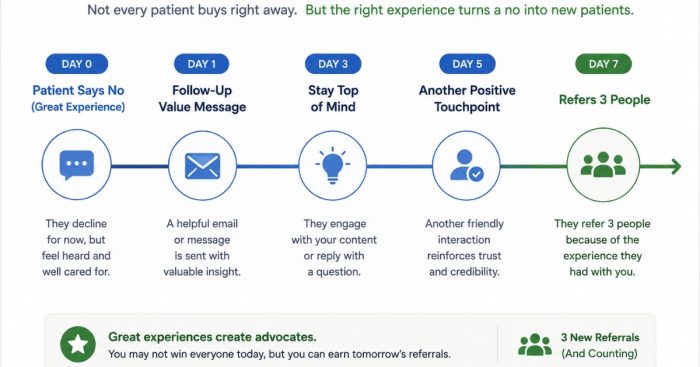
“You gave a great experience. It’ll come around.”
About a week later, that same couple referred three new patients.
Those referrals arrived because the couple genuinely enjoyed the experience—even though they never became members.
That story changes how success should be measured.
The sale isn’t the only outcome that matters.
A patient who leaves happy without buying can still become one of your strongest marketing assets.
If the team had allowed disappointment to damage that interaction, those referrals never would have happened.
The experience succeeded even though the transaction didn’t.
How do referrals compound from patient experience?
Every positive patient interaction creates the opportunity for future referrals.
Over time, those referrals build upon one another.
The couple in the previous example referred three new patients.
Some of those new patients may eventually refer others.
That’s how referral growth compounds.
Unlike paid advertising, referral marketing doesn’t require you to pay for every new patient.
Instead, satisfied patients continually create additional opportunities.
An HRT clinic we grew from $1M to $4M a year didn’t reach that level through advertising alone.
A significant portion of that growth came from patients who remained members, renewed their care, and recommended the clinic to others because the experience exceeded expectations.
Referral patients also tend to:
- Convert at higher rates
- Cost nothing to acquire
- Stay longer
Treat every interaction—including the patients who say “no”—as an opportunity to earn future referrals.
Doing so creates a growth engine that becomes stronger and less expensive over time.
How do I actually measure patient happiness?
Measure it using a few simple, consistent indicators:
- A quick post-visit sentiment check
- Review velocity
- Referral rate
You don’t need a research department or expensive software.
Simply ask patients a brief question after each visit and track the trend over time.
Next, monitor how many reviews you’re receiving and what patients are saying.
Finally, measure what percentage of new patients arrive through referrals.
An increasing referral rate is one of the strongest signs that your patient experience is improving.
The goal isn’t perfection.
The goal is spotting trends early enough to take action.
If patient sentiment or referrals begin to decline, you’ve identified a future revenue problem before it appears on your financial reports.
That gives you time to fix the issue while it’s still small.
How do I build a team that protects every interaction?
Redefine what success looks like.
A great patient experience should count as a win—even when no sale happens.
The clinic from the earlier story almost made a costly mistake.
After the couple declined the membership, the team wanted to treat the appointment as a failure.
Instead, the owner reminded everyone:
“You did the best, we did what we set out to do, that’s all you can do.”
That mindset preserved the patient experience.
A week later, the referrals arrived.
Teams that treat every lost sale as a failure often begin pressuring patients.
Pressure damages trust.
Trust drives referrals.
Instead, coach your team to focus on delivering an outstanding experience every time.
When patients feel respected, they continue speaking positively about your clinic—even if they don’t buy immediately.
That approach improves both retention and reputation.
Dr. Groysman’s practice lifted monthly revenue by more than $40K while improving team retention.
It’s another reminder that a strong team culture and an exceptional patient experience improve the same business outcomes.
FAQ’s About Patient Experience and Clinic Growth
What is the most important metric for a cash-pay clinic?
Whether patients leave happy after every interaction.
Patient happiness is the leading indicator behind revenue, retention, and referrals.
Create consistently positive experiences, and the financial metrics usually improve afterward.
Ignore the experience, and marketing alone won’t compensate.
Why is patient happiness better than tracking revenue?
Revenue reports what has already happened.
Patient happiness predicts what’s likely to happen next.
Satisfied patients are already renewing and referring others.
That means today’s experience often forecasts revenue several months into the future.
Monitoring it gives you time to correct problems before they affect your business.
Is a lost sale always a failure?
No.
Patients can decline your offer and still become valuable referral sources.
One couple featured in this article didn’t purchase a membership.
A week later, they referred three new patients because they enjoyed the experience.
Treating every “no” as a failure often creates unnecessary pressure that damages future referrals.
How do I measure patient happiness at my clinic?
Track a few consistent indicators:
- Post-visit sentiment
- Review velocity
- Referral rate
When referral rates continue increasing, it’s strong evidence that your patient experience is improving.
Review these metrics consistently.
The habit of monitoring them matters far more than using sophisticated software.
What’s the next step?
If you’re steering your clinic using only revenue reports, you’re making decisions based entirely on the past.
Book a strategy call.
In 60 minutes we’ll help you measure the leading indicators that actually predict growth—including patient happiness, review velocity, and referral rate—and show you how to build a team and patient experience that turns every interaction, even the ones that don’t end in a sale, into your most reliable source of future patients.
If it’s a fit, we’ll build the system with your team.