
Which Conversion Metrics Should a Cash-Pay Clinic Actually Track?
Most cash-pay clinics track the wrong numbers — total leads, ad impressions, website visits — and then wonder why the dashboard looks busy while revenue stays flat. The metrics that actually predict growth are a short list, and they all live downstream of the lead, closer to the money. Here’s the FAQ on which conversion metrics to track, why they matter, and what to do once you can see them.
Which conversion metrics should a cash-pay clinic actually track?
Track the metrics tied directly to revenue:
- Visit-to-membership (or visit-to-purchase) conversion
- Lead-to-booked-visit conversion
- Revenue by source
Everything else is supporting information.
A clinic can generate thousands of leads and still fail to grow if those leads don’t become booked visits and paying patients.
One men’s health clinic we work with tracks exactly these numbers.
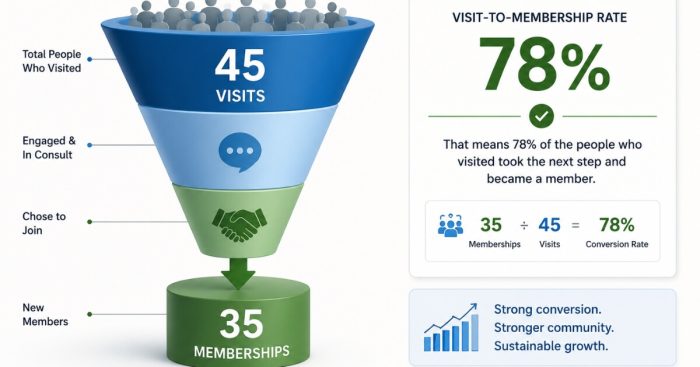
Last month it welcomed 45 new-patient visits.
Thirty-five of those patients joined a membership.
That’s a 78% visit-to-membership conversion rate.
That single metric tells the owner more about the health of the business than total lead count ever could.
These three metrics matter because they mirror the actual flow of revenue.
A stranger becomes a lead.
A lead becomes a booked visit.
A visit becomes a paying patient.
Every patient also comes from a specific marketing source.
Track each conversion point alongside the revenue generated from every source, and you’ll know exactly where growth is happening—and where it’s breaking down.
That’s the foundation of a strong patient acquisition system.
Why is visit-to-membership conversion the metric that matters most?
Because it’s where cash-pay revenue is actually won or lost.
It’s also one of the least expensive metrics to improve.
Getting patients into the clinic costs money.
You’ve already invested in marketing, follow-up, scheduling, and staff time.
Once a patient is sitting in front of you, converting them into a membership requires very little additional expense.
That makes this metric incredibly powerful.
Moving from a 50% conversion rate to 78% doesn’t require more advertising.
Instead, it requires:
- A stronger offer
- A better consultation structure
- A team that confidently presents the membership
That’s why a clinic converting 78% of its visits is in a much stronger position than another clinic spending twice as much on advertising but converting only 40%.
Both clinics may generate the same number of visits.
One simply converts many more of them into recurring revenue.
If you improve only one metric this quarter, make it this one.
It offers the greatest leverage with the lowest additional cost.
Why should I track leads and revenue by source, not just totals?
Because total lead numbers hide what’s actually driving revenue.
Saying,
“We generated 200 leads last month.”
doesn’t tell you whether those leads produced paying patients.
Imagine this instead:
- 150 leads came from one channel but generated almost no revenue.
- 50 leads came from another channel and produced nearly all your memberships.
The second channel is far more valuable.
That’s why your dashboard should separate:
- Leads by source
- Booked visits by source
- Revenue by source
The clinic mentioned earlier rebuilt its reporting so leads, referrals, and bookings appeared “in a clean line.”
That allowed the owner to instantly identify which channels truly fueled growth.
Most clinics discover the same pattern.
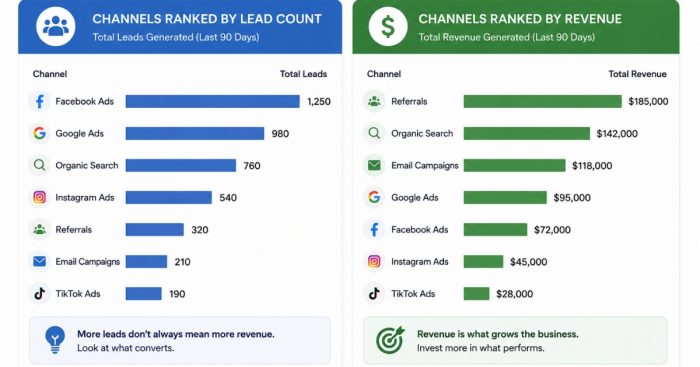
The channel producing the most leads rarely produces the most revenue.
Organic search and referrals often deliver fewer inquiries.
However, those patients typically convert at much higher rates.
Once revenue is tied to each source, smarter marketing decisions become obvious.
You stop investing in cheap leads that never become patients.
Instead, you increase investment in the channels producing long-term members.
What’s a good conversion rate for a cash-pay clinic?
For visit-to-membership conversion, anything above roughly 60% is strong.
The highest-performing clinics often reach 75% to 80%.
The 78% conversion rate mentioned earlier is an excellent example.
It demonstrates a highly effective offer and consultation process.
Earlier in the funnel, Orthobiologics Associates converts 79.4% of its leads into booked appointments.
That level of conversion helped generate more than $300,000 in cash-pay revenue within 10 months—without paid advertising.
High conversion rates allow clinics to grow without constantly purchasing additional traffic.
Still, don’t become obsessed with industry benchmarks.
The most important comparison is your own progress.
Improving from 45% to 55% represents meaningful growth.
That’s often more valuable than maintaining a flat 70%.
How do I actually track this without a data team?
Use a simple dashboard that tracks each conversion step and revenue by source.
Review it every week.
You don’t need expensive analytics software or a dedicated data analyst.
Instead, build one clear dashboard that answers four questions:
- How many leads came in, and where did they come from?
- How many leads became booked visits?
- How many visits became paying patients?
- How much revenue did each source generate?
Most clinics can manage this inside their CRM.
A well-organized spreadsheet also works, provided the data is entered consistently.
The discipline matters more than the software.
The clinic mentioned earlier redesigned its dashboard so every important number appeared “in a clean line.”
That made the information easy to read and act on.
A dashboard nobody reviews is less useful than having no dashboard at all.
Review these metrics every week.
Over time, they begin driving decisions instead of simply filling a screen.
What do I do once I can see the numbers?
Identify the weakest step in the patient journey.
Then improve that one area first.
The value of tracking isn’t collecting data.
It’s knowing exactly what action to take next.
For example:
- If lead-to-booked-visit conversion is low, improve your follow-up speed and booking process.
- If visit-to-membership conversion is low, strengthen your consultation process or your offer.
- If a marketing source generates high lead volume but little revenue, focus on attracting higher-quality leads instead.
Every metric points toward a specific operational improvement.
That’s why a short list of meaningful conversion metrics is far more valuable than dozens of vanity metrics.
An HRT clinic we grew from $1M to $4M a year didn’t reach that level by monitoring more numbers.
It grew by focusing on the handful of metrics that mattered most and improving them every week.
That’s the discipline.
Find the weakest step.
Fix it.
Measure the improvement.
Repeat.
FAQ’s About Tracking Conversions at a Cash-Pay Clinic
What conversion metrics should a cash-pay clinic track?
Track the three metrics most closely tied to revenue:
- Lead-to-booked-visit conversion
- Visit-to-membership (or visit-to-purchase) conversion
- Revenue by source
These numbers reveal where money is gained or lost throughout the patient journey.
They provide far more insight than website traffic or total lead counts.
What is a good visit-to-membership conversion rate?
Anything above roughly 60% is considered strong.
The highest-performing clinics often reach between 75% and 80%.
One men’s health clinic converts 35 of 45 monthly visits into memberships—a 78% conversion rate.
Improving this number is one of the least expensive ways to grow because it doesn’t require additional leads.
Why track revenue by source instead of total leads?
Because the channel producing the most leads often isn’t the one producing the most revenue.
Tracking revenue alongside bookings and lead sources shows exactly which marketing channels create paying patients.
That allows you to stop investing in low-value lead sources and increase investment in the channels generating profitable patients.
Do I need special software to track clinic conversions?
No.
A simple dashboard inside your CRM or a well-designed spreadsheet is enough.
The important part is entering data consistently and reviewing the numbers every week.
Regular review creates better decisions.
The software itself is secondary.
What’s the next step?
If your dashboard is full of leads and impressions but you can’t explain what percentage of visits become paying patients—or which marketing source generates your revenue—you’re making decisions without the information that matters most.
Book a strategy call.
In 60 minutes we’ll identify the key conversion metrics your clinic should track, pinpoint the weakest step in your current patient journey, and show you the improvement that will move revenue the fastest.
If it’s a fit, we’ll build the dashboard and the supporting systems alongside your team.