
The 90-Second Inbound Call Script for a Cash-Pay Medical Practice (Verbatim, NuLevel-Tested, With Branch Logic for Price-First / Date-First / Insurance Callers)
NuLevel Wellness handles 2,500 inbound calls a month per location, with 550 first-time-caller bookings.
The script the front desk runs on every one of those calls is 90 seconds long.
Capture, connect, close.
Capture the contact info before anything else so the lead is never lost. Connect on the emotional driver behind the call. Close on the next step in the process — the consult — not the final program.
This is the FAQ on the verbatim script, the four most common branch scenarios (price-first, date-first, insurance, vague), and how a cash-pay clinic trains its team to use the script without sounding like a recital.
What Should a Cash-Pay Medical Practice Say in the First 90 Seconds of an Inbound Call?
Three moves, in order.
Capture, connect, close — the NuLevel Wellness framework, run across 2,500 monthly inbound calls per location with 550 first-time-caller bookings.
Step 1: Capture
The verbatim 90-second open:
“[Clinic name], this is [first name], how can I help you?”
Then immediately after the caller says why they are calling, the team member responds with:
“Great — and is this the best number to reach you on if we get disconnected? Perfect, can I get your name and the best email so I can send you some information either way?”
That is capture in under 15 seconds.
Step 2: Connect
“Tell me a little bit about what’s going on — what made you reach out today?”
Listen-back the most important phrase the caller used, in their own words, before responding.
That is connect, 30-45 seconds.
Step 3: Close
“Based on what you’re describing, the next step is a 60-minute consult with [provider name]. I have an opening on [day] at [time] or [day] at [time] — which one works better for you?”
The close is not asking the patient to buy a program.
It is asking them to commit to the next step of the process — the consult.
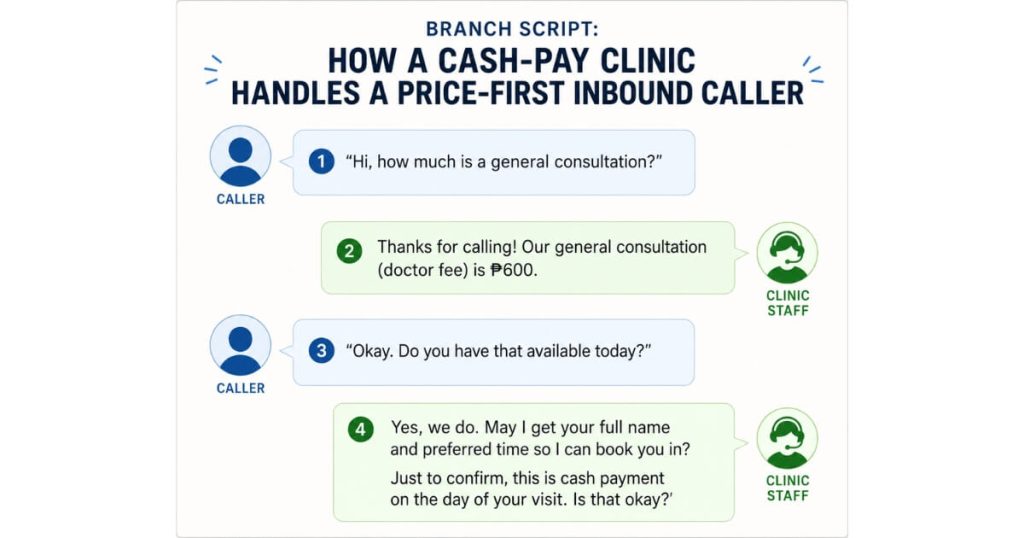
What’s the Verbatim Script When an Inbound Caller Leads With “How Much Does It Cost?”
Acknowledge the question, defer the answer to the consult, and capture before responding to anything else.
Verbatim Response
“That’s a great question — and the honest answer is, the cost depends entirely on what you actually need, which is exactly what the consult is designed to figure out.
Before I tell you the consult price, can I get your name and your best email so I can send you the details whether or not we end up being a fit?
Perfect.
Now — the consult is [$X], includes [labs / functional testing / 60 minutes with the provider], and a lot of what’s in the program is included, so a lot of new patients tell us the consult ends up paying for itself.
Want me to grab you a slot for next week?”
Why This Works
Three things happen in that sentence.
The price question gets answered without leading with a dollar figure stripped of context.
The capture happens before the conversion question gets answered.
And the value of the consult is stacked before the dollar amount lands.
The patient who would have hung up after hearing “the consult is $300” instead hears “$300, here’s what’s included, here’s the next slot.”
What’s the Verbatim Script When an Inbound Caller Asks for a Specific Date or Time?
Match the urgency without skipping capture.
Verbatim Response
“Tuesday afternoon — let me check, I want to make sure I get you with the right provider.
Real quick — before I lock you in, can I grab your name and best email?
Perfect.
And so I make sure we set you up right, what’s going on that has you calling today?”
Why This Works
The script does three things in one breath.
It acknowledges the date the caller asked for so the caller feels heard.
It captures contact info immediately so the lead is not lost if the call drops or the slot turns out to be unavailable.
And it pivots to the discovery question so the team member actually understands what the patient needs before booking them with the wrong provider for the wrong service.
The mistake to avoid is jumping straight to the calendar:
“Tuesday afternoon, let me see what we have at 2 PM, 3 PM, or 4 PM”
without ever capturing the contact info or understanding the case.
That is how a clinic ends up with a $50 deposit, a Tuesday no-show, and no way to follow up because nobody got the email.
What’s the Verbatim Script When an Inbound Caller Asks About Insurance at a Cash-Pay Clinic?
Don’t dismiss insurance, reframe it.
Verbatim Response
“Great question on insurance — we’re a cash-pay practice, which means we don’t bill insurance directly, but a lot of our patients use their HSA or FSA for the consult and the labs because those are accepted.
And honestly, it’s not that we don’t want to work with insurance — patients who go through insurance often end up with surprise bills of a few thousand dollars on the same labs.
Through us, the labs and the 60-minute provider time are bundled into the consult for [$X].
Before I tell you more about how patients usually structure it, can I grab your name and email so I can send you the consult info?
Perfect.”
Why This Works
The script does what every cash-pay sales conversation needs to do.
It acknowledges the insurance question without apologizing for being cash-pay.
It offers the HSA/FSA route as a partial bridge.
And it pivots to the value stack (bundled labs + provider time) before the patient can hang up on the cash-pay reveal.
Insurance objection comes up on roughly 30-40% of inbound cash-pay calls.
Having the verbatim response ready is what keeps the team member from improvising into a lost lead.
Why Does the Close in a Cash-Pay Inbound Call Script Ask for the Consult, Not the Program?
Because the right ask for the patient’s level of awareness is the next step in the process, not the final sale.
Book the Consult First
The patient calling for the first time has not seen the provider, has not seen the labs, has not heard the protocol, has not signed the membership agreement.
They are not in a position to buy a $5,000 6-month program over the phone.
They are in a position to book a consult — a $300 first visit that gives them a real plan and lets them decide.
The close is:
“get them to the next step of the process — they don’t need to be on your agenda, they don’t need to buy some crazy package today.”
That framing is what separates a cash-pay clinic with a 60+% inbound-to-booked conversion rate from a clinic that closes 25% because the front desk keeps trying to sell programs over the phone.
Match the ask to the patient’s awareness stage.
Book the consult on call one.
Sell the program at the consult.
Layer the membership at the result reveal.
This approach sits at the heart of the 90-second inbound call script used by high-performing cash-pay clinics. Rather than trying to sell a treatment plan before the patient has met the provider, the script focuses on creating trust, understanding the patient’s motivation, and securing commitment to the next step. When the front desk follows that structure consistently, conversion rates tend to rise while calls feel more conversational and less sales-driven.
NuLevel Wellness, the medspa where we added $6.7M in revenue across 3,727 new patients in one year runs exactly this discipline across every one of those 2,500 monthly inbound calls.
How Does a Cash-Pay Clinic Train Its Front-Desk Team to Actually Use a 90-Second Inbound Script?
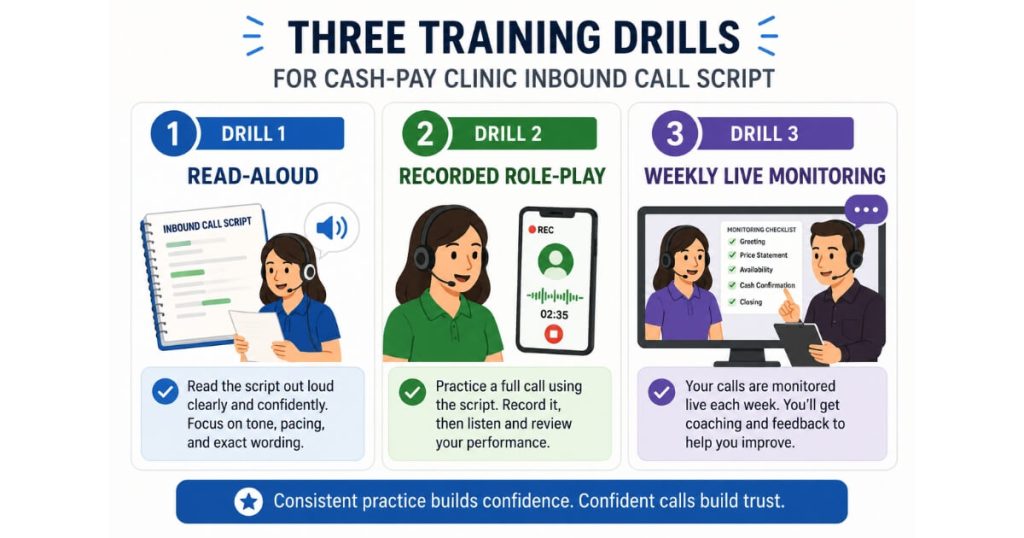
Three drills, in order.
Drill One: Read-Aloud Rehearsal
The script gets read by each team member out loud, three times, with another team member playing the caller, until the language feels natural rather than scripted.
Drill Two: Recorded Role-Play
The team member runs the script with five different caller archetypes (price-first, date-first, insurance, vague, hostile), records the calls, and the manager reviews them against a 10-point QA scorecard.
Drill Three: Live Monitoring With Weekly Coaching
Real inbound calls are recorded and listened to in 30 minutes a week of coaching sessions — one win to highlight, one fumble to fix, no more than three coaching points per call.
Why These Drills Matter
The clinics that install all three drills see their inbound-to-booked rate move 15-30 percentage points inside 60 days.
The clinics that print the script and tape it to the wall do not.
Scripts only work when the team has rehearsed them enough that they sound like a conversation, not a recital.
A regenerative medicine clinic we worked with hit a 79.4 percent conversion rate from lead to booked appointment using exactly this rehearsal-record-coach loop.
What’s the Next Step?
If you have never recorded one of your front desk’s inbound calls and played it back against a capture-connect-close framework, the audit is the most useful 30 minutes you will spend this month.
What Happens on the Strategy Call?
On the call we listen to a recorded inbound call from your clinic, score it against the capture-connect-close framework, and rewrite the script in your team’s voice with the four most common branch scripts (price-first, date-first, insurance, vague-caller).
NuLevel Wellness runs 550 first-time-caller bookings per month per location with this exact framework.
The script itself is 5 minutes of work.
The team-readiness drill is the next 60 days.
Most cash-pay clinics lose 25-40% of their inbound calls on the first 90 seconds — fixing that is the highest-ROI training a cash-pay front desk can do.