
The 4 Foundational Business Laws Every Cash-Pay Medical Practice Owner Should Live By
The same four laws show up in every $3M–$10M cash-pay HRT, functional medicine, and regenerative clinic we’ve helped scale — and the absence of any one of them shows up in every clinic that plateaus. Here’s how to put each one to work this week.
After 12+ years and over $50M in collected revenue helping cash-pay medical practice owners scale, the same four laws keep producing the same outcomes: Law of Averages, Law of Sowing & Reaping, Law of Association & Influence, and Law of Reciprocity. They sound like Sunday-morning truisms until you watch a $2M clinic stall because the owner is breaking three of them. Below are the four laws, the math behind each, and the exact moves to apply them to a cash-pay HRT, functional medicine, regenerative, longevity, or concierge practice.
What is the Law of Averages and why does it matter for a cash-pay medical practice?
The Law of Averages says that if you do something often enough, a ratio will appear — and once that ratio appears, your job as an owner is to increase the volume and improve the ratio, not to obsess over any single lead.
In Major League Baseball:
- a player who strikes out 7 out of 10 at-bats (a .300 batting average) is a Hall of Famer
In a cash-pay medical practice:
- a New Patient Coordinator who closes 3 out of every 10 inbound consults onto a treatment plan or membership is a top performer
The clinics we’ve helped scale past $5M run their entire business on this assumption:
- every patient touch is one swing
- the goal is to take more high-quality swings each week
This mindset is central to the 4 foundational business laws, particularly the Law of Averages and its focus on improving ratios rather than obsessing over individual outcomes.
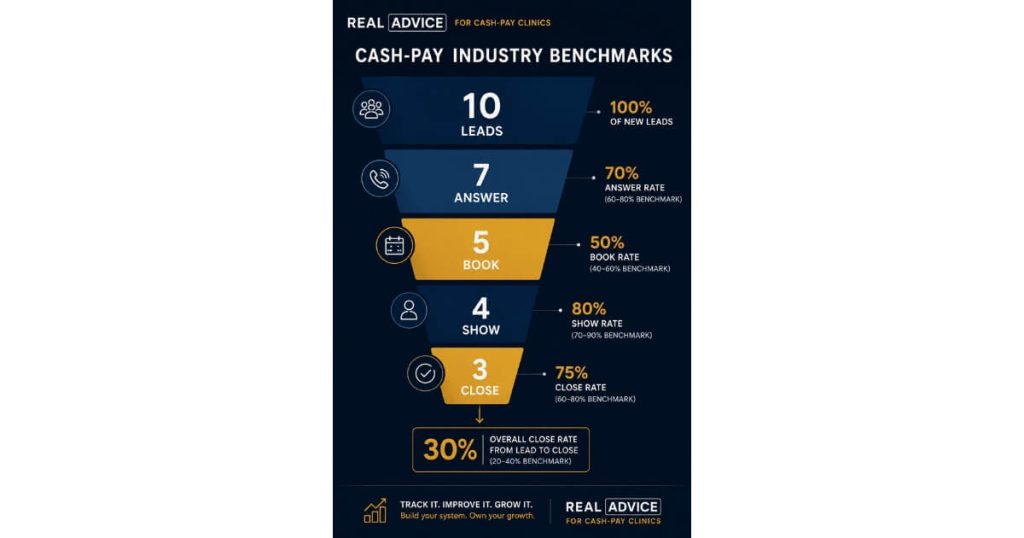
If you’re not yet tracking your ratios:
- leads in
- leads who answer the phone
- leads who book
- leads who show
- leads who close
…you’re not running a business yet, you’re running an emotional roller coaster.
Build a one-page weekly dashboard with those five numbers and look at it every Monday.
How does the Law of Averages keep my front desk and patient coordinators from burning out?
It keeps them from burning out by setting the right expectation: most leads won’t pick up, most who do won’t book, most who book won’t show, and most who show won’t say yes to the full program on day one — and that is normal, not failure.
Burnout in a cash-pay clinic almost always comes from the front desk or NPC expecting every lead to answer the phone and Venmo $4,000 upfront for a treatment.
When that fantasy collides with reality:
- morale collapses
- the next ringing phone gets answered with frustration in the voice
- patients hear it
- bookings drop
- the team blames the leads
- the owner blames the team
Pre-empt the spiral.
In your weekly team huddle, post the benchmarks:
- 30–50% of inbound leads will pick up on the first call attempt
- 40–60% of those will book a consult
- 70–85% will actually show
- 20–40% will close on a full cash-pay program on the first appointment
We’ve watched a regenerative medicine clinic we grew to a 79.4% lead-to-booked-appointment conversion rate achieve those numbers — but only because the team understood the math, called the leads who didn’t pick up three more times that week, and didn’t take the “no’s” personally.
The Law of Averages is the antidote to a team that quits in their head before lunch on Monday.
What is the Law of Sowing & Reaping and how do I apply it to clinic marketing?
The Law of Sowing & Reaping says that if you plant good seed (offers and content) on good soil (the right patient avatar and lead source), water it (follow up), and give it sunlight (consistent ad spend or organic posting), it will grow — but the variables of season, weather, and soil are not entirely in your control, so you keep planting anyway.
In practice:
- this is why we tell our clients to commit to a marketing channel for at least 90 days before evaluating it
- why we ignore the noise of a single bad ad week
- why we never let a clinic shut off SEO or organic social just because a month was slow
Apply it three ways.
First, plant only good seed:
- don’t run a generic “Free Consult” ad when the rest of the market is doing the same
- build a no-brainer offer specific to your highest-LTV vertical
Second, plant on good soil:
- an aesthetic ad in a market full of $99 Botox specials will fall on hard ground
- an HRT ad in a town with two competing TRT clinics is fertile
Third, keep planting:
- the clinics that win in our portfolio are the ones that publish 4–8 pieces of content per week
- and run paid ads for 90+ consecutive days without flinching during a slow week
The clinics that lose are the ones that re-plant a new offer every 14 days because they “don’t see results yet.”
What is the Law of Association & Influence — and why do my team’s attitudes mirror mine?
The Law of Association says you become the average of the five people you spend the most time with, and your team becomes the average of you, your spouse, and the loudest voices in the breakroom.
We have walked into clinics where:
- the owner is a problem-focused, “the leads are bad / the ads don’t work / nobody wants to work anymore” type
…and without fail:
- the NPC sounds the same on the phone
- the front desk sighs at every walk-in
- the turnover ratio looks like a fast-food restaurant
We have also walked into clinics where the owner is the most positive person in the room, and you can hear it the moment a patient walks in.
If you want a team that converts cash-pay consults at 30%+, you have to be the person who would convert them.
That means:
- doing the inner work
- reading
- coaching
- peer groups
- your own therapy if needed
…visibly.
It also means hiring:
- providers
- NPCs
…who already think this way, not assuming you can teach a fundamentally negative person to be positive.
Dr. Joy Kong’s regenerative practice scaled to the point of hiring four additional providers and getting the founder out of the daily grind — none of that happens without an owner who modeled the work ethic and mindset she expected from the team.
How do I get a “bad apple” out of my cash-pay clinic team without blowing up morale?
You move quickly, you document, and you remember that the rest of the team is watching how long you’ll tolerate the behavior.
A single negative team member — usually a front desk or NPC who has been there longest and feels entitled to complain — will spread their energy to two or three other team members within 60 days, and your culture will quietly slide from:
- “we close 30% of consults”
…to:
- “the leads suck this month”
We see this every time an owner hesitates on a known bad apple “because we can’t afford to lose them right now.”
You can’t afford to keep them.
The playbook:
- have one direct, documented conversation
- address the specific behavior
- explain the specific change you need to see within 30 days
If the behavior doesn’t change:
- separate cleanly
In our experience, the team that stays exhales — they knew before you did.
Re-hire with the 4 R’s framework:
- Role
- Responsibilities
- Requirements
- Results
…so the next person knows exactly what success looks like on day one.
What is the Law of Reciprocity and how do I use it to convert more leads?
The Law of Reciprocity says that if you give first, you are dramatically more likely to receive — which is why every high-converting cash-pay clinic funnel starts with a free thing of real value.
Examples:
- A free educational ebook on “5 Signs Your Hormones Are Off in Your 30s” gives a hormone-curious lead enough insight to feel respected, and then they raise their hand for the consult.
- A free 15-minute discovery call gives a stem-cell-curious patient enough certainty about your bedside manner to commit to a paid testing visit.
- A free in-office lab review at the start of a functional medicine consult gives the patient a reason to say yes to the $899 lab-plus-consult package — they got value before they were asked to pay.
The trap is giving away the wrong thing.
Wrong:
- a free Botox unit
Why?
- it gives away your margin
- it trains the patient that you discount
Right:
- a free educational ebook
Why?
- it gives away knowledge you would have shared in the consult anyway
- it builds the patient’s trust in you specifically before they even talk to your NPC
The HRT clinic we scaled from $1M to $4M in four years runs almost entirely on this principle — their content educates, their consults convert, and the membership compounds.

Which free-value offers actually move patients to book at a cash-pay clinic?
The free-value offers that consistently convert are the ones that demonstrate clinical thinking, not discount the service.
1. Educational PDF or quiz tied to the patient’s symptoms.
Examples:
- “The 7-Question Low T Self-Assessment”
- “5 Hormone Symptoms Most 35–55-Year-Old Women Are Told Are Normal (And Aren’t)”
- “Knee Pain Decision Tree: Surgery, Injection, or Regenerative?”
These:
- cost you nothing per lead
- build trust
- let the NPC reference the patient’s quiz answers on the booking call
2. Free 15-minute discovery call with the NPC (not the provider).
This:
- protects the provider’s time
- gives the patient a human voice
- lets the NPC qualify and book the paid consult
Concierge HRT clinics that price a $650 testing consult use the free 15 as the stepping stone — the patient never feels sold to, and the consult close rate often runs 60%+.
3. Free in-office welcome ritual on the paid consult.
Examples:
- a 5-minute walkthrough
- water
- a printed copy of the lab plan
- the provider’s eye contact for the first 10 minutes
These do more for the close than any discount.
Patients who feel cared for before the price is mentioned almost always say yes — and they almost always tell two friends.
The compounding of reciprocity is how a cash-pay clinic stops being dependent on ads.