
What Are the 10 Clarities? (The Consult-Call Framework That Closes High-Ticket Cash-Pay Patients)
Most high-ticket consults are lost before the price is ever mentioned—not because the patient couldn’t afford the program, but because they never got clear on what saying no would cost them. The 10 Clarities is the framework we train cash-pay consult teams on. It covers ten things a patient must get clear about before a $3,000–$15,000 yes is even possible. As the Dale Carnegie line at the top of our training doc puts it: “A man convinced against his will is of the same opinion still.” You don’t convince. You clarify. Here’s the FAQ.
What are the 10 Clarities a patient needs before saying yes to a high-ticket program?
Ten, in roughly this order—and a stalled consult can almost always be traced to one of them being skipped.
- Pain — what’s actually going on, in the patient’s own words.
- Cost of inaction — what not solving it is costing them (the COI next to your program’s ROI).
- Desire — the goal. Not “less knee pain,” but what they want their life to look like.
- Roadblock — why they don’t have it yet; what’s actually in the way.
- Doubt — clarity that they can’t fix this on their own (they’ve usually already proven it by trying).
- Finances — willingness to use the resources they have, or get resourceful.
- Spouse or partner — is the decision-maker at home on board, or waiting to veto?
- Trust — in you, the clinic, the treatment, and themselves. All four, or no deal.
- Timing — now, later, or never (and whether “later” is real or a polite no).
- Coachability — will they actually follow the protocol they’re buying?
Print that list and audit your last five lost consults against it.
You’ll usually find the same one or two clarities getting skipped every time. Most often, it’s #2 (cost of inaction) and #7 (the partner at home).
Fixing those two alone changes close rates.
Consult conversion is the highest-leverage stage of patient acquisition because you’ve already paid for everything upstream of it.
How do I open a consult call so the patient actually tells the truth?
With permission and an honesty contract—verbatim:
“I’m going to ask you some questions to find out if, or how, I can help you. All I ask is that you answer honestly. And if you have questions for me, interrupt me any time and I’ll answer honestly too. Does that sound fair?”
Everything about that opener is deliberate.
“If, or how, I can help you” positions the consult as a diagnosis, not a pitch.
The honesty exchange is mutual, so it doesn’t feel like an interrogation.
And “does that sound fair?” earns the first small yes while setting the frame: this call is about the truth of their situation.
Then one question starts the real conversation:
“So, can you tell me what specifically is happening with your [health, pain, weight, energy] that has us on the phone today?”
When they go vague—“I just wanted some information”—the training doc calls it what it is: a trap.
People ask for information because they’re scared and want to delay a decision.
The redirect, verbatim:
“OK, great—I’d love to tell you about that. And let me ask you, why is that important to you right now?”
When they go vague and general, you get specific, deep, and meaningful.
Our rule for the whole call is simple: diagnose, don’t demonstrate.
A doctor prescribing medicine without a proper diagnosis is malpractice.
The same is true of pitching your program before you know the real problem.
How do I help a patient see the real cost of not treating their problem?
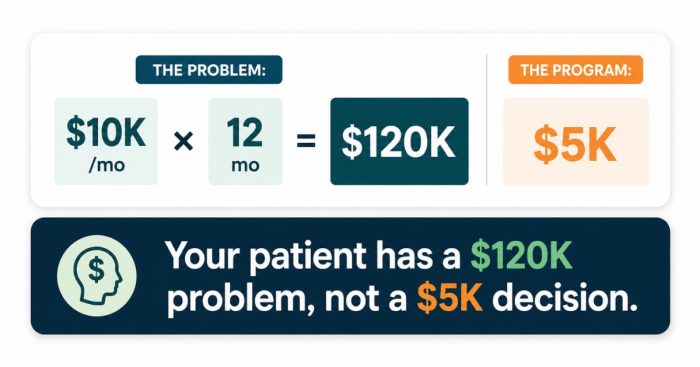
Do the math with them, out loud, until the number is theirs—because your patient has a six-figure problem, not a $5,000 decision.
The pattern from the training doc, applied to a business owner (“it’s cost me thousands”), goes like this:
“How many thousands, do you think? How much specifically?”
— $10K a month —
“And how long has this been going on?”
— a year —
“So this has cost you about $120K. Does that sound accurate?”
The answer is almost always some version of “wow, I never thought of it that way.”
That’s the moment the program price stops being the biggest number in the conversation.
In a clinic consult, the currency isn’t always dollars.
It’s the knees that keep them off the golf course, the fatigue that’s eating the marriage, or the weight that’s behind the blood-pressure numbers.
The questions adapt directly:
- “How long has this been going on?”
- “What have you missed out on because of it?”
- “What are you not able to do now?”
- “What’s the probable, almost certain future if nothing changes?”
Then make it concrete the same way.
Three years of this—at what cost to your energy, your work, and your family?
Practices that train this well close at rates most clinics don’t believe.
One regenerative practice we work with converts 79.4% of leads into booked appointments, and the consult room is where that funnel finishes the job.
What do I say when a patient says the program is too expensive?
Agree, then re-anchor to the cost of inaction — verbatim:
“Yeah, it’s not for everybody. And I support whatever you decide — but it sounds like the more expensive thing to do would be to keep losing what this is costing you.”
No defensiveness, no discounting, no ten-minute value re-pitch.
The objection answer only works, though, if clarity #2 was done earlier.
You can’t re-anchor to a cost the patient never articulated.
That’s why the framework is a sequence, not a bag of comebacks.
Two more lines from the doc belong in every consult team’s training:
“Sell the destination, not the plane” — the patient is buying Hawaii (pain-free hikes, energy at 6 AM, clothes that fit), not the 747 (your protocol’s injection schedule and visit cadence).
“Be a lighthouse, not a tugboat” — you show where the safe harbor is with calm certainty; you don’t drag anyone in.
High-ticket cash-pay programs—regenerative packages especially—die when the consult turns into a tugboat pull.
This posture is half of what makes regenerative medicine marketing convert: the marketing creates belief, and the consult protects it.
Why does explaining the patient’s problem better than they can close more consults?
Because of a line we’ve built a whole training on:
“When you explain someone’s problem to them better than they’re explaining it to themselves, they automatically—and subconsciously—grant you the authority to fix it.”
This is the deepest mechanic in the framework.
Patients arrive with a surface story (“my knee hurts,” “I’m tired all the time”).
The consult’s job is to reflect back the fuller truth:
“So what you’re saying is you’d like to get back to X, but every time you try, Y happens, and what really worries you is Z—is that right?”
When the patient hears their own situation articulated more clearly than they’ve ever said it, the question of whether you’re the right clinic quietly answers itself.
Notice this is the opposite of pitching.
The training doc’s summary says:
“Selling is not telling—questions are the answer.”
The tone instruction matters as much as the words.
Stay even, supportive, and unhurried—“not hype-y, not fast, not ‘super excited'”—because patients only go deep with someone who feels safe.
Then reflect, don’t project.
Make them feel heard before you make them an offer.
Practices that build this muscle can move remarkable volume with integrity.
It’s part of how Elite Pain Doctors added $2,095,039 in revenue in 10 months in a specialty where every patient is a considered, high-ticket decision.
How do I end the consult so the patient chooses for themselves?
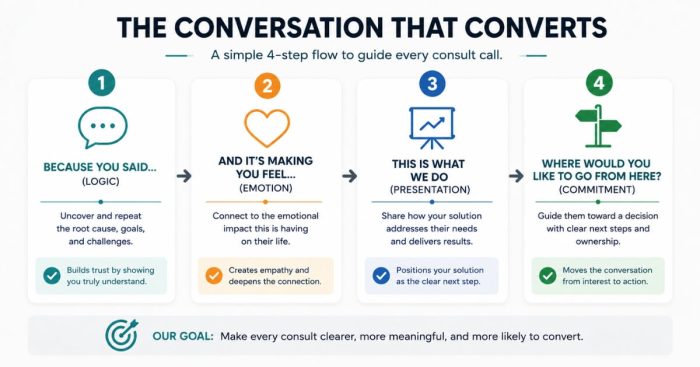
With the transition formula: recap their logic, recap their emotion, present, then hand them the decision.
Verbatim structure from the doc:
“Let me make sure I have this right — what you want is [their goal], so that you can [what it creates], which would let you feel [what they said]. Is that what you want?”
(Yes.)
“And the reason you don’t have it yet is [their roadblock] — is that right?”
(Yes.)
Then:
“Based on what you told me, this is what we do…”
Follow with the program, the logistics, and the price.
Tie everything explicitly to their words:
“The investment is [price], and if you move forward, we’ll [logistics] so you can fix [their problem] and have [their goal]. How does that sound?”
If they hesitate on timing, ask one consequence question, gently:
“How much longer is this going to be OK?”
If they need it, use the two-reasons frame:
“You came to this call for one of two reasons. If it was for a little clarity and some good ideas, I hope this has been useful. But if you came because you really want [their stated result]—this is what we do.”
Then let them choose.
The lighthouse stands; it doesn’t chase.
FAQ’s About the 10 Clarities Consult Framework
What are the 10 Clarities in order?
Pain, cost of inaction, desire, roadblock, doubt (that they can fix it alone), finances, spouse/partner, trust, timing, and coachability.
A stalled consult can almost always be traced to one of the ten being skipped—most often cost of inaction or the partner at home.
Who should run high-ticket consults at a cash-pay clinic — the provider or a coordinator?
Either can, if they’re trained on the framework.
Many clinics split it: a trained patient coordinator runs discovery and the clarities, and the provider covers clinical fit.
What fails is an untrained provider winging it as an information session—that’s how “let me think about it” becomes the default outcome.
How do I bring up the patient’s spouse without being awkward?
Ask early and practically:
“Is there anyone else who’d be part of this decision with you?”
If yes, invite them to the consult or schedule the follow-up when both can attend.
A yes that needs a veto-holder’s approval isn’t a yes yet.
Surfacing it early saves the deal.
What’s the biggest mistake clinics make on high-ticket consult calls?
Presenting the program before diagnosing the problem—showing up with “a Band-Aid for a bullet wound,” as our training doc puts it.
Price always sounds expensive to a patient who hasn’t articulated what the problem is costing them.
Does this framework work for lower-priced services too?
The full ten clarities earn their keep on considered purchases—$2,000+ programs, memberships, and regenerative packages.
For lower-ticket bookings, the opener, one pain question, and a two-option close usually suffice.
Match the depth of the conversation to the weight of the decision.
What’s the next step?
If your consults end in “let me think about it” more than they end in enrolled patients, the problem usually isn’t your price, your provider, or your patients.
Nobody on the call got clear on the ten things above.
So the patient defaulted to no.
Book a free strategy call.
In 60 minutes we’ll walk through your current consult flow against the 10 Clarities, find the two or three that are getting skipped, and show you what trained consult conversion looks like in your specialty.