
The 10 Clarities Every Cash-Pay Medical Practice Should Get on a New Patient Consult Call
A 10-Step Discovery Framework for HRT, Functional Medicine, Regenerative, and Longevity Clinics That Consistently Doubles Consult-to-Close Rates — Without Scripts That Make Your Team Sound Like Used-Car Salespeople
Cash-pay clinic owners often diagnose a low consult close rate as a “sales problem” and try to fix it by writing a tighter pitch.
The real problem is almost always upstream:
- The New Patient Coordinator or provider never got clear on why the patient is in the room
- What they actually want
- Who else has to say yes
- What the patient is telling themselves about money
The 10 Clarities below are the diagnostic that every consult should run before anyone presents an offer.
Get them and the close happens almost on its own.
Skip them and you’ll talk yourself out of every program.
What is the “10 Clarities” framework and why does it matter for cash-pay consult close rates?
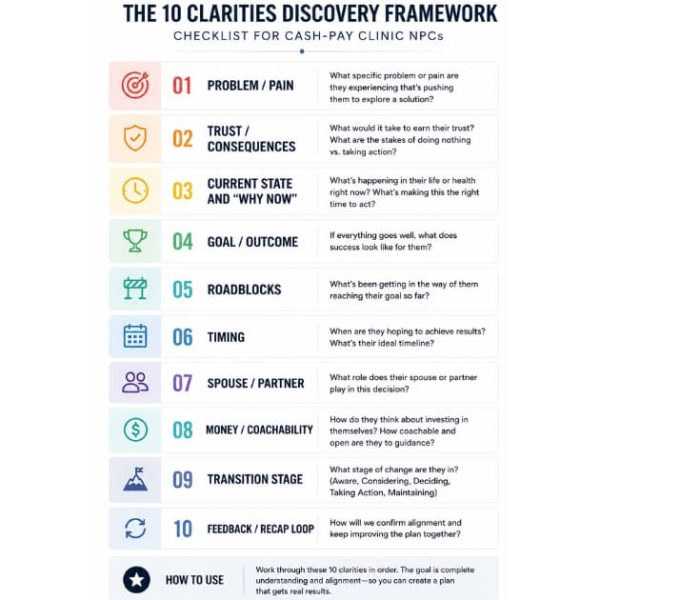
The 10 Clarities is a discovery framework that says:
Before you present any program, price, or treatment plan, the consult must get clear on ten specific things about the patient.
Those include:
- Problem / pain
- Trust / consequences
- Current state and “why now”
- Goal / outcome
- Roadblocks
- Timing
- Spouse / partner
- Money / coachability
- Transition stage
- Feedback / recap loop
It matters because consult close rate at a cash-pay clinic is almost entirely a function of how well the patient feels heard and diagnosed before the price is mentioned.
The clinics in our portfolio that close 30–40% of consults onto a $3,000–$10,000 cash-pay program are not better closers.
They are better diagnosticians.
When all 10 clarities are uncovered before the presentation, the patient often closes themselves.
However, when even one is skipped — typically spouse/partner or money — the consult ends with:
“Let me think about it.”
Which is cash-pay code for:
“No.”
What does “Clarity 1: Problem / Pain / Current State” look like on a real cash-pay consult call?
Clarity 1 asks the patient to describe:
- The specific problem
- The impact it’s having on their life
in their own words before the provider or NPC says anything diagnostic.
Most clinics skip this because the provider wants to lead with expertise.
However, the patient hasn’t earned the right to hear your expertise until they feel you understand their problem.
Ask:
“What’s going on that brought you in today? When did it start? What’s it stopping you from doing — at work, at home, in your relationship, with your kids?”
Then shut up and write down their exact words.
Why the “Impact” Question Matters
The impact question is the leverage.
A 45-year-old hormone patient who says:
“I’m tired.”
is a $0 sale.
The same patient who says:
“I’m too tired to play with my kids on Saturday and my wife is asking what’s wrong with me.”
is a $4,000 sale.
Why?
Because they’ve told themselves the cost of inaction.
Your job in Clarity 1 is to let them tell themselves.
What does “Clarity 2: Trust / Consequences” sound like for an HRT or functional medicine patient?
Clarity 2 surfaces:
- The consequences of not solving the problem
- The cost of inaction
- Any conflict of interest (COI) the patient may have with another provider
For an HRT patient:
“If we don’t optimize this in the next 6 months, what do you think happens? You’ve been to two other clinics — what didn’t work there?”
For a functional medicine patient:
“You’ve been on Synthroid for ten years and you still don’t feel right. What’s that doing to your day-to-day?”
The patient’s answers tell you:
- What they fear losing
- What they’ve already tried
- What failed previously
Usually the real fear is:
- Energy
- Relationships
- Longevity
- Career performance
How Trust Actually Gets Built
Trust is built by your willingness to:
- Ask uncomfortable questions
- Sit with the answer
- Listen carefully
Not by your credentials.
The clinic that asks:
“What didn’t work at the last place?”
and then genuinely listens is usually the clinic the patient signs up with.
How do I uncover the patient’s true goal/outcome (Clarity 4) without sounding like a salesperson?
Ask the goal question emotionally, not clinically.
For example:
“If we got this perfect — labs in range, energy back, you waking up at 5 AM and going to the gym before work — what does that change about your life? Who notices first?”
The patient will usually tell you the real outcome.
Most of the time, it revolves around:
- A relationship
- Body composition
- A career milestone
- Fear of aging like a parent
Clinical answers such as:
“I want my testosterone above 700.”
are surface-level.
The emotional goal underneath the clinical goal is what they’re actually buying.
Why Mirroring the Patient’s Words Matters
When the NPC repeats the patient’s own outcome words back to them during the presentation, close rate roughly doubles.
Why?
Because the patient has already paid emotionally.
The price is now just logistics.
This is why no two consult presentations should sound the same.
They should mirror the specific patient.
How do I handle the spouse/partner conversation (Clarity 7) without scaring the patient out of the room?
Ask it openly and early.
Do not wait until the end of the consult when it becomes an objection.
Clinics that consistently use the 10 clarities for a new-patient consult uncover spouse, timing, and financial concerns before they become reasons for a patient to delay a decision.
Ask:
“Big decisions like this usually involve a partner. Who else is part of this with you, and what do they think about you investing in your health right now?”
If the patient says:
“My wife thinks I’m wasting money on this.”
you just uncovered the real objection.
Now you can address it inside the consult instead of losing the close to a hallway conversation after the patient leaves.
Bringing the Spouse Into the Call
For couples that need to be involved, build it directly into the booking process.
For example:
“Because this is a 6–12 month investment, we ask that your spouse join the last 15 minutes of the consult by phone.”
Clinics that do this close 25–40% more because they never lose a consult to a spouse who wasn’t in the room.
Functional medicine and concierge HRT clinics we’ve helped scale all run the spouse question early — not as a last-second save at the end.
How should an NPC ask the budget / willingness-to-invest question without killing rapport?
Ask it as a logistics question, not a money question.
For example:
“Programs at this clinic typically run between $3,000 and $10,000 depending on what’s right for you. If we determined this was the right protocol, is that an investment you’re in a position to make this year — or is timing the bigger consideration?”
This accomplishes three things at once:
- It pre-frames the range so there’s no sticker shock
- It separates “can’t afford” from “won’t decide today”
- It gives the patient permission to be honest
Coachability Is the Second Half of Clarity 8
Ask:
“If we put a plan together, are you the kind of person who follows the protocol — or do you need a coach checking in with you weekly?”
Patients who say they need accountability are often pre-qualifying themselves for membership programs.
Meanwhile, patients who cannot answer honestly often need a smaller commitment first, such as:
- A lab-plus-consult package
- A lower-ticket starter offer
before the full program.
What does the “feedback / recap / 3-question loop” close (Clarity 10) sound like for a $4,000 hormone program?
The recap is the close.
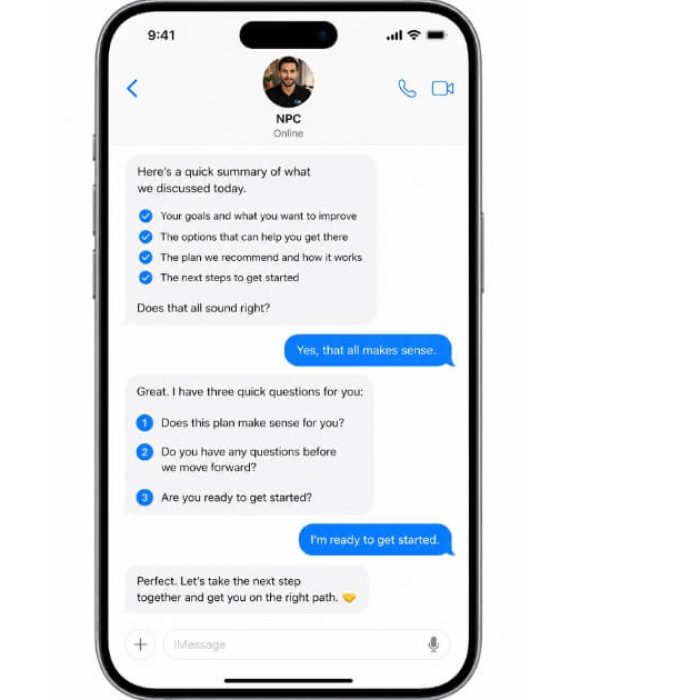
After the presentation, the NPC or provider says:
“Let me just play back what I heard. You told me you’re tired, you can’t keep up with your kids, your last clinic missed three lab markers, and your goal is to be the dad who throws the football at the BBQ in August. The protocol we just walked through addresses all three lab issues, sets you up with a provider who actually returns calls, and gives us a 90-day check-in to make sure you’re feeling it by August. Does that match what you were hoping for?”
The 3-Question Loop
The loop is:
- “Does this feel like the right thing?”
- “Does this feel like the right time?”
- “Is there anyone else you need to talk to before saying yes?”
If all three are yes:
- Ask for the credit card
If any are no:
- Isolate the real objection
- Address it directly
Most objections come down to:
- Money
- Spouse
- Fear of commitment
The clinics in our portfolio that follow this loop close 35%+ of consults on the first call.
The clinics that:
- Present
- Hand over a brochure
- Say “let us know”
usually close under 10%.
How do I train my NPC and front desk on the 10 Clarities without it sounding scripted?
The fastest path is roleplay.
The second-fastest path is recording every consult call (with patient consent) and reviewing one per week as a team.
The goal is to score:
- Which of the 10 clarities were covered
- Which clarities were skipped
Inside three months, the team usually self-corrects because they can hear which clarities they avoided when they lost a consult.
The orthobiologics regenerative practice we took to a 79.4% lead-to-booked-appointment conversion rate runs this exact drill:
- Weekly call review
- 10-clarity rubric
- Team scoring
As a result, their close rate keeps compounding because the team gets sharper every week.
Avoid Scripted NPC Calls
Avoid printed scripts the NPC reads word-for-word.
Instead, use the 10 Clarities as:
“A checklist behind the conversation.”
Not as words on a page.
The patient should never feel processed.
They should feel heard.
The diagnostic shows up in your close rate — not in your patient’s experience.