
The 10 Best (and Worst) Ways to Get New GLP-1 and Peptide Patients in 2026 — Now That the FDA Is Restricting Compounded Supply
Every week in 2026 brings another headline about the FDA squeezing compounded GLP-1s — restricted ingredients, warning letters to telehealth sellers, a compounding advisory committee meeting on the calendar for July.
If you run a cash-pay clinic, it is tempting to read that as a threat.
It is the opposite.
The crackdown is shaking out the $199-a-month mystery-vial sellers and leaving a wave of patients who still want the result and now need a real clinic they can trust.
The clinics that win the next year will not be the ones with the cheapest supply.
They will be the ones whose marketing makes them the obvious, legitimate, supervised choice.
Here are the 10 best and the worst ways to get those patients.
What actually changed for GLP-1 and peptide patient acquisition in 2026?
The cheap, anonymous supply channel is being closed — which moves patients toward clinics that look legitimate.
Here is the short version.
- The FDA resolved the tirzepatide shortage in December 2024.
- The FDA resolved the semaglutide shortage in February 2025.
- It then began winding down the mass-compounding that filled those gaps.
- In September 2025 it sent more than 55 warning letters to online sellers of compounded GLP-1s.
- On February 6, 2026 it announced steps to restrict the active ingredients still being used in non-approved compounded products and to crack down on misleading direct-to-consumer ads.
- On March 3, 2026 it issued 30 more warning letters to telehealth companies whose marketing implied their compounded product was equivalent to the branded drug.
The translation for your practice:
- The price-driven, ship-it-to-your-door competitors are losing their supply.
- They are losing their ad accounts.
- The demand did not disappear with them.
Millions of people still want medically supervised weight loss, and a large slice of them are now actively looking for an in-person clinic instead of a sketchy website.
That is the opportunity.
Your job is to be the trustworthy answer to the question they are suddenly asking.
What are the 10 best ways to get new GLP-1 and peptide patients right now?
Lead with legitimacy and a program, not a price and a molecule.
These are the ten that are working in 2026, in rough order of leverage.
1. Market the supervised program, not the drug.
Sell the medical weight-loss program — labs, dosing, body-composition tracking, the team — so you are compliant and you are not competing on the price of a vial.
2. Run TikTok for front-end discovery.
The GLP-1 buyer overlaps almost perfectly with the medspa-aesthetic audience.
Real patient stories outperform polished brand creative, and the cost per lead is usually lower than any other paid platform.
3. Own the Google name-search.
People are searching by name for weight-loss and GLP-1 care.
Start with tight phrase-match terms, get conversions, then graduate to Performance Max so YouTube starts compounding.
4. Build SEO and Google reviews as the trust layer.
Now that patients are specifically screening for a clinic they can believe, your reviews and search presence are what make every paid click convert.
5. Position yourself as the safe alternative to the sellers being shut down.
Speak directly to the patient who got burned or spooked by a telehealth vial.
Supervision, in-person care, and real lab work are your differentiators — say so plainly.
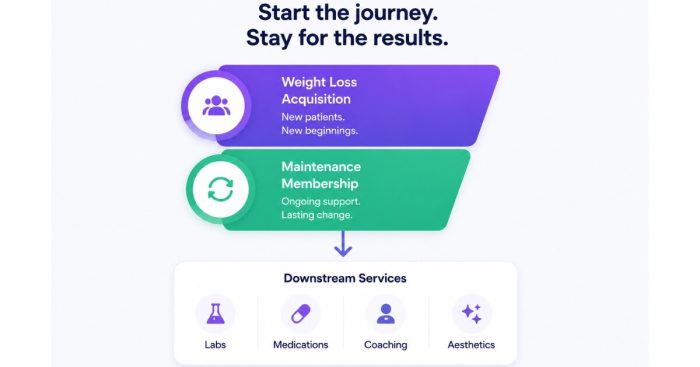
6. Capture the maintenance cliff with a membership.
The moment a patient hits goal weight, most clinics lose them.
A maintenance membership converts that cliff into recurring revenue and a multi-year relationship.
7. Stack a downstream service ladder.
Hormone optimization, aesthetics, peptides for recovery, and wellness are the natural next purchases for a weight-loss patient.
Build the ladder before you scale the ads.
8. Use a quiz or symptom funnel to qualify.
A short intake quiz raises lead quality, pre-frames the consult, and lets you route the most-ready buyers to a scheduling page with a card on file.
9. Turn results into referral engines.
Visible weight loss is the most shareable result in medicine.
A structured before-and-after and referral program turns every successful patient into two more.
10. Build a content brand around the new rules.
Patients are confused about what is legal and safe in 2026.
The clinic that calmly explains it on social and in blog content becomes the authority — and the authority gets the booking.
You do not run all ten at once.
We watched this stack compound in real time at a weight-loss and medspa clinic where we added $6.7M in revenue in one year across 3,727 new patients — TikTok pulled the front-end demand, Google captured the name-search, and the brand presence made every other channel convert better.
Pick the lead channel, maximize it, then stack.
What are the worst ways to get GLP-1 patients — the ones quietly torching your budget?
Almost all of them share one root cause:
Competing like a discount supply company instead of a medical practice.
The worst move is racing to the bottom on price — advertising a monthly number against telehealth sellers whose whole model is about to be regulated out of existence.
You will:
- Win the most price-sensitive patients.
- Win the least-loyal patients.
- Lose them the moment someone undercuts you.
Nearly as bad is advertising a specific compounded drug name.
That is:
- Exactly the misleading direct-to-consumer promotion the FDA is targeting.
- A compliance risk.
- A way to train patients to shop on molecule and price.
Then there is the one-and-done trap:
- Acquire a patient.
- Deliver three months of injections.
- Have nothing to sell next quarter.
You paid full price for a lead and captured only a fraction of its lifetime value.
Other common mistakes include:
- Relying on a single acquisition channel.
- Having no SEO.
- Having no reviews.
- Having no recognizable brand.
- Sending traffic to a generic homepage.
- Using no quiz.
- Using no fast follow-up.
- Having no card-on-file scheduling.
Then wondering why a flood of clicks produced a trickle of consults.
How do you keep your GLP-1 pipeline full now that compounded supply is restricted?
Shift from selling supply to selling a relationship — then the supply rules stop dictating your revenue.
A clinic that markets the molecule is exposed to every regulatory swing, and there will be more of them.
The FDA has a Pharmacy Compounding Advisory Committee meeting set for July 23 and 24, 2026 to weigh allowing certain peptides for obesity, wound healing, and other conditions.
The rules are moving in both directions at once.
The only durable position is to sell:
- A supervised program
- A membership
- An outcome
So the patient is buying your clinic, not a vial that may or may not be available next quarter.
This is where recurring-revenue clinics win.
The maintenance phase, the hormone and longevity upsells, and the membership model are what turn a one-time weight-loss lead into years of value.
We built that engine with an HRT clinic we grew from $1M to $4M a year, with 250 members paying $1,000 a month and $1.7M a year in memberships from SEO alone — the same recurring-revenue playbook that protects a GLP-1 practice from supply shocks.
Acquire the patient on the weight-loss promise.
Keep them on the maintenance relationship.
FAQ’s About Getting GLP-1 and Peptide Patients
How is the 2026 FDA crackdown on compounded GLP-1s actually good news for a cash-pay clinic?
Because it removes your cheapest competitors and hands you the patients they were serving.
Through 2025 and into 2026:
- The FDA resolved the semaglutide shortage.
- The FDA resolved the tirzepatide shortage.
- The FDA moved to restrict the active ingredients used in mass-marketed compounded versions.
- The FDA issued waves of warning letters to online sellers.
- The FDA issued 30 more warning letters to telehealth companies in March 2026.
The bargain-vial telehealth model is being squeezed out.
The patients who were buying $199-a-month mystery vials still want the result — they now need a legitimate, in-person clinic they can trust.
If your marketing leads with:
- Supervision
- Lab work
- Dosing safety
- A real maintenance plan
You become the obvious home for that displaced demand instead of competing on price you can never win.
Should I advertise the drug name, or the program?
Advertise the program, never the molecule.
Marketing a specific compounded drug name puts you in the exact crosshairs the FDA is targeting for misleading direct-to-consumer promotion, and it trains patients to shop on price.
Sell:
- The supervised weight-loss program
- The lab work
- The body-composition tracking
- The maintenance phase
- The medical team behind it
That framing is compliant, defensible, and supports a far higher cash ticket than a vial ever could.
What is the single biggest money leak in GLP-1 marketing right now?
Treating weight loss as a one-and-done transaction and letting patients fall off the maintenance cliff.
The revenue in GLP-1 is not the first three months of injections.
It is the years of:
- Maintenance
- Hormone optimization
- Aesthetics
- Wellness
That follow.
Clinics that acquire a patient, deliver the weight loss, and then have nothing to sell next quarter are paying full price for a lead and capturing a fraction of its lifetime value.
Build the maintenance membership and the downstream service ladder first.
Then your ad math works at a cost-per-acquisition that would bankrupt a one-and-done clinic.
Which channel works best to acquire GLP-1 and weight-loss patients?
A stack, led by TikTok and Google, with SEO and reviews underneath.
GLP-1 buyers overlap heavily with the medspa-aesthetic audience.
So:
- TikTok pulls front-end discovery demand.
- Google and YouTube capture people already searching by name.
- SEO and reviews become the trust layer.
That trust layer matters more than ever now that patients are specifically looking for a clinic they can believe.
We watched this exact stack add millions in a single year at a weight-loss and medspa clinic, with TikTok driving aesthetic demand and Google capturing the GLP-1 name-search.
Will my GLP-1 patient pipeline dry up if compounded peptides get restricted further?
Not if you are selling supervised programs rather than supply.
The FDA has scheduled a Pharmacy Compounding Advisory Committee meeting for July 2026 to weigh allowing certain peptides for obesity, wound healing, and other uses, so the rules are still moving in both directions.
A clinic that markets the molecule is exposed to every one of those swings.
A clinic that markets:
- A medical program
- A membership
- A relationship
Keeps its pipeline regardless, because the patient is buying the clinic and the outcome, not a particular vial that may or may not be available next quarter.
What’s the next step?
The 2026 shake-out is handing legitimate cash-pay clinics a once-in-a-cycle opening:
A wave of motivated weight-loss patients who no longer trust the cheap online sellers and are looking for a real clinic instead.
The practices that capture them will be the ones marketing:
- A supervised program
- A maintenance membership
- A brand patients believe in
Not the ones advertising a molecule and a monthly price.
If you run a GLP-1, peptide, or weight-loss practice and you want a channel mix and a service ladder that turns this crackdown into your best acquisition year yet, that is the conversation to book.
We will map your offer, your funnel, and your maintenance model on the call.