
How Do I Know My Cash-Pay Medical Practice Has Hit Capacity? (And How to Add a Mid-Level Without Cannibalizing the MD)
INTRO :
A booked-out calendar isn’t success — it’s a bottleneck. The cash-pay clinics that scale past their founder don’t do it by working harder. They do it by spotting the capacity signal early, hiring a mid-level provider before the founder is fully maxed, and pricing the mid-level the same as the founder so patients don’t perceive a downgrade. This is the FAQ on the four signals that say you’ve hit capacity, the price-tier mistake most owner-MDs make, and the warm-handoff playbook that protects established relationships.
——————————————————————————
How do I know my cash-pay medical practice has hit capacity?
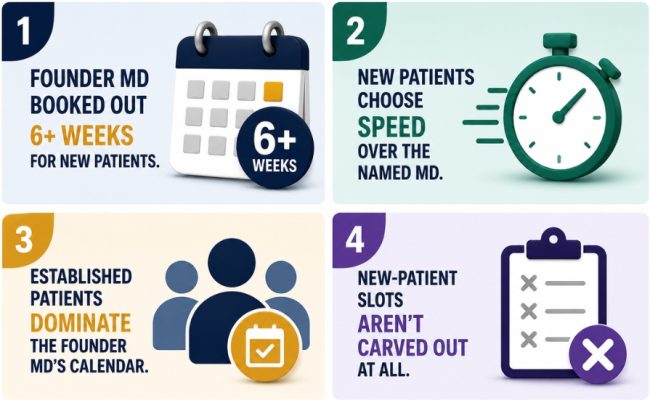
Four signals, any one of which is reason to start hiring the next provider — and three of which means you should have hired one six months ago.
**Signal 1: The founder MD is booked out 6+ weeks for new patients.** A new patient who calls today and is offered a January slot in November will mostly say yes politely and then quietly book somewhere else. Anyone willing to wait six weeks for a first consult was a patient who wanted that specific doctor; everyone else is a referral the clinic just lost. One of our cash-pay clients had Dr. Toddson booked out into January in early November — and the moment that became visible on the calendar was the moment the clinic needed to operationalize the second provider, not start considering it.
**Signal 2: New patients are choosing speed over the named MD.** When the patient coordinator says “Dr. Toddson has nothing until January, but Bailey can see you next week,” and the patient picks Bailey, the clinic just learned something important. The signal isn’t that the clinic should panic; the signal is that demand is greater than the founder MD’s available hours, and the mid-level (if priced and positioned correctly) absorbs that demand without losing the patient.
**Signal 3: Established patients dominate the founder MD’s calendar.** In a typical cash-pay practice, the founder’s weeks become 70 to 80% follow-up consults with patients they’ve been seeing for years. There’s nothing wrong with follow-ups — but the time spent on them is time not spent on net-new patient acquisition. If a glance at the founder’s next two weeks shows almost no new-patient slots and a lot of established-patient follow-ups, the clinic isn’t growing; it’s maintaining.
**Signal 4: New-patient slots aren’t carved out at all.** Many cash-pay clinics never explicitly block new-patient time on the founder’s schedule — new patients just fit in “wherever there’s an opening.” This works until demand outpaces supply, at which point new patients get pushed further and further out by follow-ups, and the clinic loses growth without the owner being able to see why.
When should a cash-pay clinic hire a mid-level provider?
When any one of the four capacity signals above shows up — typically 60 to 90 days before the founder MD is actually full. Hiring after the founder is full means the clinic has already turned away or lost a quarter of growth.
The math at one of our clients made this concrete. The founder MD works 16 hours a week in office (two clinical days). New patient slots are unscheduled — they fit in around established follow-ups. At the rate the clinic was booking new patients, the founder was on a 45-to-60-day path to running out of new-patient availability entirely. The clinic had already hired a nurse practitioner who was averaging only five to six patients per week — under-utilized but capable of taking on much more. The right hiring decision was already made; what hadn’t been done yet was the operational decision to route new patients to the mid-level by default, with the founder reserved for established follow-ups and high-complexity cases.
The same 60-to-90-day lead time applies in either direction. If the founder is already booked out 6+ weeks, the hire should have happened months ago — start now and the clinic gets back ahead of demand in about 90 days. If the founder is booked out 3-4 weeks, the hire decision should be made this week; ramping a new provider into the role takes time. The clinics that wait until “we really need someone” end up hiring in panic mode and paying market rates for whoever’s available rather than the right cultural fit.
——————————————————————————
Should a cash-pay clinic charge less for a mid-level provider than an MD?
No. Charge the same. Lower pricing on a mid-level signals to the patient that the level of care is lesser, which both undermines the mid-level provider and pushes patients onto the founder MD’s already-overbooked calendar.
This is the most common pricing mistake we see at cash-pay clinics — and the one that creates the founder-bottleneck in the first place. The owner-MD reasons “the NP costs me less, so I should charge less,” sets the NP’s consult fee at $500 against the MD’s $700, and is then surprised when nine out of ten patients want to see the MD. The patients aren’t choosing the MD because of the credential. They’re choosing the MD because of the price tag. A $700 visit feels like better care than a $500 visit, even when the protocols, the labs, and the prescriptions are identical.
The fix is single-tier pricing. Same consult fee for the MD and the NP. Same membership pricing. Same labs panel. The patient’s decision shifts from “more care vs. less care” to “want to wait for the doctor vs. want to be seen this week.” Some patients still pick the founder MD because they were referred specifically to her, and that’s fine — there’s a baseline of demand for the figurehead provider that should and will continue. But the vast majority of new patients will pick speed when the price is identical. “A regenerative medicine clinic we work with used the same single-tier pricing logic to add four more doctors and scale the founder out of the clinical schedule entirely — building a brand that runs on the practice’s reputation, not on any one provider’s calendar”.

How do I transition follow-up patients from the founder MD to a mid-level without losing them?
Warm handoff. The mid-level sits in on the founder MD’s follow-up consults for 4 to 8 weeks, then becomes the primary provider with the founder MD “popping in from time to time.”
The transition has three phases. **Phase 1: Co-attended follow-ups.** The mid-level joins the founder MD in established-patient follow-ups for a defined period — typically one full day a week for two months. The patient sees both providers, the mid-level absorbs context on the patient’s history and protocol preferences, and the founder MD verbally signals trust (“Bailey’s been doing this with me, she’s going to start taking the lead on your visits”). **Phase 2: Mid-level-led follow-ups with the founder MD attending.** Same patient, mid-level runs the visit, founder MD listens and adds a sentence or two at the end. **Phase 3: Mid-level-only with the founder MD reviewing notes async.** The patient is now a mid-level patient; the founder MD reviews labs and treatment changes in the background and only joins visits for escalations or annual comprehensive reviews.
The reason this works is that the established relationship transfers gradually rather than abruptly. A patient who hears “Dr. Toddson is too busy to see you now, you’ll be seeing Bailey instead” rejects the change. A patient who’s been co-treated with Bailey for two months and now has Bailey as their primary doesn’t feel any change at all — they just feel like the clinic added another person they trust. The same playbook applies whether the mid-level is an NP, PA, or junior MD. “A pain-management specialist we work with grew monthly revenue by $40,000+ and cut insurance dependence in half by building exactly this kind of multi-provider system at one location — establishing the team’s collective credibility before adding capacity, so new providers inherited the practice’s reputation rather than having to build their own”.
——————————————————————————
What’s the right new-patient conversion rate for a capacity-constrained cash-pay clinic?
Above 50% from website lead to booked appointment, with above 80% close rate at the consult.
One of our clients ran these numbers in October: 21 website leads, 14 discovery calls booked, 12 attended consults. That’s a 67% lead-to-booked-appointment rate (well above our 50% benchmark) and a near-100% close rate at the discovery call. The clinic was capacity-constrained, not lead-constrained. More marketing spend wouldn’t have made a difference — the clinic literally couldn’t have absorbed more new patients with the founder MD’s schedule the way it was.
The implication for a capacity-constrained clinic: stop spending marginal dollars on top-of-funnel marketing until the provider supply is rebuilt. Every new patient added past capacity creates a worse experience for the next new patient, who waits longer to be seen, gets less attention at the consult, and is more likely to bounce before becoming a recurring patient. Fix the operational layer first. Then the marketing layer compounds.
——————————————————————————
How should a capacity-constrained cash-pay clinic handle the discovery-call payment policy?
Require payment to secure the spot. A patient who’s not willing to put down a card at the discovery call is roughly 3× more likely to no-show or cancel — which is even more expensive in capacity terms when slots are scarce.
The same client above made exactly this change. Previously the patient coordinator tried to “feel out” when in the consult to ask for payment. The new script: “To secure your spot, we need to make payment today.” The clinic isn’t asking for a deposit — it’s asking for the full first-consult fee ($600 in this case, which includes labs and the initial appointment). The patients who say no were never going to convert; the patients who say yes are real bookings. Conversion at the discovery-call stage drops slightly. Show-up rate and consult close rate both spike. Net revenue per discovery call goes up.
Capacity scarcity makes this policy not just nice-to-have but operationally required. Every empty appointment slot at a capacity-constrained clinic costs the clinic more than the appointment fee — it represents a patient the clinic could have booked but couldn’t. Sub-50% show-up rates at a clinic with 6+ week wait times are a slow-motion business failure.
——————————————————————————
What’s the next step?
If you’re a cash-pay medical practice owner and any of the four capacity signals are showing up — founder MD booked 6+ weeks out, new patients picking speed over the named MD, established follow-ups crowding out new acquisition, or no carved-out new-patient slots — book a strategy call. In 60 minutes we’ll audit your provider schedule, your price-tier structure, and your warm-handoff plan, and map a 90-day path to absorbing demand without overloading the founder. If it’s a fit, we’ll fly to your clinic and build it with your team.