
How Do I Keep Membership Patients Longer at My Cash-Pay Medical Practice?
A Northern California concierge HRT clinic, Heel MD, was adding 40 new members a month — and quietly leaking churn out the back door. Here are the five retention moves Real ADvice walked them through. Every one of them is low-cost, runs on automation, and lifts membership LTV without touching the provider’s schedule.
Why do membership patients churn at a cash-pay medical practice?
Most membership churn at a cash-pay clinic isn’t a clinical problem — it’s an experience problem.
The patient signs up motivated, doesn’t get a clear sense of progress in the first 90 days, and quietly cancels when their card hits month four.
Behind every churn event there’s usually a missing touchpoint:
- A confused welcome
- No early sense of momentum
- No compliance check
- No “milestone moment” worth staying for
At a $300/month HRT membership, a single retained patient who stays an additional six months is $1,800 of pure margin.
Retention isn’t a soft metric.
It’s the cheapest dollar in cash-pay.
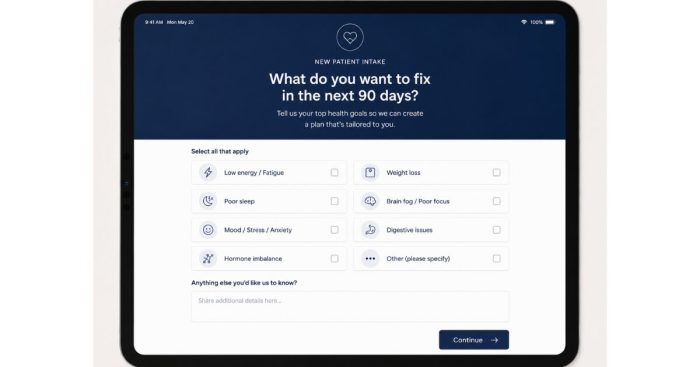
How does a pre-consultation intake form reduce HRT membership churn?
A pre-consultation intake form — built like a sales assessment, not a clinical questionnaire — gets the patient to state their goals in their own language before they ever talk to a provider.
That language becomes the spine of every retention touch over the next 12 months.
Why it works:
When a patient writes down:
- “I want to sleep through the night again”
- “Lose 15 pounds”
- “Feel like myself by my 50th birthday in October”
…the clinic now has the receipts on what success looks like for that specific patient.
At the 90-day mark, you reflect those exact goals back to them.
They feel seen, they sell themselves on the progress, and they renew.
Should a cash-pay membership clinic send a welcome video from the patient care coordinator?
Yes — every membership clinic should send a personalized welcome email within 24 hours of enrollment, with a short video from the patient care coordinator (not the provider) explaining the next 30 days.
The reason the video comes from the coordinator and not the provider:
- Providers are scarce
- Coordinators are the consistent point of contact
A patient who knows the coordinator’s face is a patient who picks up the phone when the coordinator calls.
That’s worth thousands in retained LTV across a year.
The video should answer three questions:
- What happens this week
- What happens in the next 30 days
- Who to text with questions
Keep it under 90 seconds.
Do welcome boxes actually keep cash-pay membership patients longer?
Yes, disproportionately so.
A welcome box with branded swag — a custom water bottle, a journal, a supplement starter pack — creates a physical anchor in the patient’s home that reinforces enrollment every time they see it.
Companies like Stadium (formerly Box) handle the entire fulfillment.
The math:
- A $40 welcome box
- Delivered to a patient who pays $300/month
- Stays four extra months
- Recovers itself 30× over
The mistake clinics make is treating swag as a marketing expense.
It’s a retention expense, and it pays back inside the first quarter.
Inside “an HRT clinic Real ADvice grew from $1M to $4M with 250 active members paying $1,000/month”, the welcome experience is intentional from day one — not an afterthought.
That’s a piece of why $1.7M of annual revenue runs through memberships alone.
What should a 90-day membership check-in form ask?
The 90-day form has two jobs:
- Get the patient to sell themselves on the progress they’ve made
- Capture compliance data the clinic can use clinically and operationally
Three question types to include:
1. Progress reflection
“Compared to day one, how much closer are you to the goals you wrote down at intake?”
- Include a 1–10 scale
- Include a free-text follow-up
2. Compliance
“How many doses did you miss in the last 30 days?”
3. Likelihood to refer
“How likely are you to recommend us to a friend?”
The third question doubles as a churn early-warning system — any score under 7 gets flagged for a coordinator call.
The patient who fills out a 90-day form just told you exactly what to say in your retention copy for the next nine months.
Use it.
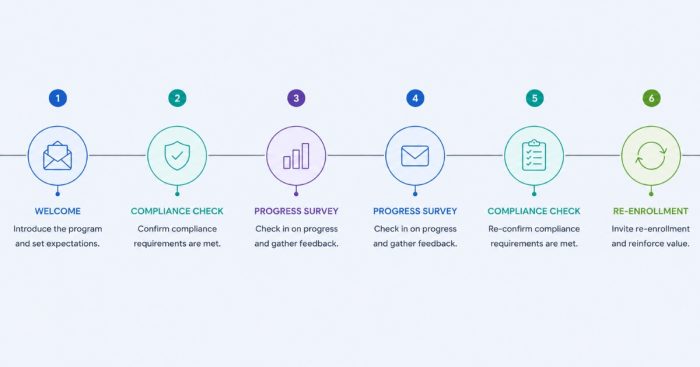
How do I automate a 12-month patient retention sequence at my cash-pay clinic?
Six scheduled touches, all automated, all triggered off the enrollment date.
Day 30
A “first month wins” text from the coordinator referencing the patient’s intake goals.
Day 60
A labs-or-symptom check-in.
Day 90
The progress reflection survey covered above.
Month 6
A “halfway there” milestone email with a benefit not mentioned at sign-up.
Month 9
A renewal nudge framed as a results recap.
Month 12
A re-enrollment offer plus a referral request.
Each touch should:
- Be no more than 100 words
- Be sent from the coordinator’s name and number
- Avoid the practice’s generic email
- Be answerable inside the same channel
SMS open rates on this sequence routinely run 90%+.
Email lands around 35–45%.
Most clinics run both in parallel.
How much does better retention add to a cash-pay membership clinic’s LTV?
A six-month bump in average tenure on a $300/month HRT membership adds $1,800 of LTV per patient.
Across 250 active members, that’s $450,000 of annual revenue you didn’t have to acquire.
At a $200 CAC, the equivalent revenue lift via new acquisition would cost you $300,000 in ad spend you no longer need.
For higher-ticket concierge or longevity memberships ($800–$1,500/month), the math is even more brutal in your favor.
A single saved year on a functional medicine clinic like VYVE Wellness, where Real ADvice drove 900% lead growth and 100+ inbound calls/month, is mid-five-figures in retained LTV.
If you want Real ADvice to audit your current onboarding-and-retention sequence and install the six-touchpoint automation,